Private Label Rice Packaging: A Guide for Distributors
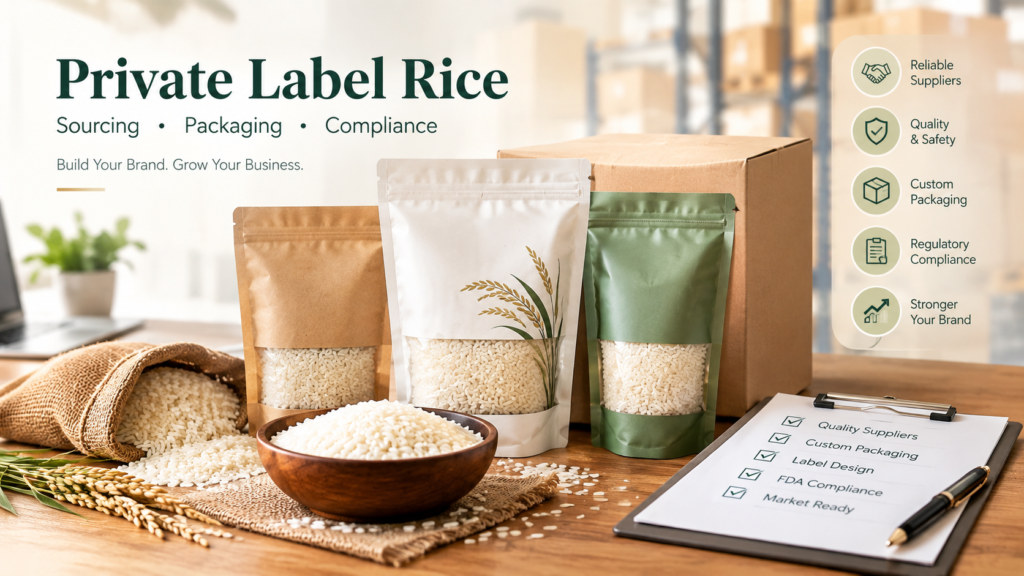
The private label rice market has grown significantly, offering distributors and independent retailers a way to compete with national brands while building their own proprietary product lines. For retailers and food service operators looking to expand into private label offerings, understanding the sourcing, packaging, and compliance landscape is essential. This guide walks through everything distributors need to know about sourcing private label rice, from selecting suppliers to managing regulatory requirements.
Understanding Private Label Rice and Its Market Opportunity
Private label rice refers to rice products packaged and branded under a retailer’s or distributor’s own label rather than a manufacturer’s brand name. These products allow distributors to develop their own rice lines while maintaining control over packaging, pricing, and brand positioning. Unlike national brands, private label options give operators flexibility in product development and the opportunity to capture higher margins.
The market for private label rice continues to expand. According to industry analysis, consumers increasingly view store brands as quality-equivalent alternatives to national brands, particularly in commodity products like rice. This shift has made private label rice an attractive growth channel for independent retailers, supermarket chains, and specialty food distributors.
Private label programs range from simple repackaging of bulk rice into retail bags to fully customized blends with proprietary varieties. Distributors can work with suppliers to develop unique product formulations, select specific grain types (long grain white, jasmine, basmati, brown rice, parboiled varieties), or create specialty blends tailored to their customer base.
Sourcing Private Label Rice: Finding the Right Supplier
Successful private label rice programs start with finding a reliable supplier who understands your brand vision and can scale production to meet your volume needs. The supplier selection process typically involves evaluating multiple factors beyond just price.
Key supplier considerations include:
- Production capacity and flexibility in package sizes. Some suppliers work with small orders (5,000–10,000 units), while others require higher minimums. Established suppliers often offer packaging options ranging from 1-pound retail bags to 25-pound and 50-pound bulk formats.
- Quality consistency and certifications. Suppliers holding ISO 22000, HACCP, or FSSC 22000 certifications demonstrate compliance with international food safety standards. This becomes particularly important if you’re selling into retail chains or through food service channels.
- Customization capabilities, including custom label design, ingredient sourcing, and specialty blends. Some suppliers offer private label programs that handle design consultation and regulatory compliance documentation.
- Geographic location and logistics infrastructure. Suppliers with efficient distribution centers and established shipping networks can reduce lead times and handling costs.
Private label rice suppliers typically operate across different tiers. Large manufacturers like Riceland and Riviana offer comprehensive private label solutions with sophisticated custom packaging options. Mid-sized mills provide flexibility with reasonable MOQs, while smaller regional suppliers may offer lower volume options with more personalized service.
Packaging Options and Design Considerations
Rice packaging decisions directly impact product protection, shelf appeal, and cost structure. Most private label rice suppliers offer multiple packaging formats to suit different retail segments.
Common retail packaging options include:
- 1- to 10-pound bags in polypropylene or polyester film
- 25- and 50-pound bags in poly-weave for wholesale and bulk buyers
- Cardboard boxes with poly-lined interior for premium positioning
- Stand-up pouches with resealable closures for convenience and differentiation
Your packaging material selection influences both cost and brand perception. Polypropylene bags offer cost efficiency and durability for dry storage. Poly-weave options work better for larger bulk quantities. Premium retailers increasingly favor stand-up pouches or cardboard, which command higher perceived value but increase packaging costs per unit.
Custom printing and labeling allow you to showcase your brand identity on every package. Most suppliers can apply custom labels with your brand name, logo, ingredients, nutritional information, and any required regulatory statements. Lead times for custom printed packaging typically range from 4–8 weeks, so plan accordingly when launching new private label lines.
FDA Labeling Requirements and Compliance
Private label rice packages must comply with FDA food labeling requirements before reaching consumers. Understanding these requirements early prevents costly label redesigns and potential regulatory issues.
Required label elements include:
- Product identity and net quantity statement (ounces and weight for packages under 4 pounds; metric equivalents often required)
- Ingredient statement listing all components in descending order by weight
- Nutrition Facts panel with serving size, calories, macronutrients, and micronutrients
- Manufacturer name and address
- Allergen declarations (if applicable—rice generally isn’t a major allergen, but may be processed in facilities with allergens)
- Country of origin for imported rice
The FDA provides a Guidance for Industry: Food Labeling Guide that covers placement rules, type size requirements, and specific formatting for different label sections. The Principal Display Panel (PDP)—the front of the package most visible to consumers—has specific requirements for where product identity and net quantity must appear.
Most established private label rice suppliers provide label templates and compliance review as part of their services. Still, distributors should verify all labeling claims independently or work with a regulatory consultant to ensure compliance before approving final artwork.
Quality Certifications and Food Safety Standards
Retailers and food service operators increasingly require suppliers to hold specific food safety certifications. Understanding which certifications matter for your distribution channels helps you select the right private label rice supplier from the start.
HACCP (Hazard Analysis and Critical Control Points) certification demonstrates that a facility has implemented systematic food safety controls, documented procedures for contamination prevention, and traceability protocols. Many US and European importers require HACCP as a condition of purchase.
ISO 22000 provides broader food safety management system certification covering the entire supply chain from production through distribution. Increasingly, major retailers and foodservice distributors request ISO 22000-certified suppliers, particularly for products sold in premium or institutional channels.
FSSC 22000 combines ISO 22000 with additional company-specific requirements. It’s recognized by the Global Food Safety Initiative (GFSI) and carries significant weight with international retailers and foodservice operators.
For organic rice products, USDA Organic certification or EU Organic Certification may be necessary. These certifications require documentation of organic farming practices throughout the supply chain.
When evaluating suppliers, request copies of their current certifications and verification dates. Don’t rely on certifications alone—also request references from other private label buyers and ask about traceability systems, supplier audits, and quality control procedures.
Minimum Order Quantities and Lead Times
MOQ (Minimum Order Quantity) and lead times significantly affect your cash flow and inventory management. Understanding these parameters before committing to a supplier prevents surprises when you place your first order.
Typical MOQs for private label rice vary based on packaging complexity and supplier size. Large manufacturers often set MOQs between 10,000–50,000 units for retail packaging. Mid-sized suppliers may accept orders of 5,000–20,000 units, particularly if you commit to ongoing orders. Smaller regional suppliers sometimes work with MOQs as low as 2,000–5,000 units, though at higher per-unit costs.
Lead times for private label rice typically range from 30–60 days from order confirmation to shipment, depending on packaging complexity and current production schedules. Custom printed labels or specialized packaging can extend lead times to 60–90 days. Rush orders may be possible but typically cost 10–25% more.
When negotiating with suppliers, discuss whether lead times differ for larger orders versus smaller ones. Some suppliers offer faster turnaround if you accept certain packaging options or agree to minimum volume commitments over a specified period.
Cost Structure and Pricing Models
Private label rice pricing depends on several variables: the rice variety selected, packaging materials and customization, order volume, and any additional services (custom blending, labeling, logistics).
A typical price breakdown for private label rice might look like this:
- Base rice cost: 40–55% of final price (varies by variety—basmati costs more than long grain white)
- Packaging materials (bag, printing, labeling): 15–25%
- Manufacturing, quality control, and logistics: 10–20%
- Supplier margin: 10–15%
Larger order quantities typically reduce per-unit costs—a 50,000-unit order might be 8–12% cheaper per unit than a 10,000-unit order. Some suppliers offer tiered pricing structures: locked-in unit costs if you commit to minimum quarterly volumes over a 12-month period.
When evaluating supplier quotes, ensure all costs are transparent. Request detailed breakdowns showing rice cost, packaging cost, and fulfillment fees separately. This clarity helps you understand where you can potentially negotiate and identifies cost-saving opportunities.
Quality Control and Product Sampling
Before committing to a large private label order, request samples to verify quality, taste, packaging, and labeling accuracy. Most suppliers provide samples either free or at a nominal cost.
When evaluating samples, check:
- Grain uniformity, color, and appearance (absence of stones, debris, or discolored grains)
- Cooking quality—does the rice elongate properly and cook to the expected texture?
- Aroma and flavor profile
- Package quality—does the seal hold, is printing clear and centered, are labels accurately positioned?
- Label accuracy—verify all text is correct, ingredients listed accurately, and nutrition facts are complete
Beyond initial sampling, establish quality control checkpoints for ongoing production runs. Please ask suppliers to provide lot numbers and retain samples from each production batch. Some distributors request independent third-party inspection for larger orders, particularly the first few production runs with a new supplier.
Building a Sustainable Private Label Rice Program
Long-term success with private label rice depends on maintaining consistent quality and building reliable supplier relationships. This means establishing clear communication channels, setting realistic expectations, and staying engaged with your supplier’s operations.
Develop a formal agreement with your supplier outlining minimum quality standards, MOQs, lead times, pricing for future orders, and escalation procedures if quality issues arise. Clear documentation protects both parties and creates a framework for scaling your private label business.
Keep detailed records of all orders, samples, quality test results, and customer feedback. This data helps you identify trends, spot potential issues early, and make informed decisions about product adjustments or supplier changes.
Monitor market trends affecting private label rice. Growing consumer interest in organic varieties, specialty blends, and transparent sourcing may open opportunities to expand your product line. Work with your supplier to stay informed about new varieties, certifications, or packaging innovations that could differentiate your products.
Frequently Asked Questions About Private Label Rice
Q: What’s the typical process for launching a private label rice product?
The typical timeline is 8–12 weeks. First, select a rice variety and supplier (2–3 weeks). Request and evaluate samples (1–2 weeks). Finalize packaging design and labeling (2–3 weeks). Place your initial order and wait for production and shipping (4–8 weeks). Many distributors begin marketing while awaiting the first shipment to build early customer awareness.
Q: Can I start with a small order to test the market?
Yes, but budget for higher per-unit costs. Many suppliers accept smaller initial orders (5,000–10,000 units) at 15–25% premium pricing compared to larger 50,000-unit orders. Some suppliers offer tiered pricing that decreases per-unit costs as you place larger repeat orders, making this a viable market-testing approach.
Q: What happens if my supplier has quality issues?
This is why formal agreements matter. Your contract should specify quality standards, notification procedures, replacement timelines, and dispute resolution. Most reputable suppliers will replace defective products or offer credits. Document all issues and communicate clearly. Persistent problems indicate it’s time to evaluate alternative suppliers.
Q: Are there restrictions on health claims on private label rice packaging?
Yes. The FDA carefully regulates health claims on food labels. Claims like “low-glycemic” or “supports heart health” require scientific substantiation and proper format on the label. Marketing language must be truthful and not misleading. Avoid health claims unless you have documentation supporting them. Consult the FDA’s Guidance for Industry on allowable nutrient content and health claims before finalizing labels.
Q: Can I use rice from different origins in the same private label line?
Yes, but consistency matters. Blending rice from different origins is possible if properly documented in your ingredient statement. However, rice from different sources may have slightly different cooking characteristics. If you blend rice, ensure the final product meets consistent quality standards across batches.
Q: What certifications matter most for my private label rice?
This depends on your target market; for retail distribution to major chain stores, HACCP or ISO 22000 certification is expected. For foodservice and institutional buyers, FSSC 22000 carries more weight. For organic lines, USDA Organic or EU Organic certification is necessary. Most quality suppliers hold multiple certifications covering different market segments.
Getting Started with Your Private Label Rice Supplier
Launching a private label rice line requires careful planning and the right supplier partnership. Start by clarifying your product vision—rice variety, target customer segment, pricing strategy, and desired brand positioning. This clarity helps you communicate effectively with suppliers and evaluate whether they’re the right fit.
Request information from multiple suppliers about their private label capabilities, certifications, typical MOQs and lead times, and pricing structures. Ask for references from other distributors using their private label services. A few conversations with current customers often reveal practical insights that standard marketing materials won’t provide.
Once you’ve narrowed your choices, request detailed samples and formal quotes. Take time to evaluate both properly. The lowest price doesn’t always deliver the best value if quality or service falls short. Successful private label programs balance competitive pricing with reliable quality and responsive supplier support.
If you’re ready to explore private label rice options, Saremco Impex offers comprehensive sourcing solutions for distributors and retailers. Whether you’re launching your first private label line or expanding an existing portfolio, the team can discuss your specific needs and help connect you with qualified suppliers or provide direct private label services. Contact Saremco Impex to discuss your private label rice project and explore how to build a competitive branded product line.
https://saremcoimpex.com
info@saremcoimpex.com