Aromatic Basmati Rice Explained: Why It Smells the Way It Does
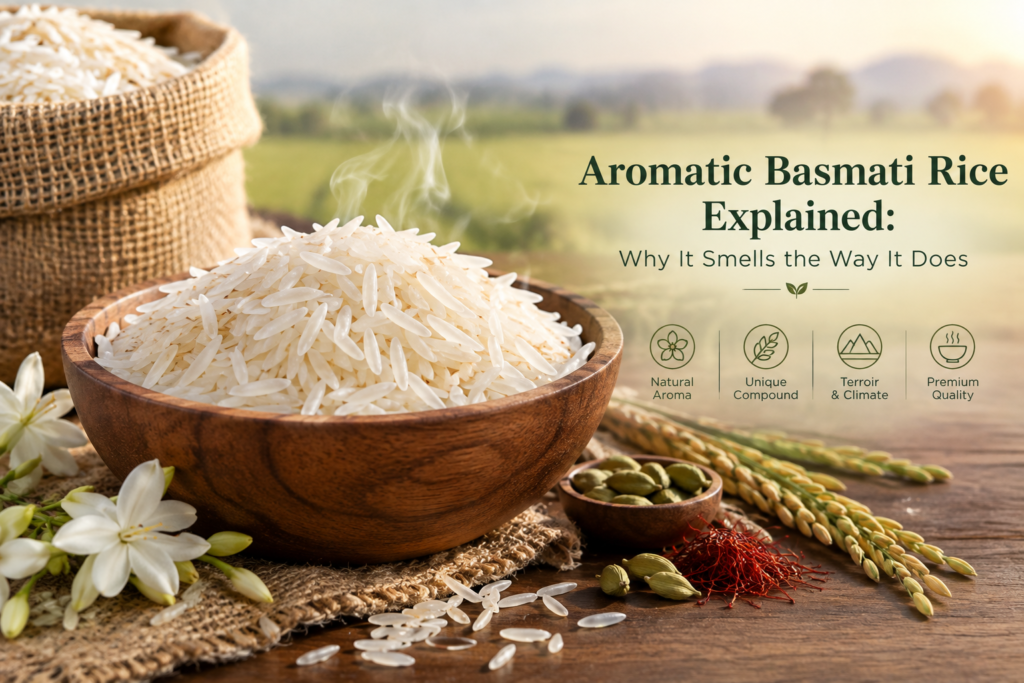
Open a bag of quality basmati rice, and the smell arrives before you even look at a grain. It is warm, faintly nutty, with something floral underneath. Describe it to someone who has never encountered it, and you might reach for comparisons: popcorn, perhaps, or pandan leaf. Neither quite captures it. That specific character — layered, persistent, and immediately recognizable — is what makes aromatic basmati rice one of the most commercially valued grain varieties in the world.
That aroma is not an accident of cooking or processing. It is the result of genetics, geography, and time — and understanding how it forms and how it can be lost matters to buyers, importers, and private-label brands sourcing basmati in bulk.
The Compound Behind the Scent
The aroma of basmati rice traces back, in the largest part, to a single organic molecule: 2-acetyl-1-pyrroline, commonly abbreviated as 2AP. Researchers have identified well over 100 volatile organic compounds in aromatic rice, including various aldehydes, alcohols, esters, and hydrocarbons. But 2AP is the dominant driver — the compound that, even in very small concentrations, produces basmati’s characteristic warm, popcorn-like scent.
What makes 2AP particularly interesting is that it is not unique to rice. The same compound appears in the crust of freshly baked bread, in pandan leaves (Pandanus amaryllifolius), and in a number of other aromatic plants. Research published via NCBI/PubMed confirms 2AP as the primary volatile compound responsible for the popcorn-like odour in aromatic rice varieties. In basmati, however, it occurs in concentrations and in combination with supporting volatiles that produce something distinctly its own.
What makes this especially relevant for commercial buyers is that 2AP is unstable. It is volatile by nature — which is precisely why it produces a scent in the first place — and that volatility means it can be lost during processing, storage, and shipping in ways that measurably reduce the aroma quality of a finished product.
Why Only Certain Rice Has This Aroma: The Genetics of Fragrance
Not every rice plant produces 2AP. The ability to accumulate this compound is determined by a specific genetic mutation, and understanding that mutation helps explain why authentic aromatic basmati rice can only be produced in certain places and from certain varieties.
The key gene is BADH2 — betaine aldehyde dehydrogenase 2. In non-aromatic rice, the BADH2 gene functions normally, producing an active enzyme that metabolizes certain chemical precursors. In fragrant rice, a mutation disrupts this gene’s function. The result is that the plant accumulates an intermediate compound (Δ1-pyrroline), which reacts non-enzymatically to produce 2AP. The aroma gene BADH2 is located on chromosome 8 of the rice genome, and the mutation that causes fragrance is recessive — meaning both copies of the gene must carry the mutation for the plant to be aromatic.
Research at Cornell University, published in the Proceedings of the National Academy of Sciences, established that this major fragrance allele originated in an ancestor of basmati rice — specifically a Japonica-type ancestor — and was later transferred through natural processes to other aromatic varieties, including Thai jasmine rice. This finding has genuine practical implications: authentic basmati fragrance has a specific genetic lineage, which is one of the reasons why growing basmati seed varieties in different climates does not simply reproduce the same aroma profile.
Why Geography Shapes the Aroma
Genetics sets the potential. Geography and climate determine how fully that potential is expressed.
Basmati rice has been cultivated for centuries in the Himalayan foothill regions of the Indian subcontinent — the areas now comprising parts of northern India (Punjab, Haryana, Uttarakhand, Uttar Pradesh, Jammu and Kashmir, Himachal Pradesh) and the Punjab province of Pakistan. India’s FSSAI standards for basmati rice, notified in 2023, explicitly recognize that the agro-climatic conditions of this specific geographical area — along with harvesting, processing, and aging methods — contribute directly to the unique characteristics of authentic basmati.
The relevant environmental factors include:
- Soil composition. The Indo-Gangetic Plain and the alluvial soils fed by Himalayan rivers provide a specific mineral profile that influences how rice plants develop and how aroma compounds accumulate in the grain during the final stages of maturity.
- Temperature during grain filling. Basmati is typically planted in late spring and harvested in autumn. The relatively cool nights during the grain-filling period — when the Himalayan foothills experience temperature drops that lowland regions do not — are considered important for 2AP accumulation. Aroma volatiles are synthesized in aerial plant parts and deposited in the maturing grain; the thermal environment during this period influences how much is retained.
- Water source. Snow-fed river systems that irrigate basmati-growing regions bring mineral profiles different from groundwater or rainwater irrigation in other areas. These contribute to soil conditions that support the crop’s aromatic characteristics.
The practical implication for buyers is that basmati varieties grown outside this geographical belt — even from the same seed varieties — do not reliably produce the same aroma intensity or grain characteristics. This is precisely why India and Pakistan have both sought protected designation status for basmati in international trade discussions.

How the Aroma Develops: From Field to Grain
Aroma in basmati rice is not a fixed quantity that stays constant from harvest onwards. It develops, transforms, and degrades depending on what happens to the grain at each stage of its journey from field to consumer.
At Harvest
Freshly harvested basmati paddy contains both “free” 2AP — loosely bound compounds that are immediately volatile and responsible for the strong fresh scent of new-crop rice — and “bound” 2AP that is attached to starch molecules in the endosperm. Free 2AP is concentrated in the bran layer surrounding the grain; bound 2AP sits deeper in the grain and is released only when exposed to heat (i.e., during cooking).
During Milling
Milling removes the outer bran layer to produce white rice. Since free 2AP concentrates in the bran, milling reduces the immediately detectable aroma level. Research from the SEARCA / University of the Philippines Los Baños found that while milling reduces free 2AP, the bound 2AP in the endosperm is retained — meaning that well-milled basmati, when cooked, releases its aroma through the application of heat. The practical upshot is that milled white basmati may smell less strongly than brown basmati before cooking, but produces a similar aromatic experience when prepared.
During Storage
Storage is where significant aroma loss occurs, and it is an area that buyers sourcing in bulk need to understand carefully. Free 2AP is volatile by nature — it diffuses out of the grain over time, especially at higher temperatures. The same research from the University of the Philippines Los Baños documented a rapid loss of 2AP during the first several weeks of storage, which then slows as the remaining compound is predominantly the more stable starch-bound form.
Temperature matters considerably. Samples stored at higher ambient temperatures lose 2AP faster than those kept cooler. This is why proper warehousing temperature management is not merely a logistical consideration — it is an aroma quality issue that directly affects the product your end customer receives.
The Paradox of Aging
This is where basmati behaves differently from most food products. Conventional wisdom in grain handling is that fresher is better. With premium aromatic basmati, the reverse is true — deliberately aged basmati is considered superior for culinary purposes and commands a higher price.
The aging process involves holding milled rice under controlled conditions for typically 12 months or more. During this period, moisture content reduces, the grain hardens slightly, and the starch undergoes structural changes that make the cooked grain longer, more separate, and less sticky. The aroma profile also matures — some of the sharper, rawer volatile notes from fresh-crop basmati mellow, while the characteristic warm fragrance persists through the bound 2AP.
For buyers positioning a private-label basmati product in the premium retail segment, aged basmati is the appropriate specification. For buyers sourcing for food service or institutional use where grain separation matters but price point is tighter, less-aged basmati may be practical.
The Adulteration Problem and Why It Matters to Buyers
Where there is a premium, there is the temptation to adulterate. Basmati’s scarcity relative to commodity rice varieties — and the significant price premium it commands — has made it a target for adulteration across several dimensions.
Common forms of basmati adulteration include:
- Blending non-basmati varieties: Mixing ordinary long-grain rice into a basmati shipment increases volume without proportionally increasing cost. The blended product may visually resemble basmati but lacks the aroma profile and cooking characteristics.
- Artificial fragrance: Adding synthetic 2AP or other aromatic chemicals to non-aromatic rice to mimic basmati’s scent. This is detectable through gas chromatography and is explicitly prohibited under India’s FSSAI standards for basmati rice, which require that basmati rice possess the natural fragrance characteristic of basmati rice and be free from artificial colouring, polishing agents, and artificial fragrances.
- Incorrect aging claims: Representing new-crop rice as aged, or exaggerating aging duration, to justify a higher price point.
For B2B buyers, particularly those sourcing for private-label programs, adulteration risk has direct commercial consequences. A retail product sold as premium aged basmati that underdelivers on aroma and elongation generates consumer complaints and returns that damage brand equity. The mitigation is not complicated, but it requires discipline: specify the product precisely (variety, crop year, aging period, maximum non-basmati grain content), request laboratory test reports covering 2AP concentration and grain physical parameters, and use third-party pre-shipment inspection as standard practice rather than as an optional add-on.
What Pakistani Aromatic Basmati Offers
Pakistan is the only country besides India that produces genuine premium-grade aromatic basmati rice, and its varieties have a distinct aromatic character that many buyers in the Middle East, Europe, and elsewhere specifically prefer.
Pakistani aromatic basmati varieties — most notably Super Basmati and Basmati 385 — are known for pronounced fragrance intensity. The Punjab province of Pakistan, fed by the Indus River system and sharing similar agro-climatic conditions with the Indian basmati-growing belt, produces grain with the characteristic 2AP-driven aroma that defines authentic basmati.
Research published in the Pakistan Journal of Analytical and Environmental Chemistry analyzed volatile compounds across four basmati varieties grown in Pakistan — Super Basmati, Basmati-515, Basmati 2000, and Basmati 370 — using gas chromatography, confirming 2AP as the principal aroma compound across all tested varieties.
For buyers interested in Pakistani-origin aromatic basmati, Saremco Impex Private Limited operates in Pakistan’s agricultural export sector and can be contacted to discuss product specifications and current availability.
[IMAGE 3 — INSERT HERE]
Suggested image: A wooden bowl or burlap surface with basmati rice grains alongside a small pandan leaf, visually connecting basmati’s aroma to its natural origins
Purpose: Illustrates the connection between 2AP-containing plants — basmati and pandan share the same key aroma compound
Suggested ALT TEXT: Basmati rice grains with a pandan leaf, both of which contain the aroma compound 2-acetyl-1-pyrroline
Practical Implications for Buyers Sourcing Aromatic Basmati
The science of basmati’s aroma has several direct implications for anyone procuring this variety in commercial quantities:
Aroma is a quality specification, not a given: When sourcing basmati, aroma strength should be part of the written specification, not assumed. Request 2AP concentration data from the supplier or ask for sensory evaluation reports from a recognized laboratory. Suppliers who cannot provide this should be asked why.
New crop versus aged supply affects aroma perception on shelf: Products made from fresh-crop basmati will smell strongly in the bag but may not deliver the same aroma on cooking that aged basmati provides. For consumer-facing products, this distinction affects repeat purchase behavior.
Packaging is an aroma preservation issue, not just a branding exercise: Free 2AP diffuses through packaging materials. Rice packaged in breathable woven polypropylene bags loses aroma faster than rice in sealed vacuum or modified-atmosphere packaging. For premium private-label products where shelf life and aroma quality are both positioning factors, packaging specification is a quality decision that should be evaluated before finalizing.
Shipping conditions affect what arrives: Basmati shipped in containers that experience high temperature swings during transit loses 2AP faster than product in temperature-controlled logistics. For buyers importing into markets with warm climates or long transit times, asking suppliers about container monitoring and transit temperature management is reasonable due diligence.
Lab tests can verify what the nose cannot reliably detect: For large-volume purchases, gas chromatography analysis of 2AP content provides an objective measure of aroma quality that is not subject to the variability of sensory evaluation. Some laboratories offer this as a standard service for basmati quality verification.
FAQ
What makes basmati rice aromatic?
The primary source of basmati’s aroma is a compound called 2-acetyl-1-pyrroline (2AP), produced naturally in the grain as a result of a specific genetic mutation in the BADH2 gene. When this gene loses its normal function, the plant accumulates precursor compounds that combine to form 2AP. This compound produces a warm, popcorn-like scent that is basmati’s signature fragrance. The geographical conditions of the Himalayan foothill region — soil, water, and seasonal temperature patterns — influence how strongly this aroma develops in the mature grain.
Does basmati rice lose its aroma over time?
Yes. Free 2AP — the immediately volatile form of the aroma compound — diffuses out of the grain over time, particularly at higher storage temperatures. Research confirms that the most significant 2AP loss occurs in the first weeks after milling, then slows as the remaining compound is predominantly the more stable starch-bound form. Proper storage conditions (cool, sealed, low humidity) help slow this process. Bound 2AP is retained in the grain’s endosperm and released during cooking through heat exposure.
Is aged basmati more aromatic than fresh-crop basmati?
Not in the simple sense. Fresh-crop basmati typically has a stronger raw aroma because of its higher free 2AP content. Aged basmati has lower free 2AP but undergoes starch changes that improve cooking quality — longer elongation, drier texture, better grain separation. The aroma when cooking aged basmati is considered more refined. Most premium basmati products are made from rice aged 12 months or more, and this is reflected in the price.
How can buyers verify that basmati rice is genuinely aromatic and not artificially scented?
The most reliable method is gas chromatography (GC) analysis, which can quantify 2AP and distinguish it from synthetic aromatic compounds. India’s FSSAI standards explicitly prohibit artificial fragrances in labeled basmati rice. For export buyers, requesting a laboratory certificate from an accredited testing facility — confirming 2AP content and the absence of synthetic aroma compounds — is the appropriate verification step.
Does jasmine rice have the same aroma as basmati?
Jasmine rice (specifically Thai Hom Mali, or Khao Dawk Mali 105) also contains 2AP and shares basmati’s characteristic popcorn-like quality. However, the aroma profiles are distinct. Jasmine rice typically produces a softer, more floral expression; basmati tends toward a drier, nuttier version of the same compound. The two grains also differ significantly in grain length, texture, and cooking behavior.
Why can’t aromatic basmati be grown just anywhere?
While the BADH2 gene mutation can theoretically be present in rice seeds grown anywhere, the expression of aroma in the mature grain is influenced by agro-climatic conditions specific to the Himalayan foothill belt — soil mineral profile, temperature during grain filling, and water source. Basmati grown outside this region from the same seed stock does not reliably reproduce the same grain length, aroma intensity, or elongation ratio. This is why both India and Pakistan assert geographical protection for authentic basmati, and why buyers should verify origin when sourcing.
A Note for Buyers and Private-Label Brands
If you are sourcing aromatic basmati rice for a consumer product — whether a branded retail pack, a food service specification, or a private-label program — understanding the science behind basmati’s fragrance gives you better tools for evaluating supplier claims, writing accurate specifications, and protecting your product quality through the supply chain.
The aroma in genuine aromatic basmati is fragile in ways that a simple bag label cannot communicate. It requires the right genetics, the right growing conditions, careful post-harvest handling, and appropriate storage — and each of those points is a place where quality can be preserved or lost.
For buyers considering Pakistani-origin aromatic basmati, Saremco Impex Private Limited works in Pakistan’s agricultural export sector across multiple product categories. Contact the team directly to discuss specifications and current availability.