How to Choose a Reliable Basmati Rice Supplier
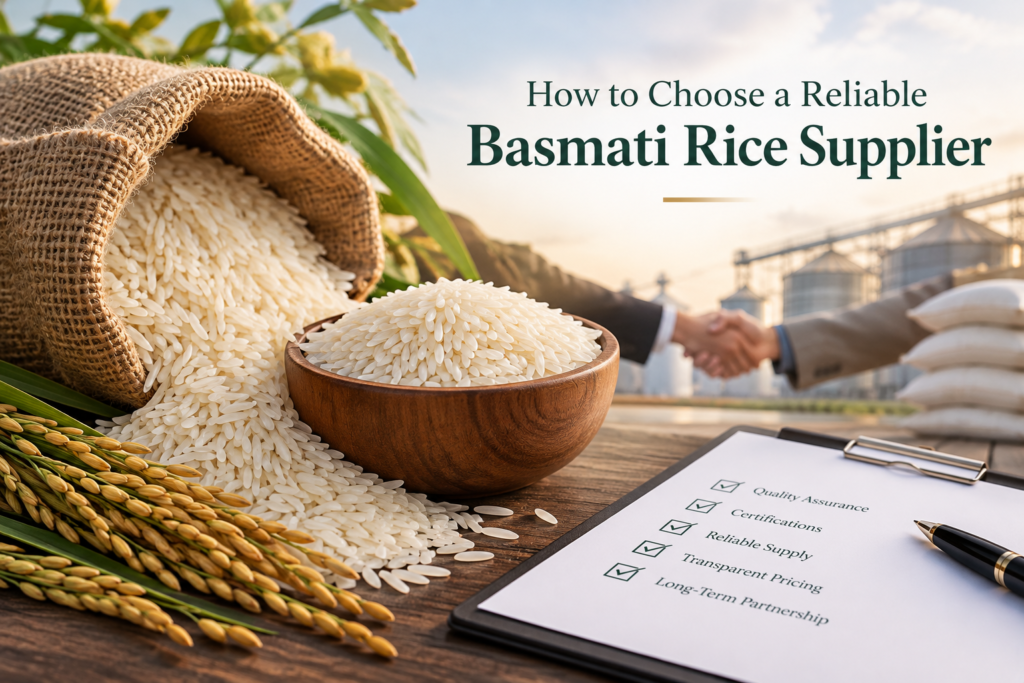
The global basmati rice market exceeds $30 billion annually, and for good reason. This premium aromatic grain commands attention—and commands prices to match. But that value only materializes when you’re sourcing from a supplier who genuinely understands quality, authenticity, and consistency.
If you’re a distributor, retailer, restaurant group, or food business evaluating basmati suppliers, the difference between a dependable partner and a problematic one often comes down to a few critical decisions made before the first shipment arrives.
Understanding the Foundation: Basmati as a Protected Product
Basmati isn’t just marketing language. Basmati rice holds geographical indication (GI) protected status, with APEDA (India’s Agricultural and Processed Food Products Export Development Authority) having issued a certificate of registration on February 15, 2016. This means authentic basmati must originate from specific regions in India and Pakistan, grown using recognized varieties.
What matters to you as a buyer is this: if your supplier isn’t transparent about origin and varietal authenticity, they’re already cutting corners. Genuine suppliers document traceability from farm to shipment.
Quality Standards: The Non-Negotiable Baseline
Basmati quality rests on measurable, standardized parameters. According to FSSAI (India’s Food Safety and Standards Authority) regulations, basmati rice must have its characteristic natural fragrance and should be free of polishing agents, artificial color, and synthetic scents. Similar standards apply globally through the Codex Alimentarius (CXS 198-1995), which establishes international food safety principles requiring rice to be free from microorganisms that represent a health hazard and to be packaged in containers that safeguard hygienic and nutritional integrity.
A reliable supplier doesn’t treat these as suggestions. They treat them as baseline requirements—the floor, not the ceiling.
The Certification Question: What Actually Matters
Certifications can be confusing. Not all certifications carry equal weight, and some are regional while others hold global recognition.
For Indian suppliers, APEDA certification is mandatory. We conduct rigorous quality checks, including pesticide residue testing and adherence to food safety standards, to demonstrate compliance with Indian and international export standards. All rice exports from India require the exporter to be registered with APEDA; shipments from unregistered exporters cannot legally be exported from Indian ports.
For Pakistani suppliers, the standards differ slightly. Certification from the Pakistan Standards and Quality Control Authority (PSQCA) is essential, involving detailed testing and stringent quality assurance measures to ensure rice exported from Pakistan meets or exceeds international standards.
Beyond country-specific registrations, look for these certifications across any supplier:
- ISO 22000 or HACCP: These document food safety management systems. They’re industry-standard, not a luxury.
- Phytosanitary Certification: This confirms the rice is free from pests and meets importing countries’ quarantine standards. It’s non-negotiable for cross-border trade.
- FSSAI License (if sourcing from India): This is India’s domestic food safety approval.
- Halal and Kosher (if applicable to your markets): These matter if you’re supplying Middle Eastern or Jewish consumers.
A supplier who holds multiple relevant certifications has invested in systems. That investment signals seriousness.
Specific Quality Metrics You Should Know
When evaluating samples or specifications, ask for these exact measurements:
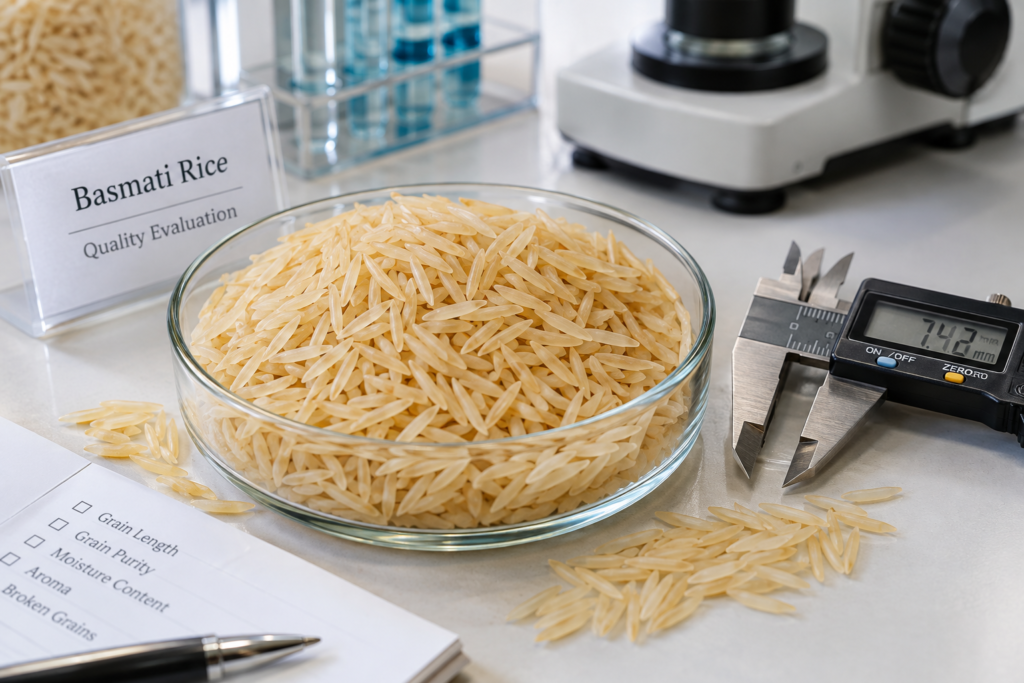
Grain Length and Elongation: Basmati’s defining characteristic is its long, slender grain. Rice quality is determined by physical appearance features including grain shape and size, length-to-width ratio, and translucency, with eating and cooking quality primarily determined by gelatinization temperature, amylose concentration, and gel consistency. Look for elongation ratios above 1.8 after cooking—this is what separates basmati from ordinary long-grain rice.
Broken Grain Percentage: Premium basmati should have fewer than 2% broken grains. Higher percentages indicate rough handling or poor milling.
Moisture Content: This should ideally be under 14%. Higher moisture invites fungal growth and reduces shelf life.
Foreign Matter and Admixture: Ask for lab reports confirming the percentage of non-basmati rice mixed in. Basmati rice is sometimes adulterated or mixed with other rice varieties, diluting its unique qualities, and authenticity testing helps preserve consumer trust by delivering the genuine product.
Aroma and Flavor: This is harder to quantify but worth discussing. The chemical compound 2-acetyl-1-pyrroline gives basmati its distinctive fragrance. A supplier who can discuss aroma quality beyond vague claims understands their product.
Ask any potential supplier for laboratory test reports covering these metrics from an accredited lab. If they can’t provide them, they’re not operating at export quality.
Third-Party Verification: The Trust Layer
For large orders, independent verification removes guesswork. Companies like HAS Rice Pakistan engage independent third-party services such as SGS and Bureau Veritas to perform pre- and post-shipment inspections, providing a layer of trust and transparency for international buyers.
These inspection services verify quantity, quality, and compliance before shipment leaves the origin port. The cost is typically shared or absorbed by the supplier. If a supplier resists, please ask them to explain the reason.
For authenticity verification, some suppliers offer DNA fingerprinting. The EU guideline (Regulation EC 972/2006) recommends DNA-based varietal identification for basmati rice exported to the EU, and the Saudi Food and Drug Authority (SFDA) requires DNA testing to prove basmati rice authenticity for certain shipments. This isn’t overkill for premium segments; it’s standard for major importers.
Communication and Transparency: The Often-Overlooked Signal
How a supplier responds to your questions reveals everything.
A reliable supplier:
- Answers specific questions about origin, variety, processing method, and aging
- Provides documentation without delay or defensiveness
- Discusses trade-offs openly (e.g., “This variety has excellent elongation but slightly less aroma than traditional basmati”)
- Explains what certifications they hold and why
- Shares sample results and historical batch data
- Discusses their quality control processes without vagueness
A problematic supplier:
- Uses generic marketing language instead of specifications
- Makes claims they can’t back with documentation
- Resists requests for test reports or third-party verification
- Offers prices that seem too low without explaining why
- Cannot clearly explain their supply chain
Start with sample orders. Request a small quantity (1–5 kg) with complete test certificates. Your own laboratory can verify specifications. This costs less than the risk of a wrong choice on a container order.
Packaging and Logistics: Quality Beyond the Mill
Premium basmati is fragile. Once milled, it begins to lose aroma; how it’s packaged and shipped matters more than many buyers realize.
Ask about:
- Packaging materials: Are bags food-grade and properly sealed? Do they protect against moisture and light?
- Storage conditions: Is the rice stored in climate-controlled facilities before shipment?
- Shipping timeline: How quickly does it move from mill to port to your facility? Delays increase the risk of quality degradation.
- Container conditions: Are containers clean and fumigated if required?
A supplier who pays attention to these details is demonstrating that they understand basmati’s premium positioning.
Building the Relationship: Documentation and Consistency
Once you’ve identified a reliable supplier, consistency becomes the priority. Establish clear contractual terms:
- Specific quality parameters with acceptable ranges
- Regular batch testing and reporting
- A process for addressing off-specification shipments
- Payment terms that don’t push the supplier toward corner-cutting
- Forecast sharing to help the supplier plan procurement
The best supplier partnerships are built on mutual understanding. Basmati is a seasonal crop; good communication helps both sides manage inventory intelligently.
Frequently Asked Questions
What’s the difference between basmati from India and Pakistan?
Both regions produce excellent basmati, though the varieties differ slightly. Indian basmati is generally regulated through APEDA, while Pakistani basmati is certified through PSQCA. The choice often comes down to supplier reliability and specific varietal preferences (Indian Basmati 1121 is known for exceptional length; Pakistani 1121 is equally prized). Quality depends more on the individual supplier than the country of origin.
How do I know if basmati is authentic or adulterated?
Please request laboratory test reports, including DNA fingerprinting results, if you’re importing into stringent markets. Visual inspection isn’t reliable—grain length alone doesn’t confirm authenticity. Reputable suppliers provide certifications and testing as standard. If a supplier can’t offer this level of documentation, the rice likely contains admixture.
What should I expect to pay for premium basmati?
Prices fluctuate with harvests and global demand, but premium basmati typically commands 2–3 times the price of ordinary long-grain rice. If a quote seems significantly below market rates, it’s likely not premium basmati. Request a breakdown of what quality justifies the price point.
Do I need APEDA certification if I’m sourcing from Pakistan?
No. APEDA applies to Indian exporters. If sourcing from Pakistan, look for PSQCA certification instead. Both are valid; they’re just different regulatory systems serving different countries of origin.
How far in advance should I order?
Basmati is seasonal. If you’re buying new-crop rice (ideal for flavor and aroma), order during harvest season (September–January in most regions). For stock availability from established suppliers, lead times are typically 2–4 weeks. Discuss seasonal availability with your supplier before committing to annual forecasts.
Conclusion
Choosing a reliable basmati rice supplier isn’t about finding the cheapest option or the one with the slickest marketing. It’s about identifying a partner who combines three things: genuine understanding of basmati quality, documented compliance with international standards, and transparent communication.
Start by requesting samples with full testing documentation. Evaluate their responsiveness, their willingness to answer specific questions, and their ability to provide third-party verification. Check certifications relevant to your destination market. Ask about their supply chain, their milling processes, and how they handle quality consistency across batches.
The suppliers worth partnering with are the ones who treat basmati as a premium product worthy of serious quality control—not as a commodity.
Looking to explore reliable basmati rice sourcing options? Saremco Impex Private Limited specializes in agricultural product sourcing with a focus on quality and compliance. Please reach out to discuss your basmati requirements and connect with their team to explore sourcing options tailored to your business needs.