Sella Rice vs Steam Rice: Which One Should You Import?
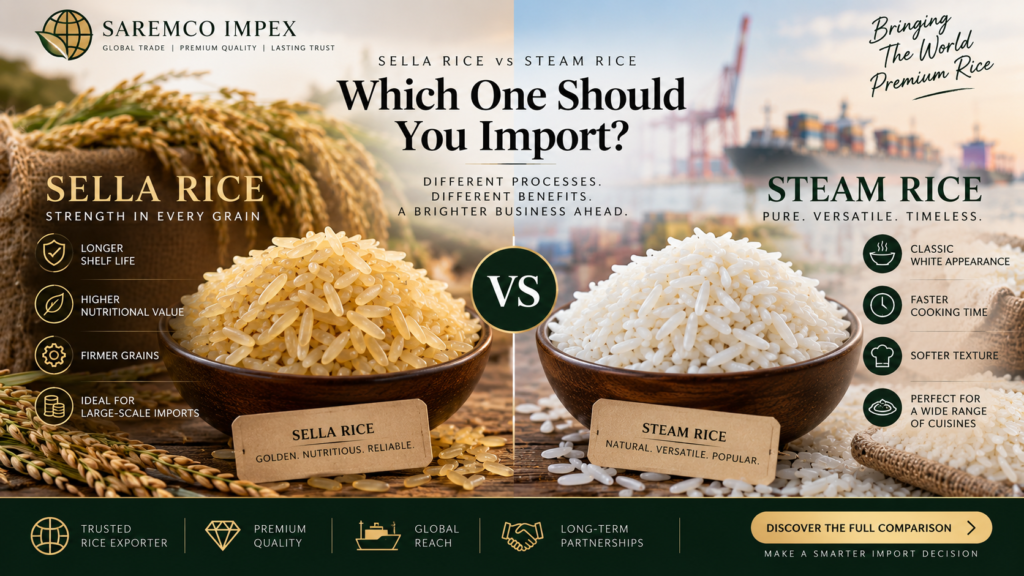
If you’re sourcing rice for import, distribution, or food service operations, you’ve likely encountered two processing methods: Sella (also called parboiled) and Steam. These aren’t just different package labels—they represent fundamentally different processing approaches that affect shelf life, cooking properties, nutritional content, and market demand. Making the right choice impacts your supply chain efficiency, customer satisfaction, and bottom line. This guide breaks down what makes each processing method distinct and helps you decide which is right for your business.
Understanding the Processing Difference
The fundamental difference between Sella and Steam rice lies in when and how moisture is applied during processing.
What Is Sella (Parboiled) Rice?
Sella rice undergoes a specific parboiling process before milling. After harvesting, paddy (rice in husk) is soaked in water, then steam-treated under pressure. This process forces nutrients from the bran layer into the endosperm (the white rice interior). The paddy is then dried and milled to remove the husk and bran.
The result is rice with a distinctive golden or cream color. Sella’s characteristic appearance comes from nutrient migration during parboiling—the starch has partially absorbed vitamins and minerals that were originally in the outer layers.
What Is Steam Rice?
Steam rice, sometimes called white rice or raw rice, is milled directly from paddy without the parboiling step. Harvested paddy is dried, then milled to remove the husk and bran layer. Some processors apply light steaming at the very end for polishing and moisture adjustment, but this is fundamentally different from the intensive parboiling process used in Sella production.
Steam rice retains its natural white appearance and represents the more traditional processing method. It’s the familiar white rice that consumers have expected for generations.
Key Differences in Detail
Shelf Life and Storage Stability:
Sella rice has a significant advantage in storage longevity. Because the parboiling process partially cooks the grain, Sella is more resistant to insect infestation and microbial deterioration. The processed nature of Sella rice means it can maintain quality for 24–36 months under proper storage conditions—significantly longer than Steam rice.
Steam rice, with its untouched bran layer removed but lipids still present in the endosperm, has a shorter shelf life. Under typical storage conditions (cool, dry environment), Steam rice maintains optimal quality for 12–18 months. After this period, the lipids gradually oxidize, potentially causing rancidity and flavor deterioration.
For importers managing international supply chains with longer shipping times and warehouse storage, Sella’s extended shelf life is a substantial logistical advantage. You can hold larger inventory quantities without quality concerns.
Nutritional Profile:
The parboiling process used in Sella rice production creates a nutritional advantage. During parboiling, water-soluble B vitamins (thiamine, niacin, and folic acid) and minerals migrate from the bran layer into the endosperm before the bran is removed.
This means Sella rice retains more vitamins and minerals in the final product compared to Steam rice, where these nutrients are lost when the bran is removed. In developing markets where rice is a dietary staple, this nutritional difference can be meaningful. Some markets actively prefer Sella specifically for this reason.
Steam rice, while less nutritionally dense, can be fortified—manufacturers add synthetic vitamins and minerals post-milling to match or exceed natural levels. Fortification is common in many developed markets and emerging economies to address micronutrient deficiency concerns.
Cooking Properties and Texture:
The cooking experience differs notably between the two processing methods:
Sella rice: Because the grain has been partially cooked during parboiling, it requires slightly longer cooking time (18–22 minutes typically). However, the grain structure is more robust—Sella grains are less prone to breaking during cooking. The texture tends toward firm rather than soft, making Sella excellent for dishes requiring grain separation (fried rice, pilafs).
Steam rice: Cooks faster (14–18 minutes) with more tender results. The grain is more delicate and can break if overcooked or handled roughly. Steam rice is preferred for dishes where a softer, more absorbent texture is desired (risotto, congee, dishes with curries or sauces).
Neither is inherently “better”—the choice depends on the intended end use and regional preferences.
Color and Appearance:
Sella rice has a characteristic golden or cream color ranging from pale yellow to light brown depending on the parboiling intensity and milling process. This distinctive color is immediately recognizable and has cultural significance in many cuisines, particularly in parts of South Asia, Africa, and the Middle East.
Steam rice is white or off-white, matching consumer expectations in most Western markets and many Asian markets. The color consistency of white rice is a selling point in regions where consumers associate white rice with purity and tradition.
Consumer perception varies dramatically by region. In Middle Eastern and African markets, Sella rice’s golden color is preferred. In East Asian and North American markets, white Steam rice dominates consumer choice.
Price Considerations:
Sella rice typically costs 10–20% more than equivalent Steam rice varieties because the parboiling process is more energy-intensive and requires specialized equipment. Processing costs directly impact the wholesale price you’ll pay as an importer.
However, the price premium often reflects value beyond just processing costs. Sella’s extended shelf life reduces spoilage losses over extended storage. The robust grain structure means fewer breakages during shipping and handling, potentially improving your effective yield per shipment.
For high-volume importers, a cost-per-usable-unit calculation (accounting for shelf life and breakage) often shows Sella and Steam as more comparable than the simple per-kilogram price suggests.
Market Demand and Regional Preferences
Understanding regional demand patterns is critical for import decisions. Market preferences significantly influence which processing method will sell effectively in your target market.
Regions Preferring Sella Rice:
Middle East and GCC countries (Saudi Arabia, UAE, Kuwait, Qatar) show strong preference for Sella rice. West African countries (Nigeria, Ghana, Ivory Coast) are significant Sella consumers. Parts of South Asia also maintain traditional Sella preferences, particularly for specific culinary applications.
Regions Preferring Steam Rice:
North America and Western Europe overwhelmingly prefer white Steam rice. East Asian markets (China, Japan, Southeast Asia) traditionally favor Steam varieties. Most developed economies default to white rice unless specifically seeking specialty options.
Which Should You Import? A Decision Framework
Choose Sella Rice if:
- Your target markets are the Middle East, Africa, or South Asia
- You’re building inventory and need long shelf life without spoilage
- Your distribution channels have extended storage periods
- You want nutritional advantages without fortification costs
- You’re targeting price-conscious consumers in developing markets
- Your logistics involve long shipping times and warehouse storage
Choose Steam Rice if:
- Your primary markets are North America, Western Europe, or developed East Asia
- You prioritize faster consumer turnover and don’t need extended shelf life
- You’re supplying restaurants, food service, or institutional buyers
- Your customers expect traditional white rice appearance
- You want lower per-unit acquisition costs
- You’re competing in markets where fortification is standard
Quality Standards and Certification
Whether importing Sella or Steam rice, both should meet identical quality standards when sourced from reputable exporters. Look for:
- ISO 9001:2015 certification for quality management
- HACCP compliance for food safety protocols
- FDA registration (for North American imports)
- Certificates of Analysis from independent laboratories
- Moisture content specifications (10–12%)
- Purity above 99% | Less than 2% broken grains
- Phytosanitary certificates for international shipment
Frequently Asked Questions
Q: Is Sella rice treated with chemicals during parboiling?
A: No. Traditional parboiling uses only water, steam, and heat. No chemical additives are required. Modern facilities may use food-grade anti-caking agents during drying, but the parboiling process itself is chemical-free.
Q: Can I store both types the same way?
A: Yes, storage conditions are identical—cool (below 20°C), dry (below 12% humidity), protected from pests and light. However, Sella tolerates these conditions longer before quality degradation. Steam rice requires more careful inventory rotation.
Q: Which has higher demand in international trade?
A: Globally, white Steam rice has higher total volume due to demand from developed markets and China. However, Sella maintains strong demand in Middle East and African markets. For importers, demand depends entirely on your target geography.
Q: Does cooking time difference matter for commercial operations?
A: Yes, if you’re supplying food service. An extra 4–6 minutes cooking time per batch affects throughput in commercial kitchens. For retail, the difference is negligible. Consider your end-customer when evaluating this factor.
Making Your Import Decision
The choice between Sella and Steam rice for import depends on matching the product characteristics with your market opportunity and operational constraints. There’s no universally “better” option—only the right option for your specific business model.
Sella rice excels in supply chains with longer transit times, customers who value nutrition naturally, and markets where golden-colored rice is preferred. Steam rice performs better in fast-moving distribution channels, quality-conscious developed markets, and food service operations.
The most successful importers often source both varieties, matching each to its optimal market segment rather than betting exclusively on one processing method. This diversification hedges against regional demand fluctuations and allows you to serve multiple customer segments with a single supplier relationship.
Ready to Choose the Right Rice for Your Market?
Whether you need the longer shelf life and robust performance of Sella Rice or the traditional appearance and faster cooking of Steam Rice, the right choice depends on your market, customers, and supply-chain needs.
Looking for a reliable rice supplier? Explore Saremco Impex Private Limited’s rice range and find the right option for your business.
Contact us today to discuss your rice sourcing and export requirements.
Explore Saremco Impex Rice Products
E-Mail: info@saremcoimpex.com
Contact: +92 341 111 5222 +92 341 111 5333 +92 341 111 3555 +92321 646 3001