Pakistani Rice Export: Types, Quality, Packaging and Global Markets
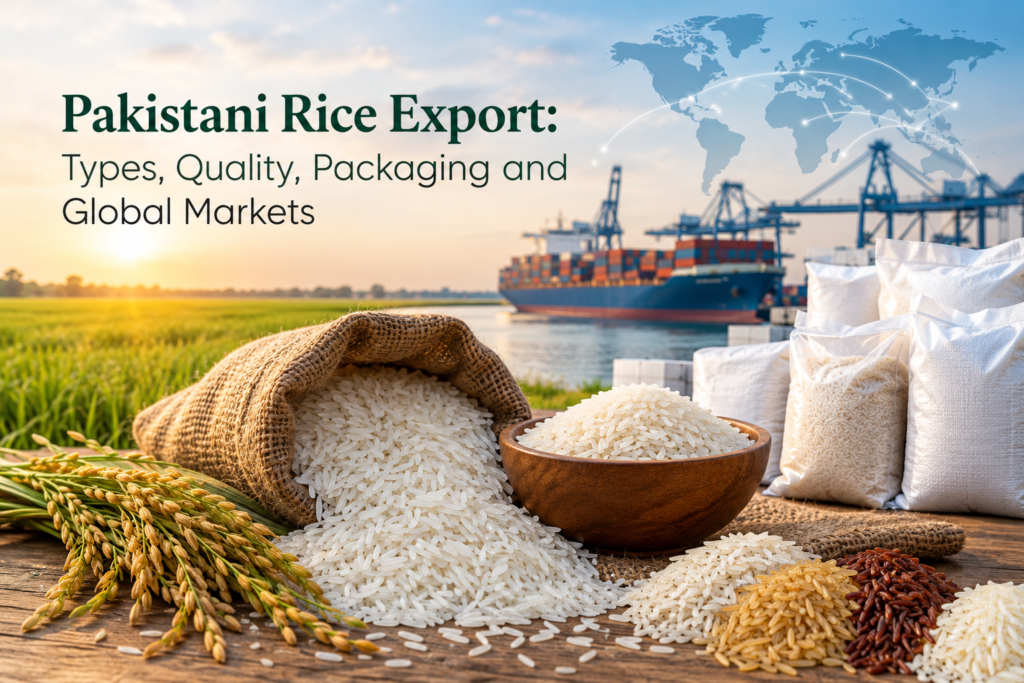
Few agricultural commodities define Pakistan’s place in world trade as clearly as rice. Fields across the Indus Basin feed domestic kitchens, and a large share of each harvest also goes into containers bound for the Gulf, Africa, Central Asia, Europe and East Asia. For importers, the real questions are practical. Which Pakistani rice suits your market, what should the specification say, how should it be packed, and where does demand actually come from?
This guide walks through those questions in the order a buyer usually meets them. It covers the main varieties in Pakistani rice export, the quality factors that decide price and acceptance, packaging and shipping, and the markets that shape the trade.
Why Pakistan Matters in the Rice Trade
Pakistan’s Trade Development Authority (TDAP) describes the country as one of the ten largest rice producers in the world. According to TDAP’s rice sector overview, rice covered about 3.35 million hectares and produced roughly 8.5 million tonnes in 2021, mostly in Punjab and Sindh. The same overview puts exports that year at around 4 million tonnes, worth about US$2.16 billion. Pakistan ranked third worldwide by quantity and was the leading exporter of brown rice.
Those are 2021 figures, so treat them as a baseline. The sector’s recent direction is harder to pin to one number. In a 2025 interview with S&P Global, the chairman of the Rice Exporters Association of Pakistan said the industry was aiming for 8 million tonnes of exports in the 2025–26 fiscal year, with Africa a central focus. Forecasts differ between agencies. Buyers can compare the USDA’s Production, Supply and Distribution database with trade-body figures before making volume commitments.
Types of Rice in Pakistani Rice Export
Pakistan’s rice trade splits into two broad families: aromatic basmati and the larger-volume non-basmati group. Each serves a different kind of buyer.
Basmati varieties
Basmati is the premium end of the market. It is a long, slender, aromatic grain that elongates when cooked and stays separate rather than sticky. In Pakistan, it is grown mainly in the Kalar tract of Punjab. TDAP lists varieties such as Basmati 370, Basmati 385, Basmati 198, Basmati 2000 and Super Basmati. The two names buyers meet most often are:
- Super Basmati: Long-grain, strongly aromatic and widely traded. It is a common choice for biryani and pulao.
- 1121 basmati: Extra-long grain with pronounced elongation after cooking. It is popular with buyers who want a showpiece grain.
Because basmati commands a higher price, authenticity matters. TDAP has noted that mixing basmati with cheaper varieties is a recognised risk in the trade. Buyers should ask for varietal purity to be stated in the contract and checked on arrival.
Non-basmati varieties
Non-basmati rice moves in much larger volumes. TDAP’s variety list includes PK-386 and the IRRI types, along with KS-282, KSK-133 and hybrid rice.
- IRRI-6: An economical, medium-to-long grain. It is a staple of bulk trade, especially to African markets.
- IRRI-9: A longer, whiter grain often chosen where appearance and milling quality count.
- PK-386: A long-grain variety with moderate aroma, positioned between standard white rice and traditional basmati.
Processing forms buyers can choose
The same variety can be traded in several forms, and the form changes both the price and the use.
| Form | What it is | Typical use |
|---|---|---|
| Paddy | Rice with the husk still on | Further milling by the buyer |
| Brown (husked) rice | Husk removed, bran retained | Wholesale and specialty food markets |
| White (milled) rice | Bran and germ removed in whole or part | Retail packs and food service |
| Parboiled (steamed) rice | Soaked and heat-treated before milling | Markets that prefer firm, separate grains |
| Broken rice | Fragments of milled kernels | Industrial food processing and lower-cost segments |
Quality: What Importers Should Specify
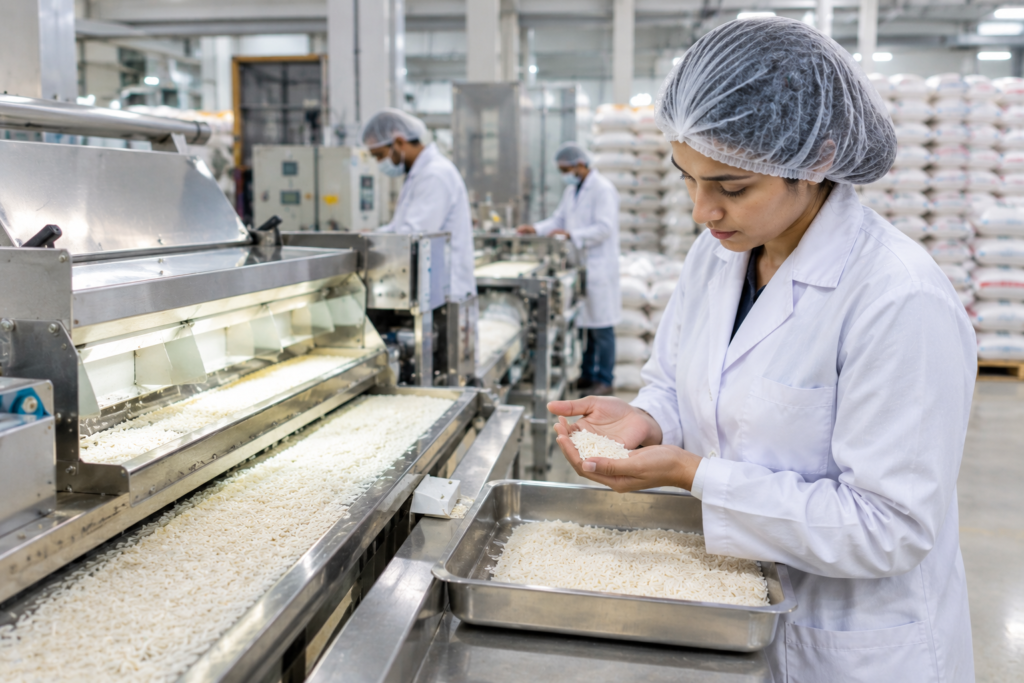
Two buyers can both order “Pakistani basmati” and receive very different products. The gap is usually in the specification. A sound contract states the following.
- Variety and grain dimensions. Name the variety, and specify average kernel length where it matters. International standards classify milled rice as long, medium or short grain by length or length-to-width ratio. The Codex Alimentarius standard for rice is the usual reference point.
- Broken kernel percentage. This is among the biggest price levers. Premium lots allow few broken grains, while economy grades allow considerably more. State the limit as a number.
- Moisture content. Codex sets a ceiling and recognises that stricter limits may be needed for hot climates or long voyages. Many buyers write a lower figure into the contract, because excess moisture invites mould and insect damage in transit.
- Milling degree and appearance. Specify whether the rice is well milled or extra well milled. Also set tolerances for chalky grains, discoloured or damaged kernels, and red-streaked grains.
- Foreign matter. Stones, husks, other grains and dust should be capped and measured.
- Food safety and residues. Importing countries apply their own limits on pesticide residues and contaminants such as heavy metals and mycotoxins. Check the rules of the destination market before you fix the specification, not after the cargo is loaded. TDAP and industry voices have pointed to improved seed varieties and reduced pesticide use as part of how basmati exporters manage compliance.
- Sampling and inspection. Agree in advance on a pre-shipment sample, an independent inspection company and the testing method.
A useful habit is to approve a sealed sample against the written specification before the order is confirmed. Then insist that the shipment match the approved sample, not just the price list.
Packaging and Shipping for Export
Rice is a durable commodity, but only if it stays dry and clean. Packaging choices come down to the market and the channel.
Bulk and wholesale. Woven polypropylene (PP) bags in the 25 kg and 50 kg range are common for wholesale and distribution. Larger sacks and jumbo bags suit very large bulk buyers who repack at destination.
Retail-ready. Smaller consumer packs in laminated or multi-layer film, often 1 kg to 5 kg, are made for supermarkets. Private-label buyers usually supply their own artwork and specifications.
Containerized loading. Most rice moves in 20-foot or 40-foot containers. The cargo weight depends on bag type and container, so ask your freight forwarder for the realistic payload instead of assuming it. Check the container floor and walls for moisture, odour and damage before loading.
Whatever the pack, ask about the following:
- Bag material, weight tolerance and stitching or sealing quality.
- Clear marking of variety, grade, net weight and country of origin.
- Whether fumigation or other treatment is needed for the destination.
- How moisture is controlled during storage, trucking to port and the sea voyage.

Where Pakistani Rice Goes: Key Global Markets
Pakistani rice exports serve several distinct buyer groups, and each leans toward a different product.
The Gulf and the Middle East. The United Arab Emirates has been reported as the largest single destination for Pakistani rice, and basmati is a strong performer there. TDAP officials have also pointed to Saudi Arabia and the United States as significant markets for parboiled basmati.
Africa. Africa is a long-standing outlet for non-basmati rice. Kenya and Somalia are recurring names in trade commentary, and Sindh’s IRRI-6 has traditionally found steady demand across the continent. Pakistan has also promoted its rice through trade road shows in West Africa.
Central Asia. This region is drawing attention. Reporting by Gulf News, citing Dawn, noted that shipments to Kazakhstan passed 17,000 tonnes in a recent monthly count, including about 10,300 tonnes of basmati. Uzbekistan received more than 10,000 tonnes.
South and Southeast Asia, and China. Bangladesh remains a large potential buyer, though the same report notes that high freight costs have dented competitiveness. Kenya, Malaysia and Indonesia also appear in reports of strong demand, and China is a recurring destination for non-basmati.
Europe. Super Basmati has historically had a significant European following, which is why residue and contaminant compliance matters so much for exporters targeting that market.
One caution applies to all of these. Market shares shift with harvest size, freight rates, minimum export price rules and competition from other origins. Check current conditions with a recent source before committing to volume.
Documents and Compliance Checklist
A smooth shipment depends as much on paperwork as on the grain. Rice trades under HS heading 1006, with subheadings that separate paddy, husked, milled and broken rice. Importers should expect to discuss:
- Commercial invoice, packing list and bill of lading.
- Phytosanitary certificate issued by Pakistan’s plant quarantine authorities.
- Certificate of origin.
- Quality or analysis certificate, and any inspection report agreed in the contract.
- Any destination-specific requirements, such as import permits or lab tests.
Pakistan’s National Agri-trade and Food Safety Authority (NAFSA) was set up to oversee sanitary and phytosanitary compliance for agricultural trade, so it is worth asking any supplier how they handle these requirements.
Questions to Ask Before You Buy
Put these to any prospective supplier of Pakistani rice:
- Can you supply a pre-shipment sample and a written specification covering variety, broken percentage, moisture and foreign matter?
- How is varietal purity verified?
- How is moisture controlled from milling to loading?
- Which packaging options and bag sizes are available?
- Which inspection and testing arrangements do you support?
- What is the typical lead time from order to loading?
- Can you share references for shipments to my destination market?
Straight answers to these tell you more about a supplier than any brochure.
Sourcing Pakistani Rice with Saremco Impex Private Limited
Buyers who want a Pakistan-based export partner can look at Saremco Impex Private Limited, which runs rice, salt and general trading divisions. On the rice side, its rice catalog lists Super Kernel Basmati, 1121 Kainat, 1121 steam and sella parboiled rice, 386 long grain, and IRRI-6 and IRRI-9 non-basmati. The company says its rice is milled at its Pasrur facility in Punjab, and you can read about its mills and processing facilities on the website.
Several points from this guide are addressed on the company’s own pages. Saremco Impex states that consignments are checked through laboratory testing and third-party inspection, and it lists its certifications on a dedicated quality and certifications page. It also publishes its export process and port logistics workflow and the destinations it serves worldwide. On packaging, it offers retail and bulk options, including private-label bagging, and says documents such as phytosanitary certificates and certificates of origin are available on request.
As with any supplier, ask for a sample, the written specification and the relevant test reports, and confirm them against your own market’s requirements.
Conclusion
Pakistani rice export rewards buyers who do their homework. Choose the variety to fit the end use, write the specification in measurable terms, match the packaging to your channel, and confirm the compliance rules of your own market before the cargo sails. Basmati and non-basmati each have a clear role, and the strongest purchasing decisions rest on samples, documents and a supplier’s willingness to answer detailed questions.
If you are planning to import Pakistani rice and want product information, specifications, packaging details or a quotation, contact Saremco Impex Private Limited with the variety, quantity, destination port and packaging you need.