Basmati Rice Import Requirements by Country (2026 Guide)
Every basmati importer eventually hits the same wall: the rice itself might be excellent, but the shipment gets held up at port because a certificate is missing, a pesticide residue test came back over the limit, or the label wasn’t formatted the way the destination country wants it. Import requirements for basmati rice aren’t identical from one market to the next, and treating them as if they were is how containers end up sitting in customs.
This guide walks through the basmati rice import requirements that matter most for the largest buying markets — the EU, UK, US, Saudi Arabia, UAE, and key African destinations — along with the documentation every shipment needs regardless of where it’s headed.
Documentation Every Basmati Shipment Needs
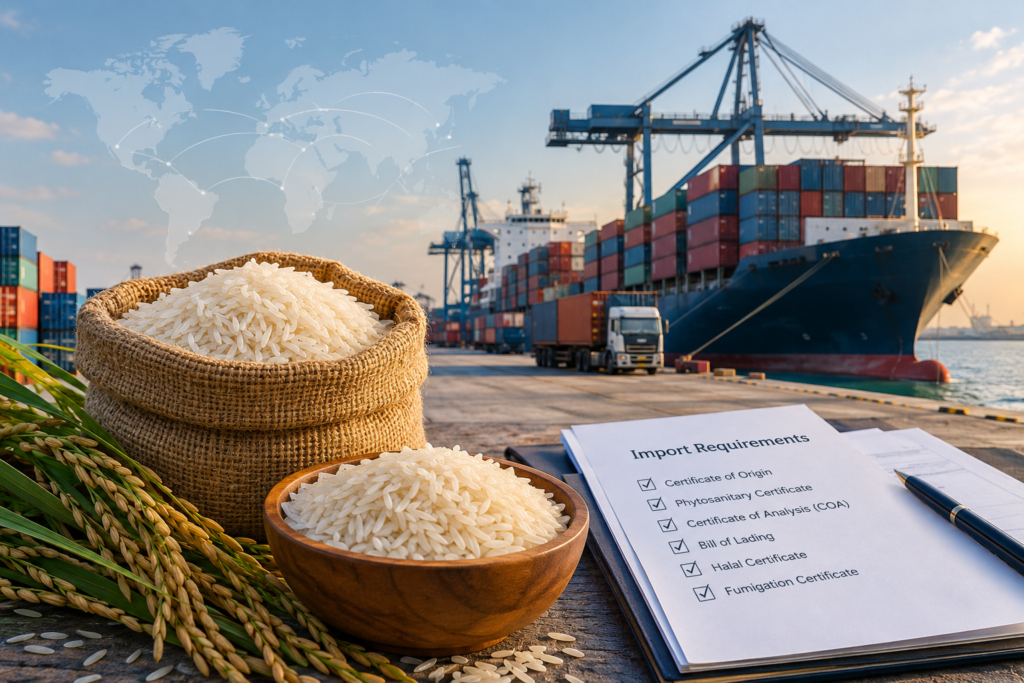
Regardless of destination, most countries expect a baseline set of documents before rice clears customs. Get these right first, then layer in country-specific requirements on top:
- Certificate of Origin — confirms the rice was grown and milled in Pakistan (or the exporting country), often required for preferential tariff treatment.
- Phytosanitary certificate — issued by the exporting country’s plant protection authority, confirming the shipment is free of regulated pests and plant diseases.
- Certificate of Analysis (COA) — an independent lab report covering moisture content, grain length, broken percentage, and pesticide residue levels.
- Bill of Lading — the shipping document that also serves as a title to the goods.
- Halal certificate — required or expected in most Middle Eastern and several African and Southeast Asian markets, even though rice is inherently plant-based; it confirms no cross-contamination occurred during milling or packaging.
- Fumigation certificate — where required, confirming the shipment or container has been treated against insect infestation.
Country-by-Country Requirements
The table below summarizes the requirements that come up most often across basmati rice’s major import markets. Treat it as a starting point rather than a final checklist — regulations are updated periodically, so always verify current rules with the destination country’s food safety authority or your customs broker before shipping.
| Market | Key Requirements | Notes |
| European Union | Phytosanitary certificate; pesticide residue testing incl. tricyclazole MRL of 0.01 mg/kg; increased-frequency official controls on Pakistani basmati consignments; EU Basmati marketing name rules (min. 25 tons/2 years traded to use the protected name) | Zero-duty access for Pakistani rice; strict, regularly updated MRL enforcement. |
| United Kingdom | Phytosanitary certificate via IPAFFS; equivalent MRL and food safety checks to the EU post-Brexit | Zero-duty access under the UK’s developing countries trading scheme |
| United States | FDA food facility registration for the foreign mill; FDA Prior Notice before each shipment arrives; FSVP compliance by the U.S. importer; English-language labeling | No single blanket approval — compliance is shipment-by-shipment and importer-driven |
| Saudi Arabia | SFDA product registration via the SABER platform; Product and Shipment Certificates of Conformity; Halal certification from an SFDA-approved certification body; GSO 9:2013 labeling standards | Halal certification applies even though rice is plant-based, to confirm no cross-contamination during milling. |
| UAE | MOIAT Certificate of Conformity; compliance with UAE-approved MRLs; GCC-harmonized standards | Digital conformity assessment increasingly required before port clearance |
| East & West Africa (typical) | Phytosanitary certificate; Certificate of Origin; import permit from the destination country’s food or agriculture authority | Requirements vary more by country; generally less stringent MRL testing than the EU/UK. |
European Union
The EU is one of the strictest and most closely watched basmati markets, and also one of the largest — Pakistan exported roughly 450,000 tonnes of rice to Europe in 2023, most of it basmati, according to the CBI (part of the Netherlands Enterprise Agency). The EU’s 2018 decision to cut the maximum residue level for the fungicide tricyclazole from 1 mg/kg to 0.01 mg/kg reshaped the competitive landscape between Pakistani and Indian basmati, since Pakistani exporters generally rely less on that particular fungicide.
Since 2023, the EU has also formally protected “Basmati” as a marketing name under Regulation 2023/2835, meaning exporters need to demonstrate a genuine trading history — at least 25 tons of basmati placed on the EU market or exported from it over the previous two years — to use the term. Testing frequency for pesticide residues on Pakistani rice consignments has also increased in recent years, so a current, accredited lab report is essential before booking a shipment.
United Kingdom
Post-Brexit, the UK runs its own import control system — the Import of Products, Animals, Food and Feed System (IPAFFS) — for phytosanitary and food safety declarations, though the underlying safety and residue standards remain closely aligned with the EU’s. Pakistani rice continues to receive zero-duty access to the UK market under its developing country trading arrangements. However, shipments still need to clear IPAFFS checks and meet UK MRL limits.
United States
The US doesn’t pre-approve shipments or issue blanket import licenses for rice. Instead, the foreign milling facility must be registered with the FDA, and the US-based importer is responsible for Foreign Supplier Verification Program (FSVP) compliance. Every shipment also requires FDA Prior Notice — submitted before the food arrives, including the facility’s registration number, product description, and expected port of entry — so FDA can decide whether to inspect it on arrival.
The FDA’s own guidance on importing food products is worth reading directly if you’re setting this up for the first time, since missing Prior Notice or facility registration is one of the more common reasons shipments get held at US ports.
Saudi Arabia
Saudi Arabia’s Food and Drug Authority (SFDA) requires rice products to be registered on its SABER conformity platform before shipment, with both a Product Certificate of Conformity and a Shipment Certificate of Conformity issued ahead of clearance. Halal certification is required from an SFDA-approved certification body — again, this applies to rice specifically to confirm the milling and packaging process didn’t introduce any non-halal contamination — alongside labeling that meets GSO 9:2013 standards.
United Arab Emirates
The UAE, through the Ministry of Industry and Advanced Technology (MOIAT), requires a Certificate of Conformity for rice shipments, verified against UAE-approved maximum residue limits and GCC-harmonized food safety standards. As with Saudi Arabia, digital conformity assessment ahead of port arrival is increasingly standard rather than optional.
East and West African Markets
Requirements across African import markets vary more country to country, but generally center on a phytosanitary certificate, Certificate of Origin, and an import permit issued by the destination country’s food or agriculture ministry. Residue testing tends to be less exhaustive than the EU’s, though buyers should still confirm current requirements directly, since several countries have been tightening food-safety oversight in recent years.
Why Pesticide Residue Limits Matter More Than Buyers Expect
Of all the requirements above, MRL compliance causes the most shipment rejections in practice. A batch of rice can meet every grain-quality specification and still get turned away at a European port if residue levels for a single regulated substance exceed the limit. This is why reputable exporters test every lot before it’s loaded, rather than relying on results from a previous season’s harvest.
Saremco Impex Private Limited backs its export lots — including Super Kernel and 1121 Kainat basmati rice — with SGS, Intertek, and PCSIR lab testing before shipment, which is the kind of documentation worth requesting from any supplier regardless of destination market.
Building an Import Checklist Before You Contract
A practical way to avoid delays is to work backward from your destination country’s requirements before signing a purchase contract, rather than discovering a gap after the container is already at sea:
- Confirm current MRL and labeling rules with your destination country’s food safety authority or a licensed customs broker — these are updated periodically.
- Request a current Certificate of Analysis from the exporter covering moisture, grain length, broken percentage, and pesticide residues.
- Confirm Halal certification if shipping to the Middle East, and check that the destination authority recognizes the certifying body.
- Verify phytosanitary and origin documentation will be issued in time for your shipping schedule — these typically can’t be backdated.
- Check labeling language and format requirements for the destination market before packaging is finalized, since relabeling after production adds cost and delay.
Working with an exporter that already manages export documentation and port logistics as a standard part of their process — rather than assembling paperwork per shipment — tends to reduce the number of surprises at the destination port.
Frequently Asked Questions
Do all countries require Halal certification for basmati rice?
No. Halal certification is generally required or expected in Middle Eastern markets like Saudi Arabia and the UAE, and in some African and Southeast Asian markets, but it isn’t a universal requirement — the EU and US, for example, don’t mandate it, though individual retailers sometimes request it.
What is the EU’s pesticide residue limit for basmati rice?
The most closely watched limit is for the fungicide tricyclazole, set at 0.01 mg/kg since 2018 — a significant reduction from the previous 1 mg/kg limit. Other regulated substances carry their own limits, so a full residue panel from an accredited lab is the safest way to confirm compliance before shipping.
Can I use the word “Basmati” on packaging sold in the EU?
Since Regulation 2023/2835, using “Basmati” as a marketing name in the EU requires demonstrating a genuine trading history in the product — specifically, at least 25 tons exported to or placed on the EU market over the previous two calendar years.
Does the US require FDA approval before importing basmati rice?
The FDA doesn’t pre-approve or certify individual shipments. Instead, the foreign mill must be registered with the FDA, the US importer must maintain FSVP compliance, and Prior Notice must be filed for each shipment before it arrives at a US port.
How long does customs clearance typically take for basmati rice imports?
This varies widely by port, season, and whether documentation is complete on arrival. Shipments with complete, accurate paperwork filed in advance generally clear faster than those requiring follow-up documentation once the container has already arrived.
Planning to import Pakistani basmati rice?
Let Saremco Impex make the process easier. With 45+ export destinations and support for lab testing, certifications, export documentation, and logistics, we help importers prepare shipments according to destination-market requirements.
Saremco Impex Private Limited ships basmati and non-basmati rice to 45+ export destinations and handles certification, lab testing, and export documentation as a standard part of each order. If you’re planning an import and want to confirm current specifications, you can review the rice catalog or request a proforma quote to get destination-specific documentation sorted early.