How Basmati Rice Is Graded for Export Markets: A Complete Guide
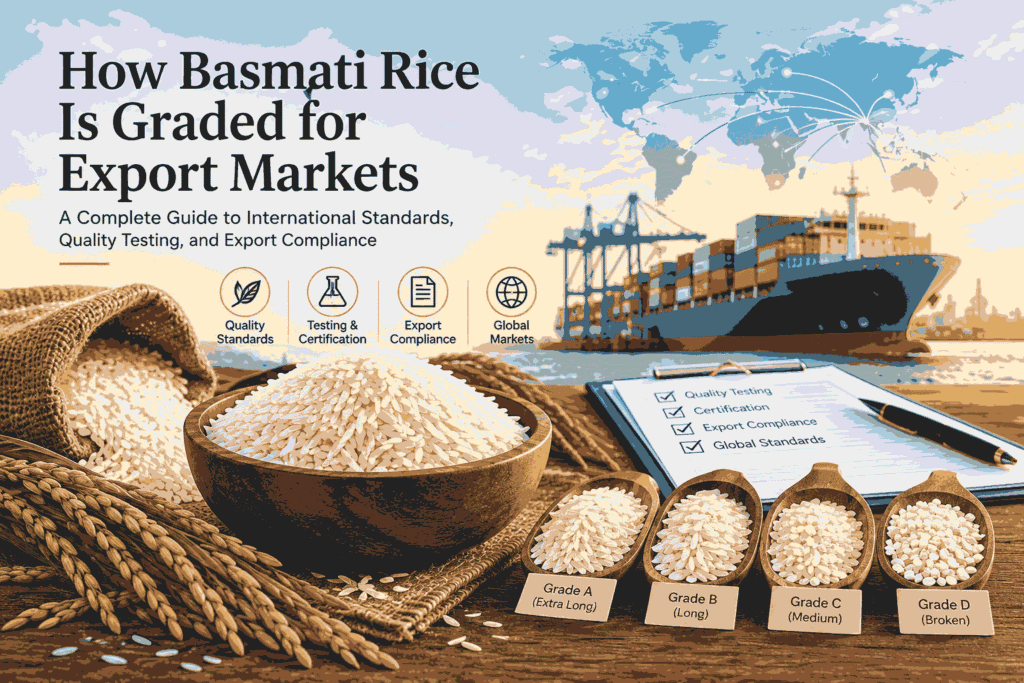
When basmati rice arrives at a grain processing facility, it doesn’t go directly into export containers. Before a single grain reaches an international buyer, it undergoes a rigorous grading process designed to ensure quality, consistency, and compliance with strict global standards. This process determines not only the final price, but also the exporter’s reputation and importers’ satisfaction across 45+ markets worldwide.
If you’ve ever wondered why some basmati rice commands premium prices while others are sold at competitive rates, the answer lies in understanding exactly how basmati rice is graded for export markets. Whether you’re an importer, distributor, retailer, or simply curious about what happens before your rice reaches the kitchen, this guide explains the complete grading system, international standards, and the factors that determine export-grade quality.
What Does Basmati Rice Grading Actually Mean?
Basmati rice grading is the systematic classification of rice based on specific quality parameters that determine its suitability for export. Grading isn’t arbitrary—it’s based on internationally recognized standards that define everything from grain length and color to moisture content and defect tolerances.
When exporters grade basmati rice, they’re essentially sorting millions of grains into categories that communicate exactly what the buyer is receiving. A buyer in the United Arab Emirates, for example, might require Grade A basmati with a specific grain length and fragrance profile. A distributor in Europe might need EU-compliant rice meeting Maximum Residue Limits (MRL) standards. A North American importer might need FDA-registered basmati meeting US food safety protocols.
Grading systems allow all parties—exporters, importers, retailers, and end consumers—to speak the same language about quality. It eliminates ambiguity, ensures consistency across shipments, and protects both buyer and seller.
International Basmati Rice Grading Standards
The world’s basmati rice industry doesn’t have a single universal grading system. Instead, it operates under several overlapping standards developed by different organizations and countries. Understanding these standards is essential for anyone involved in the export trade.
The India Standard for Rice (ISI)
India’s Bureau of Indian Standards (BIS) established the India Standard for Rice, which divides basmati rice into several grades. While Saremco Impex Private Limited sources from Pakistan’s Punjab region, the BIS standard remains highly influential in global basmati trade because India is the world’s largest basmati rice exporter.
Under the ISI system, basmati rice is classified as:
Grade 1 (Finest): The premium tier with maximum grain elongation (typically 8.5mm+), minimal defects, and superior fragrance
Grade 2: High-quality basmati meeting export standards but with slightly more defects or grain length variation
Grade 3: Commercial-grade basmati acceptable for bulk export but with wider tolerances
Pakistan’s Export Standards
Pakistan, home to the world-class Basmati heritage known as “Basmati King,” enforces its own standards through the Pakistan Standards and Quality Control Authority (PSQCA) and export regulatory bodies. Pakistani basmati rice destined for international markets is typically classified into export grades that emphasize:
- Grain elongation during cooking (a signature characteristic of premium Pakistani basmati)
- Natural fragrance without artificial additives
- Whiteness and appearance
- Moisture content stability
- Foreign matter and broken grain tolerances
FDA and North American Standards
For basmati rice exported to the United States and Canada, compliance with the US Food and Drug Administration (FDA) requirements is non-negotiable. FDA-registered rice must meet standards for:
- Pesticide residue limits
- Mycotoxin levels
- Microbial contamination thresholds
- Heavy metal content
- Proper labeling and documentation
European Union MRL Standards
The European Union maintains strict Maximum Residue Limits (MRLs) for pesticide residues in rice and other agricultural products. Basmati rice destined for European markets must comply with EU regulations, which are often more stringent than standards in other regions. This is why quality certifications and laboratory testing play such a critical role in premium export operations.
Key Grading Criteria for Export-Quality Basmati Rice
Not all grading criteria carry equal weight. Export-quality basmati rice is evaluated against several specific parameters, each of which influences the final grade and market value.
1. Grain Length and Elongation Ratio
Grain length is perhaps the most visible and marketable characteristic of basmati rice. It’s one of the first things buyers inspect when evaluating shipments.
Raw grain length refers to the length of the rice grain before cooking. Premium basmati rice typically measures 8.0mm to 8.5mm or longer. Varieties like the 1121 Kainat—a popular long-grain basmati variety—can reach 8.4mm or even longer in raw form.
Cooked elongation ratio is equally important. When cooked, premium basmati rice can nearly double in length, reaching 15mm to 18mm. This characteristic is what gives basmati rice its distinctive “long and slender” appearance on the plate. Buyers specifically seek basmati rice that elongates during cooking rather than expanding in width, as this maintains the grain’s integrity and visual appeal.
Grading systems typically categorize basmati as:
- Extra Long (1121 varieties): 8.4mm+ raw, elongating to 18mm+ when cooked
- Super Long (Super Kernel): 7.5mm–8.2mm raw, elongating to 16mm–17mm
- Long Grain: 7.0mm–7.5mm raw, elongating to 15mm–16mm
- Standard Long: 6.8mm–7.0mm raw
2. Whiteness, Color, and Appearance
Export-grade basmati rice must meet specific color and appearance standards. Buyers worldwide have expectations about what premium basmati “should look like.”
Rice color is evaluated through standardized color charts and optical sorting systems. Premium basmati rice should display:
- Uniform whiteness with minimal discoloration
- Brightness indicating proper milling and polishing
- Natural translucency without chalky or opaque grains
- Freedom from yellowing or age-related discoloration
Some basmati varieties, particularly aged basmati (rice stored for 1–2 years after harvest), develop a golden hue that actually commands premium prices in certain markets. Conversely, rancid or moldy grains result in immediate downgrading or rejection.
Modern milling facilities use optical sorting technology (such as Bühler Sortex machines) to automatically detect and remove discolored, broken, or defective grains at speeds exceeding 10 tons per hour, ensuring consistency across entire shipments.
3. Moisture Content
Moisture content is a critical quality parameter that affects shelf life, cooking performance, and transportability. Basmati rice for export must maintain precise moisture levels—typically 11–13%—to ensure:
- Proper cooking texture (too much moisture results in mushy rice; too little causes brittleness)
- Safe storage without mold, fungal growth, or pest infestation
- Transportability during long ocean voyages where humidity fluctuations are common
Exporters test moisture content using calibrated moisture meters and laboratory analysis. Rice with moisture levels below 10% or above 14% is downgraded or rejected. Saremco’s processing operations maintain rigorous moisture control protocols to ensure every shipment meets specification.
4. Broken Grains and Foreign Matter
Export standards set strict limits on broken grains and foreign matter because these directly affect usability and perception of quality.
Broken grains include any grain fragment shorter than three-quarters of the whole grain’s length. Premium export-grade basmati typically allows:
- Grade 1 (Finest): Maximum 2–3% broken grains
- Grade 2: Maximum 4–5% broken grains
- Grade 3 (Commercial): Maximum 8–10% broken grains
Foreign matter includes stones, straw, husks, dirt, insects, and other contaminants. Premium basmati destined for export markets must be virtually free of foreign matter (typically less than 0.1% by weight). This is why multi-stage processing and optical sorting are essential investments for exporters serving premium markets.
5. Fragrance and Aroma
Basmati rice’s distinctive fragrance is one of its most valuable characteristics and a key component of premium grading. The aroma comes from a naturally occurring compound called 2-acetyl-1-pyrroline (2-AP), which develops as the rice plant matures.
Fragrance grading is typically subjective, evaluated by trained sensory assessors who smell samples and rate them on standardized scales:
- Strong fragrance indicates high-quality, fresh basmati
- Mild fragrance suggests older stock or storage degradation
- No fragrance or off-odors result in downgrading
Some premium basmati varieties maintain fragrance better than others. Certain Pakistani basmati cultivars are renowned for maintaining intense aroma even after months of storage, while others may fade over time.
6. Chalky Grains and Uniformity
Chalky grains are partially or fully opaque grains that contrast with the translucent appearance of premium basmati. High proportions of chalky grains suggest:
- Immature harvest
- Poor drying techniques
- Suboptimal growing conditions
- Storage issues
Optical sorters automatically detect and remove chalky grains, but the proportion of chalky grains in the paddy before processing affects the final yield and grade of the milled rice. This is why basmati sourced from premium-growing regions with favorable climate and soil conditions typically commands higher grades and prices.
The Basmati Rice Grading Process: From Paddy to Export Container
Understanding the grading process requires following basmati rice through every stage of processing, from harvest through export.
Stage 1: Paddy Reception and Initial Inspection
When freshly harvested paddy (unmilled rice) arrives at the processing facility, it’s inspected for overall quality, moisture content, and foreign matter. The paddy is weighed, sampled, and tested. Substandard paddy may be rejected or accepted at a lower price.
Stage 2: Cleaning and De-Stoning
The paddy moves through mechanical cleaners that remove visible foreign matter, straw, and light debris. De-stoning equipment (gravity separators and stone traps) removes rocks and dense materials that could damage milling equipment or end up in finished rice.
Stage 3: Drying and Moisture Adjustment
Paddy is dried in controlled environments to achieve optimal moisture content for milling. This stage is critical—improper drying can result in broken grains during milling or moisture-related defects later.
Stage 4: Milling and Husking
The paddy moves through rice hullers that remove the outer husk, revealing the brown rice beneath. Multiple milling passes gradually remove the bran layer, creating white (polished) rice. The number of polishing passes affects whiteness and the percentage of broken grains produced during milling.
Stage 5: Optical Sorting and Grading
This is where modern technology transforms bulk rice into a graded, export-ready product. High-speed optical sorters examine each grain and make split-second decisions based on color, size, shape, and density. Defective grains (broken pieces, discolored grains, chalky grains, stones, foreign matter) are ejected into separate containers, while premium grains proceed to the next stage.
A single modern sorter can process 10–15 tons per hour, simultaneously sorting grains into multiple quality categories.
Stage 6: Fragrance and Final Inspection
Premium export-grade basmati often receives fragrance testing and final visual inspection. Samples are drawn from each batch and tested for aroma, cooking quality, and overall appeal. Laboratory analysis confirms moisture content, exact grain length, and the percentage of broken grains.
Stage 7: Packaging and Export Preparation
Graded rice is packaged according to buyer specifications—1kg consumer pouches, 20kg retail bags, 50kg commercial sacks, or bulk jumbo totes. Labels indicate the grade, origin, processing date, and any relevant certifications. Documentation including certificates of analysis, phytosanitary certificates, and certificates of origin is prepared.
All export shipments from reputable processors undergo independent third-party inspection by organizations like SGS, Intertek, or PCSIR to verify claims and provide buyers with certified test results.
Why Grading Matters in Different Export Markets
Different regions have different expectations for basmati rice quality, driven by consumer preferences, regulatory requirements, and market positioning.
Middle East and GCC Markets
The Middle East and GCC countries (United Arab Emirates, Saudi Arabia, Qatar, Oman, Kuwait) represent some of the world’s largest basmati importers. These markets demand:
- Premium appearance with uniform whiteness
- Strong fragrance (aroma is culturally significant)
- Consistent elongation during cooking
- Quick turnaround (3–5 days transit time from Karachi or Port Qasim)
Saremco’s Super Kernel Basmati and 1121 Kainat varieties are specifically cultivated and processed to meet GCC market preferences.
European Markets
European importers, particularly in the United Kingdom, Germany, the Netherlands, and Italy, emphasize:
- Strict compliance with EU MRL standards for pesticide residues
- Halal certification (increasingly important for Muslim-majority communities)
- Transparent sourcing and traceability documentation
- Food safety certifications including HACCP protocols
European shipments require 18–22 days transit time and must clear rigorous customs inspections at ports like Felixstowe, Rotterdam, and Hamburg.
North America (USA and Canada)
North American markets require:
- FDA registration of the processing facility and exporter
- Compliance with FSMA (Food Safety Modernization Act) standards
- Pesticide residue analysis within US tolerance levels
- Comprehensive labeling in English with proper nutrition information
Premium basmati rice entering North America undergoes 24–28 days of transit and faces stringent FDA port inspections.
Asian and Southeast Asian Markets
Asian importers prioritize:
- Competitive pricing for bulk commercial shipments
- Flexibility in packaging options
- Quick availability for just-in-time supply chains
- Consistent quality across multiple shipments
Shorter transit times (10–15 days) to ports in Malaysia, Singapore, China, and Indonesia make this a logistics advantage.
How Basmati Grading Affects Export Pricing and Value
Grading directly determines the final price basmati rice commands in export markets. The pricing structure typically follows a tiered system:
| Grade Category | Price Range (FOB) | Market Position |
| Grade 1 (Finest) | $600–$800/MT | Specialty retail, upscale restaurants |
| Grade 2 (Mid-Range) | $450–$600/MT | Mainstream retail, foodservice |
| Grade 3 (Commercial) | $300–$450/MT | Budget channels, bulk foodservice |
Premium Grades (Grade 1, Extra Long, Finest)
Premium grades command prices 20–40% higher than commercial grades. These are sold to specialty retailers, upscale restaurants, and quality-conscious consumers. They justify premium positioning based on superior elongation, fragrance, and appearance, and require smaller shipments with higher margins.
Mid-Range Grades (Grade 2, Super Kernel, Standard Long)
Mid-range grades represent the bulk of export trade. They are sold to mainstream retailers, foodservice operations, and bulk importers. These offer a balanced quality-to-price value proposition and support large-volume, consistent supply contracts.
Commercial Grades (Grade 3, IRRI-6, 386 varieties)
Commercial grades are price-competitive options for budget-conscious buyers. These are sold in large container quantities for institutional use and food manufacturing. They accept lower fragrance and grain uniformity in exchange for value and generate higher volume with lower per-unit margins.
Quality Testing and Third-Party Verification
In modern basmati rice export, quality claims aren’t accepted on faith—they’re verified through independent laboratory testing.
SGS and Intertek Inspections
SGS (Société Générale de Surveillance) and Intertek are two of the world’s leading inspection and verification companies. When basmati rice is prepared for export, these organizations:
- Draw samples from the loaded container
- Conduct chemical analysis for pesticide residues, heavy metals, and microbial contamination
- Measure grain characteristics including length, moisture, and broken grain percentage
- Verify certifications and documentation accuracy
- Issue a Certificate of Analysis (COA) that accompanies the shipment
Buyers use these independent certifications to verify the seller’s claims and gain confidence in quality before accepting shipment. This practice has become standard in the industry, providing transparency and protecting all parties.
PCSIR Testing in Pakistan
The Pakistan Council of Scientific and Industrial Research (PCSIR) provides locally available laboratory testing services for basmati rice exporters. PCSIR can verify:
- Moisture content accuracy
- Foreign matter and broken grain percentages
- Pesticide residue levels
- Microbial safety
- Heavy metal content
Many Pakistani exporters use PCSIR testing as a cost-effective alternative or complement to international inspection companies.
Common Basmati Rice Varieties and Their Grading Characteristics
Different basmati rice varieties have distinct characteristics that influence how they’re graded and marketed.
Super Kernel Basmati (7.5mm)
- Raw grain length: 7.5mm–8.0mm
- Cooked elongation: 16mm–17mm
- Characteristics: Excellent fragrance, consistent elongation, premium whiteness
- Typical market: Middle East, Southeast Asia, premium retail worldwide
- Grade positioning: Premium to mid-range
1121 Kainat Extra Long (8.4mm)
- Raw grain length: 8.4mm–8.8mm (longest available variety)
- Cooked elongation: 17mm–18mm+ (exceptional elongation ratio)
- Characteristics: Extra-long grains, excellent cooking texture, high market value
- Typical market: GCC countries, upscale international retailers, specialty markets
- Grade positioning: Premium (highest price tier)
1121 Steam and Sella Parboiled
- Raw grain length: 8.0mm–8.4mm (same as regular 1121, but parboiled)
- Cooked characteristics: Golden color, slightly firmer texture, superior shelf stability
- Benefits: Parboiling retains nutrients, reduces cooking time, extends storage life
- Typical market: Health-conscious consumers, professional kitchens, bulk foodservice
- Grade positioning: Premium to mid-range
IRRI-6 and IRRI-9 (Non-Basmati Long Grain)
- Raw grain length: 6.8mm–7.2mm (shorter than basmati)
- Characteristics: Cost-effective, consistent quality, suitable for bulk supply
- Fragrance: Minimal (not aromatic like basmati)
- Typical market: Budget-conscious importers, institutional food services, commercial bakeries
- Grade positioning: Commercial grade (lower price tier)
PK-386 Fragrant Long Grain
- Raw grain length: 7.0mm–7.2mm
- Characteristics: Mild fragrance, consistent quality, Pakistani heritage
- Typical market: South Asian communities, budget-conscious retail
- Grade positioning: Commercial to mid-range
Saremco Impex produces multiple varieties under its Daa Heritage and Daa Prime brands, allowing importers to choose the variety and grade that best matches their market positioning and customer expectations.
How Basmati Rice Grading Ensures Export Compliance
Regulatory compliance is non-negotiable in international food trade. Basmati rice grading systems serve multiple compliance functions:
Pesticide and Chemical Residue Compliance
Basmati rice must be free of prohibited pesticides and below tolerance thresholds for approved pesticides. Different markets have different standards:
- EU MRL: Often strictest at 0.01mg/kg for many pesticides
- US EPA: Slightly more lenient tolerance levels depending on the pesticide
- GCC Markets: Sometimes more permissive but increasingly adopting international standards
Grading systems that include residue testing ensure non-compliance is caught before shipment.
Heavy Metals and Microbial Safety
Lead, cadmium, arsenic, and other heavy metals must be below regulated thresholds. Similarly, microbial contamination (E. coli, Salmonella, Listeria) must be verified as absent or below safe levels. Testing as part of the grading process catches potential issues.
Allergen and Contamination Control
While basmati rice itself isn’t a major allergen source, cross-contamination with allergens (peanuts, tree nuts, sesame) during processing is a concern for strict exporters. Proper facility design, cleaning protocols, and testing help prevent contamination and support labeling accuracy.
Traceability and Documentation
Grading documentation creates a traceable record: which paddy lot was processed, when, in which facility, using which equipment, tested by which laboratory, and shipped in which container. This traceability is critical if a recall ever becomes necessary.
Frequently Asked Questions About Basmati Rice Grading
How long does basmati rice stay in a premium grade?
Basmati rice quality degrades over time, particularly in fragrance and color. Premium Grade 1 basmati may maintain its grade for 6–12 months under proper storage conditions (cool, dry, dark). After 12–18 months, the same basmati might drop to Grade 2 as fragrance fades and color yellows slightly. Commercial warehouses often rotate stock to ensure fresher rice reaches markets.
Can basmati rice be “upgraded” through processing?
No. Processing can’t improve the fundamental quality of poor-quality paddy. A well-processed shipment represents the best possible result from the input paddy, but exceptional final quality starts with exceptional paddy. This is why premium exporters invest in exclusive paddy sourcing from premium-growing regions, long-term relationships with quality-focused farmers, premium-price purchasing to incentivize quality cultivation, and rigorous paddy inspection and rejection protocols.
What’s the difference between “aged” and “fresh” basmati rice?
Fresh basmati rice (processed within 3–6 months of harvest) has strong fragrance and bright whiteness. Aged basmati (stored 1–2 years after harvest) develops a golden hue and more delicate, refined fragrance that some gourmet consumers prefer. Both are premium products, but appeal to different market segments. Some aging is beneficial; excessive age causes deterioration.
Why do some basmati rice shipments have a “certificate of origin”?
A Certificate of Origin declares that the basmati rice originates from a specific country (usually Pakistan or India). Many importers prefer Pakistani basmati due to its reputation for superior elongation and flavor. Certificates protect importers from fraudulent misrepresentation and support premium pricing for authentic origin basmati.
How do exporters ensure consistency across multiple shipments?
Professional exporters maintain consistency through standardized sourcing from identified farmer groups or regions, batch blending to achieve consistent characteristics across shipments, rigorous testing of every production batch before shipping, standard operating procedures applied consistently across all processing, qualified personnel trained on quality control and grading protocols, and regular audits by internal and external quality assurance teams. Saremco’s ISO 9001:2015 and HACCP certifications formalize these consistency protocols.
Can imported basmati rice be re-graded or repackaged?
Yes. International distributors often receive bulk basmati rice in large containers and repackage it into smaller retail units under their own brands. However, re-grading (claiming a lower-grade basmati is premium) is fraudulent and illegal. Exporters and importers maintain detailed documentation to prevent such misrepresentation.
The Role of Technology in Modern Basmati Rice Grading
Modern basmati rice grading depends heavily on technology that would have seemed like science fiction just 20 years ago.
Optical Sorting Technology
Machines like Bühler Sortex use advanced imaging and artificial intelligence to examine rice grains at extraordinary speeds. Optical sorters can:
- Scan up to 200 grains per second per channel
- Identify subtle color variations invisible to human eyes
- Detect foreign matter (stones, glass, insects) by density
- Sort grains into 4–8 separate quality categories simultaneously
- Achieve 99.8% accuracy in defect detection
This automation ensures consistent, objective grading independent of human subjectivity.
Moisture Measurement Systems
Real-time moisture meters provide instant feedback during drying, allowing operators to adjust drying conditions dynamically, prevent over-drying (which causes brittleness), prevent under-drying (which causes mold risk), and maintain optimal moisture uniformity across the entire batch.
Laboratory Information Management Systems (LIMS)
Modern processing facilities use LIMS software to record every test result automatically, track batch-to-batch quality trends, generate compliance reports for audits, maintain complete historical records for traceability, and alert operators to out-of-specification results immediately.
DNA Testing for Basmati Authenticity
The most advanced exporters now use DNA testing to verify that basmati rice is genuine basmati (not a lower-quality variety fraudulently labeled as premium basmati). This technology detects DNA markers specific to authentic basmati cultivars.
Choosing a Basmati Rice Exporter You Can Trust
Given the complexity of basmati rice grading and the stakes involved for importers, choosing a reliable exporter is crucial. Look for:
Verified Certifications and Compliance
Check for ISO 9001:2015 certification, HACCP compliance, FDA registration (for North America shipments), and Halal certification (for GCC and Islamic markets). These certifications indicate formal quality management systems, not just marketing claims.
Saremco Impex Private Limited is fully compliant with ISO 9001:2015, HACCP, US FDA registration, and international food safety protocols, verified through regular audits.
Independent Third-Party Testing
Reputable exporters routinely provide SGS, Intertek, or PCSIR laboratory reports with each shipment. These independent certifications provide objective verification of quality claims.
Transparent Sourcing and Processing
Ask potential exporters: Where does your paddy originate? (Specific regions or farmer relationships) Where and how is rice processed? (Facility location, equipment specifications) What certifications and testing do you conduct? Can you provide references from existing international buyers?
Global Logistics Capability
Export-focused basmati rice suppliers should have direct access to major seaports and experience with international logistics, compliance documentation, and customs procedures. Saremco operates its own logistics operations with direct access to Karachi, Port Qasim, and Gwadar, enabling efficient shipments to 45+ countries worldwide.
Responsive Customer Service
Quality exporters provide prompt responses to inquiries and quotations (within 24 hours), flexible packaging and specification options, problem resolution and customer support, and a long-term partnership mindset, not transactional relationships.
Conclusion: Basmati Rice Grading Is Quality Assurance in Action
Basmati rice grading exists for a reason. It translates subjective concepts like “premium quality” into objective, measurable standards that buyers and sellers can both understand and trust. Whether a buyer is sourcing bulk basmati for a foodservice operation or specialty basmati for a gourmet retailer, grading systems ensure they know exactly what they’re purchasing.
The international basmati rice trade—worth billions annually—depends on this grading infrastructure. Standards developed by India, Pakistan, the FDA, the European Union, and international organizations like SGS create a common language that allows basmati rice to flow from Pakistani rice mills and fields to tables on six continents.
For importers and distributors, understanding basmati rice grading translates directly to business advantages: you can make informed purchasing decisions, negotiate effectively, and position your products accurately in your markets. For exporters, adhering rigorously to grading standards and maintaining certifications builds reputation and justifies premium pricing.
The next time you purchase basmati rice—whether as a bulk commercial buyer or a home cook—you’re benefiting from grading standards that were developed, tested, and refined over decades. That uniform appearance, consistent elongation, and delicate fragrance aren’t accidental; they’re the result of rigorous, systematic grading ensuring only the best reaches the market.
Explore the Rice Catalog or Request a Quote today to discuss your requirements.