Rice HS Code Guide for Importers & Exporters
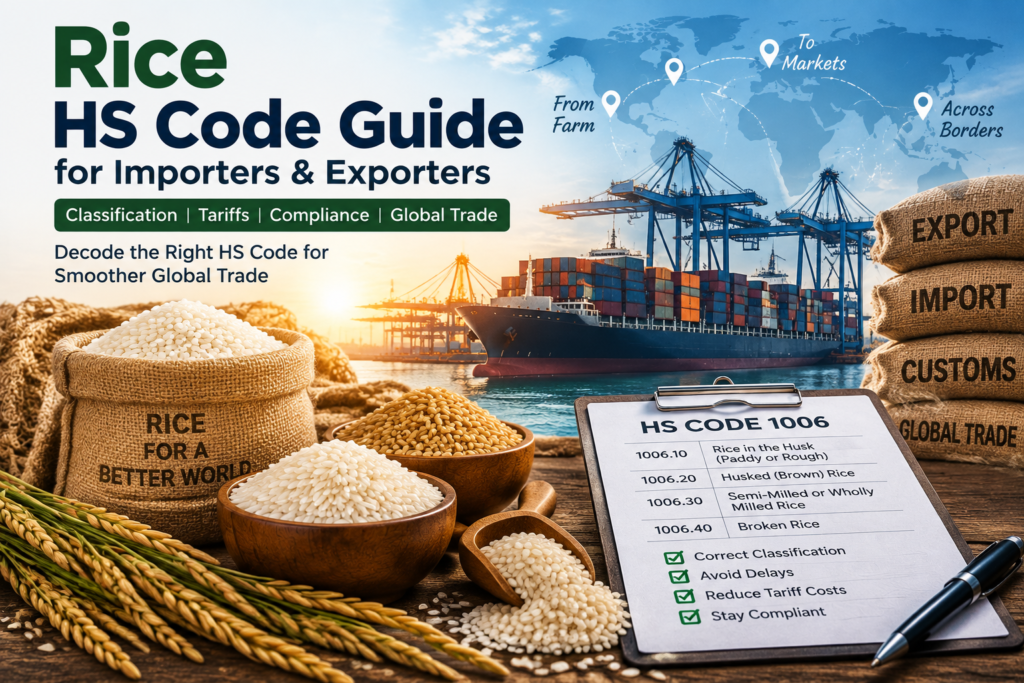
When a container of basmati rice arrives at a port, customs officials don’t search through the shipment to understand what they’re clearing. Instead, they look at a single six-digit number: the HS code. This number determines whether your shipment faces a 5% tariff or a 35% tariff, whether it qualifies for trade agreement benefits, and whether it requires additional documentation or holds. For rice importers and exporters, understanding the Harmonized System (HS) code isn’t optional—it’s the difference between a smooth transaction and a costly delay.
This guide explains what HS codes are, how rice is classified within the international system, and how to use this knowledge to streamline imports and exports while remaining compliant with customs regulations.
What Is an HS Code?
The Harmonized System (HS) is a standardized nomenclature developed and maintained by the World Customs Organization (WCO) to classify traded products. It came into effect in 1988 and is now used by over 200 WCO member countries and economies as the basis for their customs tariffs, international trade statistics, and regulatory compliance.
Every physical product crossing an international border is assigned an HS code. This code is not arbitrary—it flows from a logical system organized by economic activity and material composition. For example, HS code 1006.30 tells customs officials that they’re dealing with Chapter 10 (Cereals), heading 1006 (Rice), and subheading 1006.30 (Semi-milled or wholly milled rice, whether or not polished or glazed).
The significance of this classification extends far beyond paperwork. The HS code you assign determines the tariff rate applied to your shipment, whether your goods qualify for preferential trade agreement benefits, what documentation is required, and whether the product faces any import restrictions in the destination country. A misclassified shipment can face unexpected duties, customs holds, or even seizure.
Rice Classification in the HS System
Rice falls under Chapter 10 of the HS nomenclature—the chapter designated for cereals. The primary heading for all rice products is 1006. Within this heading, the system breaks down by processing stage and form, creating distinct categories that reflect different market uses and regulatory treatment.
The Main Rice HS Codes
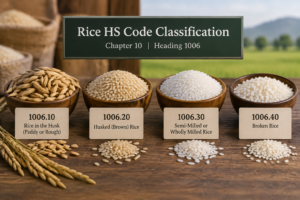
1006.10 — Rice in the Husk (Paddy or Rough)
This is rice as harvested, with the protective husk still intact. It’s primarily used by mills for further processing rather than direct consumption. Exporters of paddy rice are less common than exporters of milled varieties, but paddy serves an important role for importing countries that operate their own milling facilities. When transporting paddy, moisture management is critical to prevent fungal growth or grain degradation during ocean transit.
1006.20 — Husked (Brown) Rice
The husk has been removed, but the bran layer remains intact, retaining nutrients and a brownish color. Brown rice is popular in health-conscious markets and among consumers seeking higher fiber content. It requires careful handling and adequate ventilation during shipment to prevent moisture accumulation.
1006.30 — Semi-Milled or Wholly Milled Rice
This is the workhorse category for most international rice trade. The bran has been partially or completely removed, producing the white rice that dominates global commerce. This heading encompasses polished rice, parboiled rice, glazed rice, and aromatic varieties like basmati. The vast majority of Pakistan’s rice exports fall into this category, as do most retail rice products worldwide.
1006.40 — Broken Rice
These are fragments of rice grains separated during milling—pieces under 75% of whole grain length. Broken rice typically faces lower tariffs than whole grain rice and is often repurposed for animal feed, rice flour production, or industrial uses. Only 100% broken rice uses this code; rice with some whole grains mixed in remains classified as 1006.30.
Why HS Code Classification Matters
Tariff Rates and Duty Assessment
Different HS codes face different tariff rates. The difference between 1006.30 (milled rice) and 1006.40 (broken rice) can mean the difference between a 10% duty and a 3% duty in many markets. For large shipments, this translates to thousands of dollars in additional costs if the wrong code is used. The tariff rate depends on the importing country—the EU, USA, China, and India all have different duty structures—so exporters must verify rates for their specific destination before shipment.
Trade Agreement Benefits
Countries negotiate free trade agreements that grant preferential tariff rates to qualifying goods. If rice is correctly classified and meets rules of origin requirements, it may enter under a zero tariff rate instead of the standard rate. Misclassification disqualifies the shipment from these benefits, and recovering the difference after the fact is difficult.
Regulatory Compliance and Documentation
Certain rice varieties and processing types trigger specific documentation requirements. For instance, basmati rice in EU markets must meet specific geographical indication standards and quality criteria. Using the correct HS code ensures that customs authorities apply the right regulatory scrutiny—using the wrong code can result in requests for additional certifications or, worse, shipment detention.
Country-Specific HS Code Extensions
The six-digit HS code is the international standard, but individual countries are permitted to extend these codes with additional digits to create more specific classifications. These extensions allow countries to differentiate between product varieties, broken percentages, or other characteristics relevant to their trade policies.
Pakistan’s Rice HS Codes
Pakistan’s major rice exports use primarily two codes under the Pakistan Customs Tariff. HS code 1006.30 covers all white, parboiled, and steam-milled varieties with broken grain percentages from zero to 25%. HS code 1006.40 is reserved exclusively for 100% broken rice. Over 95% of Pakistan’s rice exports fall under 1006.30, making it the critical code for Pakistani exporters and their international buyers.
India’s HSN System
India uses an eight-digit HSN (Harmonized System Nomenclature) code. Basmati rice is classified under 10063010, while other milled rice falls under 10063090. This distinction is critical for GST purposes—basmati exports face 0% GST, while domestic basmati sales face 5% GST. For importers buying Indian rice, understanding this distinction is essential, as it affects pricing structure and documentation.
EU and USA Classifications
The EU uses 10063000 for rice imports but applies preferential tariffs to basmati rice on a recognized list (which includes Pakistani basmati varieties like 1121 and Super Kernel). Non-basmati long grain rice faces significantly higher duties. The USA uses 1006.30.2065 specifically for aromatic rice like basmati, with different duty rates than standard milled rice. China and Hong Kong apply the six-digit code 10063000 but impose duties ranging from 50-65%, though these can be reduced under FTA provisions.
Documentation and the Role of HS Codes
Your HS code classification must appear on several critical trade documents. The commercial invoice, packing list, bill of lading, and goods declaration all reference the appropriate HS code. When exporting from Pakistan, the Goods Declaration (GD) filed through the WEBOC (Web Based One Customs) system requires accurate HS code entry. Importing countries use this code to verify that documentation matches the physical shipment.
- Commercial Invoice: Quotes the HS code, unit price, and total value
- Packing List: References the HS code for each product line being shipped
- Bill of Lading: May include HS code information for customs pre-clearance
- Goods Declaration (Pakistan WEBOC): Requires the exact HS code for customs clearance
- Certificate of Origin: Often references the HS code to prove eligibility for preferential trade rates
Common Classification Mistakes and How to Avoid Them
Misclassifying Broken Rice
Rice with 20% broken grain content should be classified under 1006.30, not 1006.40. The 1006.40 code applies only to 100% broken rice. Using 1006.40 for partially broken shipments can delay clearance and expose you to duty disputes.
Confusing Basmati and Non-Basmati Codes
In countries that distinguish basmati from non-basmati (India, EU), using the wrong code costs money. EU import duties for basmati are typically zero or reduced; non-basmati faces EUR 175/MT tariffs in some cases. Correct classification directly impacts profitability.
Using the Wrong Processing Stage
Milled rice should not be classified as brown rice (1006.20), and brown rice should not be classified as paddy (1006.10). Using the wrong processing stage code creates documentation mismatches that customs can challenge.
How to Determine the Correct HS Code for Your Shipment
Step 1: Identify the Rice Form
Is your rice paddy (unhusked), brown (husked, bran intact), milled (bran removed), or broken? This is the primary determinant. Milled rice is by far the most common export form.
Step 2: Check Your Destination Country’s Tariff Schedule
Visit the customs authority’s official tariff database for your importing country. Search for 1006, then examine the notes and any country-specific extensions. Some countries have detailed notes explaining when basmati codes apply.
Step 3: Verify with Your Logistics Partner
Freight forwarders and customs brokers maintain updated tariff databases and can provide definitive guidance. When in doubt, consulting a professional is far cheaper than facing customs disputes.
Step 4: Document Your Classification Rationale
Keep records of why you chose a particular HS code. If customs challenges your classification, having documentation showing your diligence strengthens your position.
HS Codes and Broader Trade Compliance
HS codes are the foundation of international trade documentation, but they work alongside other requirements. A correct HS code doesn’t guarantee smooth clearance if you’re missing phytosanitary certificates, quality certifications, or origin documentation. Exporters should view HS code classification as one critical component of a comprehensive compliance strategy.
Frequently Asked Questions
Can I use the same HS code for rice exports to different countries?
The six-digit base code (e.g., 1006.30) is standard, but countries may apply additional extensions or apply different duty rates. Always verify the specific importing country’s tariff schedule. A basmati shipment to the EU faces zero duty, but the same shipment to China faces 65% duty (before FTA reductions). Ensure your documentation reflects the actual destination country’s code.
What happens if I use the wrong HS code?
Customs can assess additional duties retroactively, delay clearance pending reclassification, or, in severe cases, seize the shipment. The financial impact ranges from unexpected tariff costs to significant demurrage charges (port storage fees) while the shipment is held. The best approach is to get the classification right from the start.
Does rice in bulk containers get a different HS code than packaged rice?
No. HS codes classify the product itself, not its packaging. Whether rice is shipped in bulk containers, 50-kilogram bags, or retail boxes, the HS code remains the same. Packaging affects presentation and consumer marketing, but not customs classification.
Are there HS codes for rice flour or rice bran?
Yes. Rice flour falls under HS code 1102.90, while rice bran has its own classification. These are distinct from whole grain rice codes and face different tariff treatments. If you’re processing or selling rice derivatives, verify the correct classification for your specific product.
How often do HS codes change?
The WCO updates the HS nomenclature every 6 years, with the most recent revision in 2022. However, changes to rice codes (1006.XX) are rare. More common are changes to country-specific duty rates or the addition of preferential trade provisions. Subscribe to your country’s customs authority updates to stay informed.
Getting HS Codes Right
HS code classification is not a detail—it’s a fundamental requirement that ripples through your entire supply chain. Correct classification ensures predictable duty costs, faster customs clearance, and access to preferential trade rates. Incorrect classification creates delays, unexpected expenses, and compliance risk.
Whether you’re exporting basmati from Pakistan to Europe or importing broken rice to Asia, taking time to verify the correct HS code is an investment that pays immediate dividends. The few minutes spent on classification accuracy can save thousands of dollars and weeks of logistics delays.
Managing rice imports or exports? Understanding HS codes is just one piece of compliance. Saremco Impex Private Limited specializes in Pakistani rice exports and understands the nuances of HS code classification across different markets. Contact the team to discuss how accurate classification and proper documentation can streamline your rice trade operations.
https://saremcoimpex.com
info@saremcoimpex.com