Basmati Long Grain Rice from Pakistan: Export Quality and Buying Guide
Search for basmati long grain rice from Pakistan exporters’ supply, and you will find dozens of near-identical offers: “premium,” “extra long,” “aged.” The real differences sit in the specifications: raw grain length, how far the grain stretches when cooked, broken percentage, moisture, and the paperwork that travels with the container. This guide explains what those terms mean and how to compare quotations. It also covers how to confirm that a shipment of Pakistani basmati is what the contract says it is.
What Makes Pakistani Basmati “Long Grain” in Practice
Basmati is a long, slender, aromatic rice grown in the Indo-Gangetic plains. The Trade Development Authority of Pakistan (TDAP) publishes a Book of Specifications for Basmati that defines the minimum characteristics for rice sold under the name. These include:
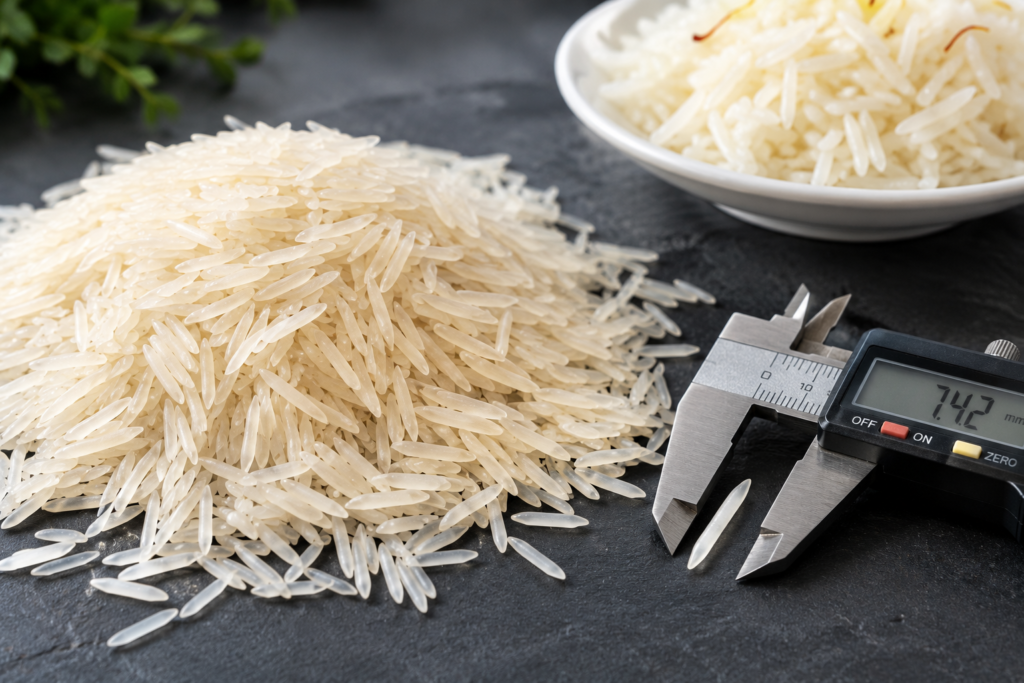
- a pre-cooked milled grain length of at least 6.50 mm
- an average grain breadth of 1.9 mm or less
- a length-to-breadth ratio of at least 3.5
- non-sticky cooked grains with a minimum average cooked length of 12 mm
- a minimum cooking elongation ratio of 1.70
Those figures are the floor. Commercial “long grain” basmati usually sits well above them, and the gap is where price tiers are made.
Aroma matters as much as length. The fragrance is attributed mainly to a compound called 2-acetyl-1-pyrroline (2AP), and it fades with poor storage or very old stock. A buyer evaluating a sample should therefore check three things together:
- the raw grain, for length and translucency
- the cooked grain, for elongation and separation
- the aroma, for freshness
A rice that looks long but cooks sticky or smells flat will disappoint, however good the photograph was.
Basmati Varieties Exported from Pakistan
Pakistan registers its basmati varieties under the Seeds Act, and each must trace back to a traditional basmati parent such as Basmati 370. The registered list includes Super Basmati and PK 1121 aromatic, among others. For importers, the practical choices usually come down to a few trade categories:
- Super Kernel Basmati. The long-grain workhorse of Pakistani basmati exports. It is a strong fit for retail packs, restaurants and biryani production where aroma and clean cooking matter, with a more accessible price point than the longest grades.
- 1121 extra long grain. The longest-grain tier. Buyers choose it when visual impact on the plate and high elongation drive the sale.
- Steam and Sella (parboiled) basmati. The same grain families, parboiled before milling. The result is firmer, more forgiving in large-batch cooking and generally more tolerant of long supply chains. Foodservice and catering buyers often prefer it.
The right choice depends on your channel. A supermarket private label and a catering wholesaler rarely want the same grain.
Quality Parameters Importers Should Specify
A purchase contract for basmati should name measurable parameters rather than adjectives. These are the ones that most often decide disputes.
Grain length and elongation. Specify minimum average raw length and the cooked length or elongation ratio if visual appearance matters in your market. Longer raw grain commands a higher price, but only if the lot is uniform. A few extra-long grains in a mixed lot do little for the buyer.
Broken grain percentage. Broken kernels lower the visual quality and cooking performance of the lot. Set a maximum percentage and agree on how it will be measured.
Moisture content. Moisture affects storage life and cooking texture, and it matters most for long sea voyages. Rice that leaves the mill too damp can develop mold in transit, and very dry rice breaks more easily. The TDAP specification notes that harvested paddy is dried to 12–14% moisture for storage. Agree on an upper limit with your supplier and have it confirmed in the pre-shipment test.
Purity and foreign matter. Stones, husk fragments, discolored grains and mixed varieties should all be addressed. Optical color sorting and de-stoning are standard at modern mills, and it is reasonable to ask what the supplier uses.
Age of the rice. Aged basmati generally cooks drier and more separate than new-crop rice. If your customers expect a particular cooking character, state whether you want new-crop or aged stock.
Variety authenticity. Mislabeling is a real risk in basmati trade, so ask how origin and variety are verified. The next section covers this.
Authenticity, Origin and Verification
“Basmati” is protected as a geographical indication in Pakistan under the Geographical Indications (Registration and Protection) Act 2020. According to the TDAP specification, the Trading Corporation of Pakistan is the designated authority that verifies that rice shipped for export is sourced from the defined geographical area and meets the basmati specification. It issues authenticity certificates for importing countries. Where an importing country asks for extra checks, samples can undergo DNA-based verification, which is notably the case for some exports to the European Union.
Pakistan’s basmati specification has also been submitted for geographical-indication protection in the EU. The EU Official Journal publication lists the characteristics and the varieties notified under the Seeds Act. If you import into Europe, it is worth reading before you finalize any contract.
For you as the buyer, this means authenticity can be documented. Ask every supplier which certificates accompany a shipment and which authority issues them, and do not accept “pure basmati” as a verbal assurance.
Choosing Between Raw, Steam and Sella
If you are new to basmati, the processing style is as important as the variety.
Raw (white) basmati is the traditional product, with the most delicate aroma and the most obvious “fluffy” finish. It suits retail and home-cooking markets. Steam basmati is lightly steamed before milling, giving a slightly cleaner, more uniform look. Sella basmati is fully parboiled in the paddy, which hardens the kernel and produces a golden grain that cooks firm and resists breakage. Many caterers and large biryani operators value that reliability over a delicate scent.
Neither is “better.” Match the style to your customer’s kitchen, not to the price list.
Packaging, Loading and Documents
Packaging depends on where the rice will be sold. Retail buyers often want consumer packs in the 1 kg to 5 kg range, while wholesalers commonly take larger sacks. Industrial buyers sometimes use bulk bags. Whatever the format, check:
- the bag material and its moisture protection
- the labeling language and the legal declarations required in your country
- whether private label printing is available and what minimum quantity applies
- how the container is loaded and whether the rice is protected from condensation
On paperwork, the standard set for a basmati shipment typically includes a commercial invoice, a packing list, a bill of lading, a certificate of origin and a phytosanitary certificate. The TDAP specification notes that Pakistan’s Department of Plant Protection issues phytosanitary certificates ensuring the goods meet the importing country’s plant-health measures. Depending on the destination, you may also need a certificate of analysis, a non-GMO declaration or other documents. Requirements differ by country and product, so confirm the exact list with your own import authority and with the exporter before ordering.
[SUGGESTED IMAGE 2]
Image generation prompt: Realistic, high-resolution commercial photograph inside a clean, well-lit rice packing warehouse in Pakistan. Pallets of plain white woven polypropylene rice sacks stacked neatly beside an open 40-foot shipping container, with two workers in hairnets, gloves and high-visibility vests checking a sack against a clipboard. Wide-angle composition from a slightly low perspective, bright natural light entering through the container door, clean concrete floor, realistic proportions. Plain unbranded sacks with no text, logos, labels, certification marks or watermarks.
ALT TEXT: Export preparation of Basmati long grain rice from Pakistan with sacks being loaded into a shipping container
How to Compare Supplier Quotations
Two quotes for “Pakistani basmati” can differ by a wide margin for good reasons. When you compare them, line them up on the same terms:
- Same variety and grade, stated by name and with a minimum raw length.
- Same tolerances for broken grain, moisture and foreign matter.
- Same crop and age, new-crop or aged.
- Same Incoterm, such as FOB, CFR or CIF, so that freight and insurance are not hidden in one price and missing from another.
- Same packaging, including bag type, net weight and labeling.
- Same inspection and documents, including who inspects the goods and who pays.
Always request a pre-shipment sample, cook it, and keep a sealed counter-sample. If a supplier will not provide either, treat that as information.
Where Saremco Impex Fits
Saremco Impex Private Limited is the international trading and export arm of Daa Group. On its official website, the company lists a rice division with two brands and a Pasrur rice mill in Punjab.
Its premium basmati range is sold as Daa Heritage Rice, which the site lists as Super Kernel Basmati, 1121 Kainat extra long grain, and 1121 Steam and Sella. The separate Daa Prime Rice brand covers non-basmati commercial grades, so buyers who need basmati should look at the Heritage range. According to the website, the company offers retail and bulk packaging from 1 kg to 50 kg, private label options, and documents including certificates of analysis, phytosanitary certificates, certificates of origin and non-GMO declarations on request. It also states that shipments are inspected before loading by third-party firms such as SGS or Intertek, and that the company is a member of the Rice Exporters Association of Pakistan.
As with any supplier, ask for current copies of certificates, test reports and specification sheets rather than relying on a website summary. For more on how basmati is graded before it reaches the container, see Saremco Impex’s guide on how basmati rice is graded for export markets.
Conclusion
When your search for basmati long grain rice Pakistan suppliers turns into a shortlist, the decision comes down to specifics. Decide the variety and processing style your market needs, write measurable tolerances into the contract, and ask how origin and quality are verified. Cook the sample before you place the order.
If you are planning an import and want specifications, packaging options or a quotation for Daa Heritage Rice, you can contact the Saremco Impex team through the Saremco Impex website. Tell them your target market, the variety you are considering, your expected order size and your preferred delivery terms so that they can respond with relevant details.