How to Start Importing Goods from Pakistan: A Practical Guide for First-Time Buyers
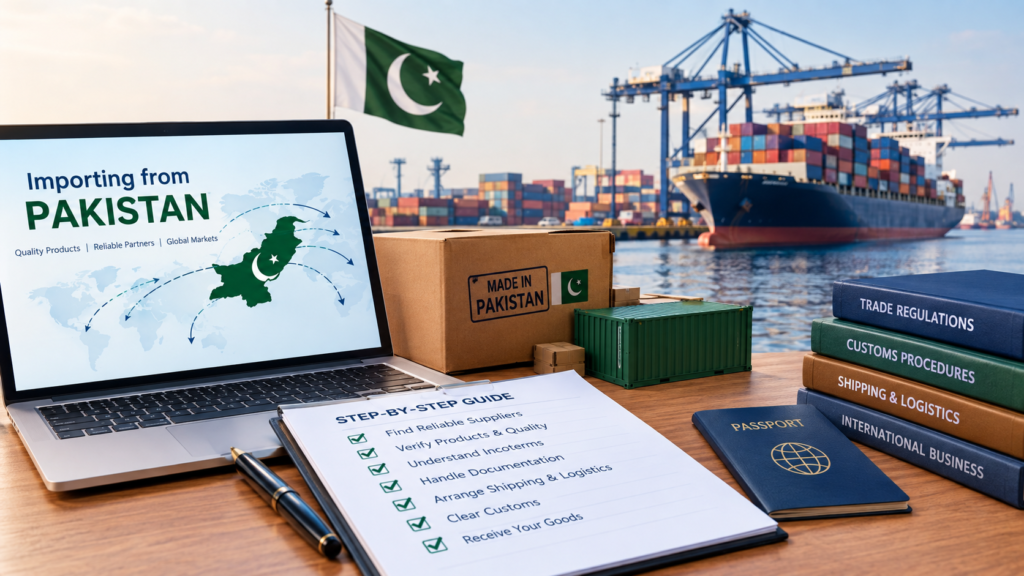
Most first-time importers don’t struggle to find a supplier. They struggle because they don’t know what to check, in what order, and which problems are cheap to fix early and expensive to fix after the container has sailed. If you plan to import from Pakistan, a few decisions made before your first purchase order will shape almost everything that follows.
This guide covers the practical sequence: choosing a product, understanding your own country’s rules, vetting suppliers, agreeing terms, and managing the shipment. It is written for buyers, distributors and procurement teams who are new to Pakistan as a sourcing country.
Start with the product, not the supplier.
It’s tempting to open a B2B marketplace and start messaging exporters. A better first step is to define exactly what you want to buy.
Pakistan’s export base is broad. It spans textiles and apparel, agricultural goods, minerals and stone, leather, and food products. Each category has different quality risks, documentation and import rules in your country. A cotton towel and a bag of edible rock salt have almost nothing in common once they reach a customs officer.
Before contacting anyone, write down:
- The exact product and grade you need (for example, edible fine-grain versus industrial coarse)
- The target specification, such as grain size, moisture limit, purity or fabric weight
- Packaging format and size (retail packs, 25 kg bags, bulk)
- Expected order size, first order and repeat orders
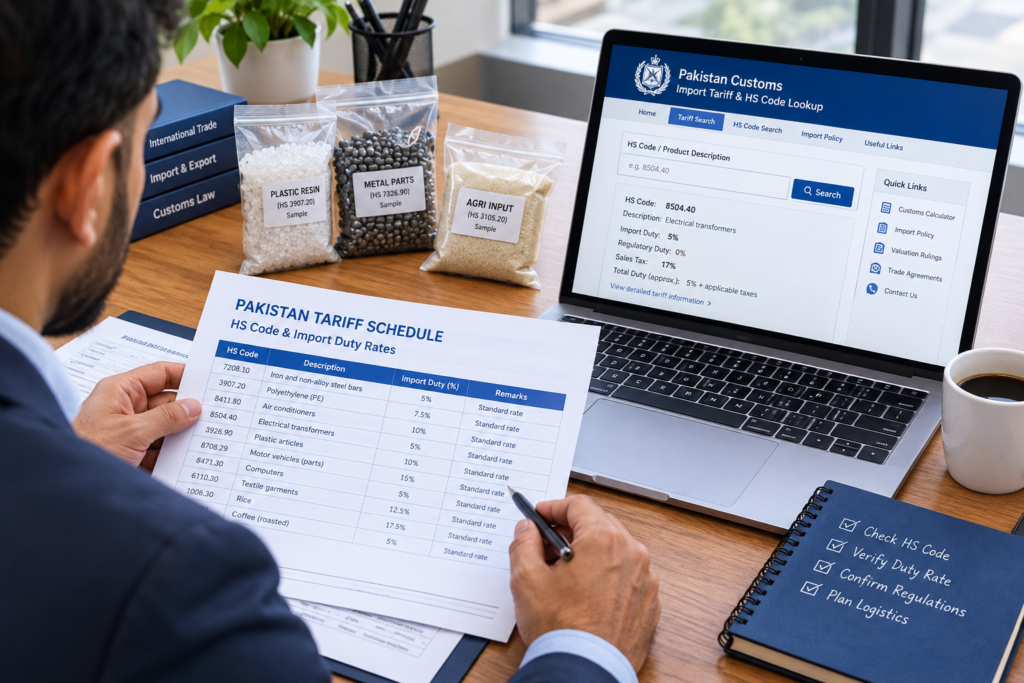
- The HS code your customs authority would apply to it
The HS code matters more than most beginners expect. It determines the duty rate, whether a licence or permit is needed, and whether any preferential trade arrangement applies. Get it wrong and your landed cost estimate is wrong too.
Learn your own country’s import rules first.
Pakistani exporters handle their side of the paperwork. Your side is your responsibility, and it varies by destination.
Importers into the EU can check tariffs, rules of origin, customs formalities and product requirements by HS code on the European Commission’s Access2Markets portal. Buyers elsewhere should look for the equivalent from their own customs authority. For food products, you will usually also need to look at food safety, labelling and sometimes pre-arrival notification rules. These are set by your national food regulator, not by Pakistan.
Tariff preferences are also worth checking. Pakistan has benefited from the EU’s GSP+ scheme for years. According to a September 2026 ProPakistani report, the current framework expires at the end of 2026, with a transition period expected to run to the end of 2028. The same report says continuation is not guaranteed. If your cost model depends on a duty preference, confirm its status for your product at the time you place the order, not just when you build the budget.
Understand how exports work on the Pakistani side.
You don’t need to run the export process, but knowing roughly how it works helps you judge whether a supplier is professional.
A Pakistani exporter generally needs a National Tax Number and registration with Pakistan Customs’ trade systems before shipping. The Trade Development Authority of Pakistan lays out the sequence in its step-by-step guide for new exporters, including company registration, tax registration and WeBOC registration. Customs declarations for exports now run through the Pakistan Single Window, a platform that lets traders file import, export and transit information through one entry point.
Exporters are also bound by foreign exchange rules. The State Bank of Pakistan’s foreign exchange manual for exports covers how export proceeds must be realised and how the Single Window fits into that process. For you as a buyer, the practical meaning is that a legitimate exporter works through banks and recorded customs declarations. A supplier who suggests avoiding either deserves suspicion.
Finding and vetting Pakistani suppliers
Directories, trade fairs, chambers of commerce, TDAP’s export promotion network and direct web searches are all legitimate routes. None of them replaces your own checking.
A reasonable vetting routine looks like this:
- Confirm the entity. Ask for the registered company name, address and tax registration, and check that the name on the invoice, bank account and website all match.
- Ask whether they are a manufacturer or a trader. Both can be fine, but the answer changes who controls quality.
- Request product specifications in writing. Phrases like “best quality” aren’t specifications.
- Ask for relevant certifications and test reports, then check that they cover the specific product you are buying and are current. Don’t assume a certificate on a website applies to your batch.
- Order samples. Test them against your specification, ideally at an independent lab if the product is food, a cosmetic ingredient or an industrial input.
- Get references you can contact, or at least a trading history you can verify independently.
Websites and directory listings show what a company says about itself. Treat them as a starting point.
Narrowing down: an example from rock salt and minerals
Take Himalayan salt, one of the better-known Pakistani exports. Buyers often assume all “pink salt” is interchangeable. It isn’t. Edible fine salt for retail packaging, coarse salt for grinders, industrial-grade salt, and decorative products like lamps differ in processing, packaging, testing and import classification.
On its homepage, Saremco Impex Private Limited describes itself as a supplier and manufacturer of Himalayan rock salt products, with edible pink salt among its exports. It also lists an agriculture division covering spices and herbs, and a mines and minerals division. A buyer comparing suppliers in any of these categories should ask the same questions: which grades are offered, which can be sampled, what packaging formats exist, and which test documents can be supplied with each shipment.
Agreeing terms before you pay anything
Once a supplier passes your checks, put the commercial terms in writing. At minimum, a purchase contract or proforma invoice should cover:
- Product description, specification and tolerance limits
- Quantity, unit price, currency and total value
- Packaging, labelling and marking requirements
- The Incoterm, such as FOB or CIF, which sets who pays for and carries risk on each leg of transport
- Payment method and timing
- Production and shipment dates
- Required documents
- What happens if the goods don’t match the agreement
Payment deserves particular care on a first order. A letter of credit gives both sides some protection but costs more and demands exact document compliance. Telegraphic transfer is simpler but puts more trust in the supplier. Many importers split payment, with a deposit before production and the balance against shipping documents, though what works depends on the order size and the relationship. Whatever you choose, pay only into an account in the company’s registered name.
Documents to expect
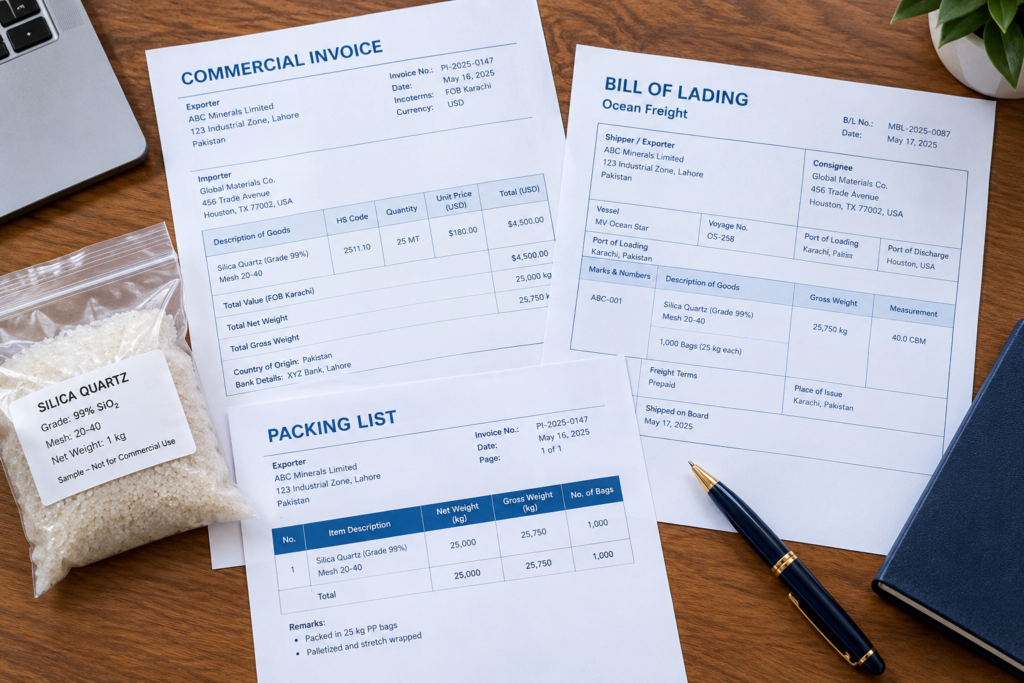
The exact set depends on the product and destination, but most shipments involve some combination of:
- Commercial invoice and packing list
- Bill of lading (sea) or air waybill (air)
- Certificate of origin, which may be needed to claim a tariff preference
- Quality, analysis or inspection certificates, where relevant to the product
- Phytosanitary, health or other regulatory certificates for agricultural and food goods
Ask your customs broker in advance which of these your authority requires for your HS code, then tell the supplier early. Missing paperwork is a common cause of delays at the border, and it is usually avoidable.
Quality control: where problems actually happen
Problems usually appear when a supplier moves from a well-made sample to full production. Three habits reduce that risk.
First, keep an approved sample sealed and retained as your reference. Second, arrange pre-shipment inspection by an independent inspector, particularly for first orders, so the goods are checked against the contract before payment of the balance. Third, write acceptance criteria and remedies into the contract so that a failed batch has a defined consequence.
Shipping and logistics
For bulk goods, sea freight from Karachi is the usual route, while smaller or urgent consignments often go by air. Work with a freight forwarder or customs broker at your destination who has handled similar products. Ask them to quote the full landed cost: freight, insurance, duty, taxes, port charges and inland delivery. Lead times vary by product, season and port conditions, so build in a buffer rather than relying on a supplier’s best-case estimate.
A sensible way to start
Begin small. A modest first order with sample testing, inspection and a clean document trail teaches you more than a large order placed on trust. If the supplier performs, scale up and consider a framework agreement for repeat orders.
If you are considering Himalayan salt, spices and herbs or minerals from Pakistan, you can learn more about Saremco Impex Private Limited and its product divisions on the company website and get in touch with your requirements from there.
Frequently Asked Questions
Do I need a licence to import from Pakistan?
That depends on your country and product, not on Pakistan. Check your customs authority’s requirements for your HS code, including any permits for food, plant or animal products.
What is the safest payment method for a first order?
There is no single answer. A letter of credit offers more protection but is costlier and document-sensitive. Telegraphic transfer is faster but relies more on trust. Many first-time buyers use a staged payment and always pay into the supplier’s registered business account.
How do I confirm a Pakistani supplier is genuine?
Match the company name across its registration, invoice and bank account, request verifiable references, order and test samples, and consider a pre-shipment inspection for early orders.
What is an HS code and why does it matter?
It is the international product classification used by customs. It determines duty rates, regulatory requirements and whether trade preferences apply to your goods.
Can I get duty-free access when importing from Pakistan?
Some destinations offer preferences, such as the EU’s GSP+ scheme, but eligibility is product-specific, and the scheme’s terms are changing. Check the current status for your HS code before pricing your order.