Industrial Salt Uses: De-Icing, Water Softening & More
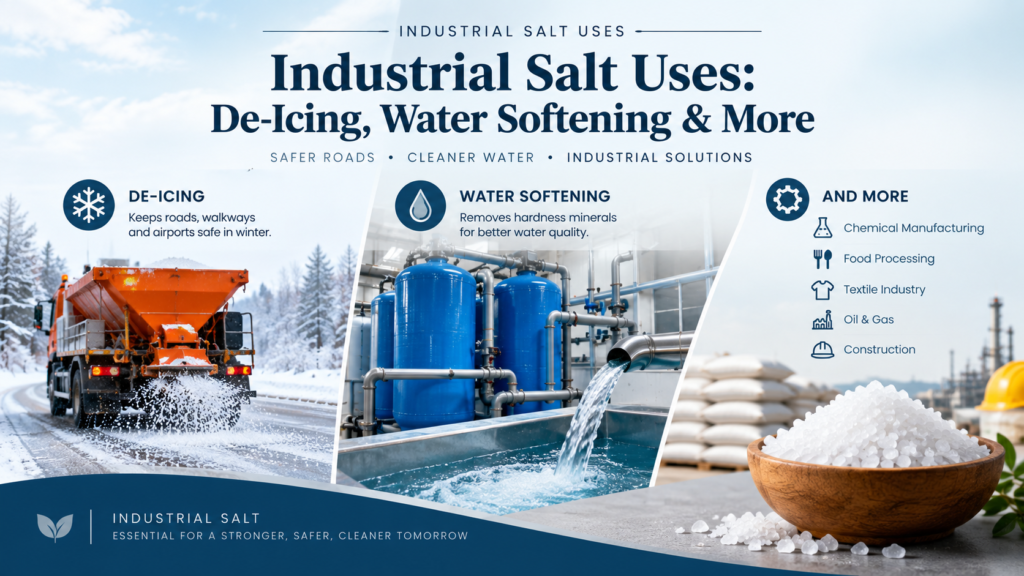
Salt is one of the cheapest commodities a plant manager or municipal buyer will ever order. It is also easy to order wrongly, because “industrial salt” is not one product. The same sodium chloride can be a coarse, off-white rock salt for icy roads, a clean granular grade for a resin softener, or a brine feedstock for a chemical plant. Each use puts different demands on purity, grain size, and packaging.
Below is a practical rundown of the main industrial salt uses and what each one means for a buyer or importer.
Where industrial salt actually goes
The U.S. Geological Survey’s 2026 salt summary gives a good picture of a mature market. In the United States, the chemical industry accounted for roughly 42% of salt sales, mostly as brine feeding chlorine and caustic soda production. Highway de-icing took about 37%. The rest was split among agriculture, food processing, general industry, water treatment, and distributors.
Those figures describe one country, and Pakistan’s mix will differ. Still, they show the two demand poles: bulk, price-sensitive volume (roads, chemical feedstock) and smaller, specification-sensitive volume (water treatment, food, specialty processing). Most suppliers sit closer to one pole than the other, and it helps to know which one you’re buying from.
De-icing: cheap, coarse and seasonal
Salt melts ice by lowering the freezing point of water. It dissolves into a brine, and that brine keeps melting more ice around it. A saturated sodium chloride solution stays liquid down to roughly −21°C, according to a transportation research report on deicing agents. In practice, plain salt loses much of its punch well before that point, which is why cold-climate road authorities often use blends or other chlorides.
For buyers, de-icing salt is mostly about consistency at volume:
- Purity is not the priority. The FHWA anti-icing manual notes that mined rock salt typically carries 1–4% impurities such as gypsum, shale, and quartz. That is acceptable for roads.
- Gradation matters. Particles that are too fine blow or wash off the surface. Particles that are too coarse melt slowly. The same FHWA source points to ASTM D 632 as the specification used for highway ice-control salt in the U.S. Check which standard your destination market or tender document actually requires.
- Moisture and caking. Salt that has clumped in storage won’t spread properly. Ask about moisture limits and how the product is packed for a long sea voyage.
- Demand is weather-driven. A mild winter can leave stockpiles unused, while a harsh one empties them. Order timing and lead time deserve as much attention as price.
There is also an environmental side. Chloride doesn’t break down or bind to soil, so it moves readily into groundwater and streams, as the Minnesota Stormwater Manual explains. That is why some municipalities cap application rates or require specific products. A supplier’s grade may be technically fine and still not fit local rules.

Water softening: where purity earns its price
Hard water carries dissolved calcium and magnesium, which the USGS defines as the basis of water hardness. Salt-based softeners trade those ions for sodium or, in some systems, potassium. Once the resin is saturated, the unit flushes itself with a strong salt brine and starts over. The EPA’s water softener tech sheet describes the exchange and regeneration cycle.
That process changes what a buyer should ask for. Softener salt sits in a brine tank and dissolves over months. Anything that doesn’t dissolve, such as clay, sand, or other insolubles, collects at the bottom and can foul the system. So water-softening grades are usually judged on:
- sodium chloride content
- insoluble matter
- particle or pellet form (granular, crystal or compressed)
- moisture and how well the salt keeps its shape in storage
Bags for this segment are typically small enough for one person to lift (25 kg is common), so handling and shelf storage count as much as the chemistry. Distributors serving the residential market should also confirm what regulations or standards apply in the importing country. Requirements differ, and a supplier’s spec sheet won’t answer that for you.
Chemical processing, textiles, leather and more
Away from roads and softeners, salt shows up in several industries:
- Chlor-alkali production. Salt is split into chlorine and caustic soda, which feed PVC, paper pulping and many other products. USGS lists this as the largest single use in its U.S. data.
- Textile dyeing. Salt helps dyes attach to fibre in certain processes.
- Leather and hide curing. Salt draws moisture out of hides and slows spoilage.
- Oil and gas drilling. Brine is used in drilling fluids.
- Detergents and soap. Salt works as a filler and helps with viscosity.
Each of these buyers will send you a specification, and the spec, not the product name, is what you should quote against. Words like “industrial grade” or “chemical grade” mean different things at different companies.
What to ask a supplier before you order
Whatever the use, these questions save time:
- What is the NaCl percentage, and how is it tested? Ask for a recent lab report on the specific lot, not a brochure figure.
- What are the insolubles and moisture levels? These decide whether a grade works for softeners or processing.
- What grain size or gradation is available? Ask for the range and how consistent it is between shipments.
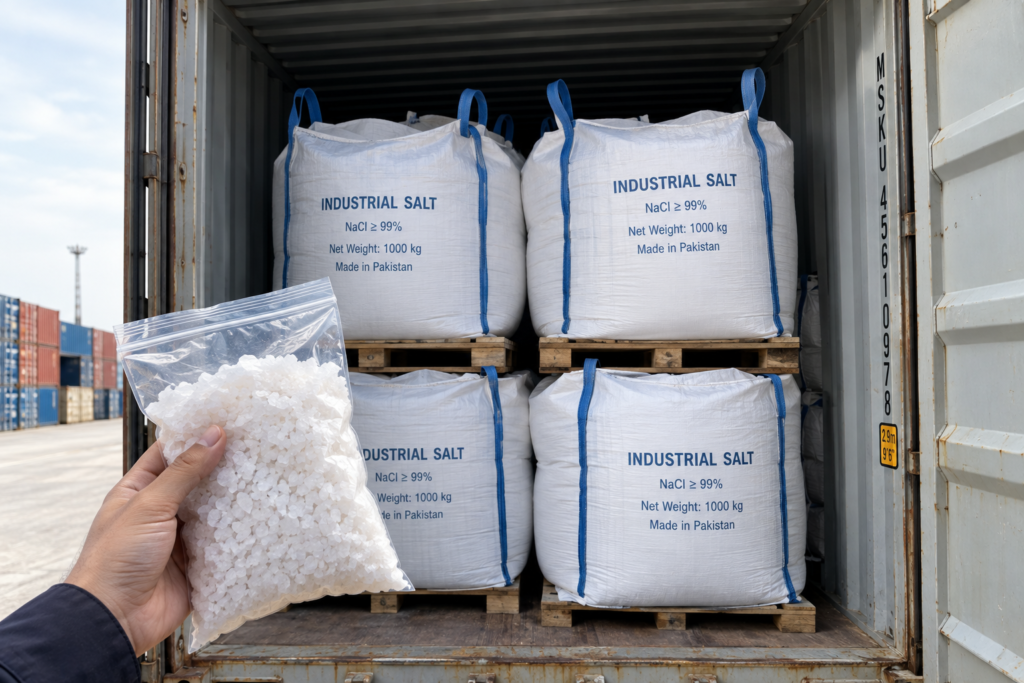
- How is it packed? Woven polypropylene bags, jute sacks, and one-tonne bulk bags all behave differently in humid ports. Ask whether liners or moisture barriers are used.
- What documents come with the shipment? A certificate of origin and bill of lading are standard. Ask whether a certificate of analysis is included.
- What are the container loading, lead time, and port options? Salt is heavy and cheap so that freight can outweigh product cost.
- Can you send a sample first? For anything above a trial order, a sample tested against your spec is a cost-effective way to protect yourself.
Sourcing industrial salt from Pakistan
Pakistan sits on one of the world’s major salt deposits in the Salt Range, and its exporters mostly ship pink Himalayan salt, along with rock and white grades. Saremco Impex lists de-icing, chemical and water-softening bulk grades among its salt offerings. The company’s website also describes a processing and packing facility at Pind Dadan Khan and packaging options that include woven bags, jute sacks and one-tonne bulk totes. As with any supplier, buyers should get the exact grade specification and test reports for their intended use in writing.
Frequently asked questions
Is industrial salt the same as table salt?
Chemically, both are mostly sodium chloride. What differs is purity, processing, and permitted use. Industrial grades are not intended for eating unless the supplier specifically sells and certifies them as food grade.
Can I use de-icing salt in a water softener?
Generally no. De-icing salt is coarser and carries more insolubles, which can build up in the brine tank and affect the resin. Use a grade sold for softeners.
Is rock salt or evaporated salt better for water softening?
Evaporated and solar salts are usually cleaner. Rock salt costs less but leaves more residue. The right choice depends on your equipment maker’s guidance and how often you can clean the tank.
What salt is used to make chlorine?
Mostly salt dissolved into brine, according to the USGS summary above. Chemical plants often buy or produce it as brine rather than dry salt.
What should I look for in a bulk salt quote?
The grade specification, NaCl and insolubles limits, packaging type, container quantity, Incoterm (the trade term that fixes who pays for what during shipping), port, lead time, and payment terms. A low price with no spec attached tells you little.
Choosing the right grade
The best industrial salt is the one that matches the job. A road authority and a water-treatment distributor can both buy sodium chloride, but they need different products and different paperwork. Define the use, write down the specification, test a sample, and compare suppliers against that document.
If you’re planning a salt purchase, you can contact Saremco Impex to discuss your grade, volume, and packaging requirements.
info@saremcoimpex.com