IRRI-6 vs IRRI-9 Rice: Uses, Quality Differences, and Export Markets Explained
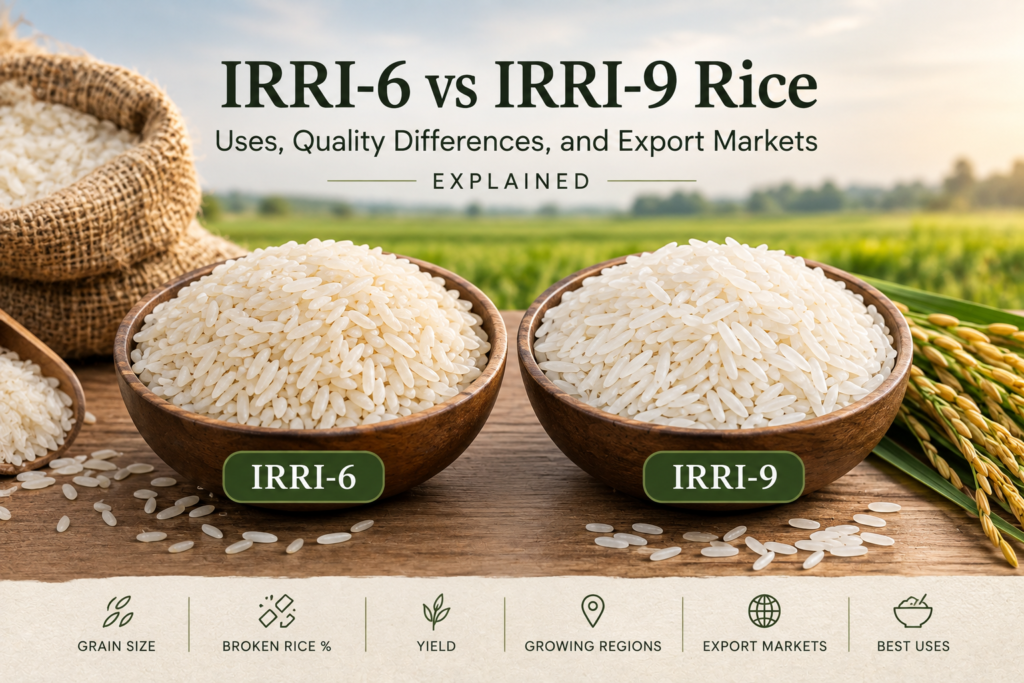
If you’ve spent any time sourcing rice from Pakistan, you’ve almost certainly run into these two names in the same breath: IRRI-6 and IRRI-9. Buyers often ask suppliers which one is “better,” but that’s the wrong question. The right one is which variety fits your market, your price point, and how your customers actually cook it.
Both are non-basmati, long-grain varieties bred from International Rice Research Institute (IRRI) lineage and grown mainly in Punjab and Sindh. They dominate Pakistan’s bulk rice exports precisely because they’re affordable, consistent, and available in volume — but they’re not interchangeable. This guide breaks down what separates IRRI-6 rice from IRRI-9, where each one performs best, and how to think about the choice if you’re placing an import order.
What Is IRRI-6 Rice?
IRRI-6 is a coarse, long-grain non-basmati rice variety widely cultivated across Sindh’s interior districts — Larkana, Dadu, Sukkur, Nawabshah, and Jacobabad — as well as parts of Punjab. It’s one of the highest-volume rice exports out of Pakistan, largely because it grows reliably in a range of weather conditions and delivers a strong yield per hectare, generally in the 4 to 4.5 tons range.
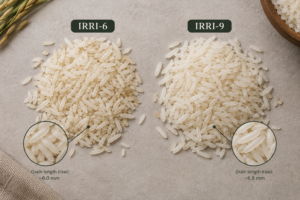
The grain itself runs around 6.0 mm raw, shorter than IRRI-9, and it typically carries a higher broken-rice percentage — anywhere from 5% up to 25% depending on the milling grade ordered. That’s not a defect; it’s simply how the variety is positioned. Buyers who need a low-cost staple rice for bulk institutional use, food aid programs, or everyday retail packs specifically ask for IRRI-6 because the price-per-ton math works in markets where fragrance and grain elongation matter less than availability and cost.
Typical Uses of IRRI-6
- Everyday household cooking in bulk-consumption markets
- Institutional catering, school feeding programs, and food-security stock
- Processed rice products (rice flour, parboiled rice, animal feed blends)
- Blending stock for private-label retail brands
What Is IRRI-9 Rice?
IRRI-9 is the fuller-bodied sibling. Its raw grain runs closer to 6.8 mm, similar in length to Pakistan’s fragrant non-basmati variety PK-386, though without the aroma. Cooked, it holds its shape better and gives a slightly more substantial bite than IRRI-6, which is why some buyers describe it as sitting in the gap between basmati and standard IRRI rice.
IRRI-9 also tends to have a lower broken-rice percentage, usually in the 5–10% range, and offers a yield of roughly 3.5 to 4 tons per hectare — a touch lower than IRRI-6, but with a more consistent grain profile. It’s grown extensively in central Punjab districts such as Gujranwala, Mandi Bahauddin, and Hafizabad.
Typical Uses of IRRI-9
- Food-service and catering programs where consistent grain appearance matters
- Retail packs in markets that want a “step up” from basic IRRI-6 without paying basmati prices
- Blended rice products where grain uniformity affects cooking time
IRRI-6 vs IRRI-9: Side-by-Side Comparison
| Feature | IRRI-6 | IRRI-9 |
| Raw grain length | ~6.0 mm | ~6.8 mm |
| Broken rice % | 5–25% (grade dependent) | 5–10% |
| Typical yield/hectare | 4–4.5 tons | 3.5–4 tons |
| Main growing regions | Sindh (Larkana, Sukkur, Dadu), parts of Punjab | Punjab (Gujranwala, Mandi Bahauddin, Hafizabad) |
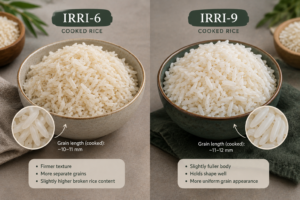
| Cooking texture | Firmer, more separate, higher broken content | Slightly fuller body, holds shape well |
| Price positioning | Lowest-cost long-grain non-basmati | Marginal premium over IRRI-6 |
| Strongest export demand | East & West Africa, Middle East, Bangladesh | Middle East, Kenya, Tanzania, Philippines |
Note that these are general industry characteristics rather than fixed figures — actual grain length, broken percentage, and yield vary by crop season, milling grade, and specific paddy lot, so always request a current lab specification sheet before finalizing a purchase.
Where Each Variety Sells Best
Export destination plays as big a role in variety selection as taste does. Based on established Pakistani rice trade patterns:
- IRRI-6 moves in the highest volumes to East and West African markets — Kenya, Tanzania, and neighboring countries where affordable, high-yield staple rice is the priority — along with steady demand from the Middle East and Bangladesh.
- IRRI-9 sees strong pull from the Middle East (including the UAE and Iraq), Kenya, Tanzania, and the Philippines, particularly from food-service buyers who want a fuller-bodied grain without paying for basmati.
For context on how Pakistan’s overall rice sector performs in these markets, the Pakistan Bureau of Statistics publishes trade data, and the Food and Agriculture Organization of the United Nations tracks global rice production trends by variety group, which is useful background if you’re benchmarking sourcing decisions against wider market movement.
How to Decide Which One to Buy
If you’re importing rice and trying to choose between the two, a few practical questions usually settle it:
- What’s your price ceiling? If margin is tight and volume matters more than grain appearance, IRRI-6 is generally the more economical choice.
- Does your customer base notice grain texture? Food-service operators and retailers targeting a slightly more discerning buyer often prefer IRRI-9’s fuller cook.
- What broken-rice tolerance does your market accept? Some markets are perfectly comfortable with a 25% broken IRRI-6 blend; others need the lower breakage of IRRI-9 or a specific sortex grade.
- Do you need parboiled or white rice? Both varieties are available in raw white and parboiled/sella form, and the processing method changes cooking behavior more than the variety name does.
Quality Checks That Matter More Than the Variety Name
Regardless of which grade you order, the variety name alone doesn’t guarantee consistency. What actually protects a buyer is the paperwork and testing behind the shipment: moisture content (usually capped at 12–13%), verified grain length and broken percentage from an independent lab, and pesticide residue testing where the destination market — the EU in particular — enforces strict maximum residue limits (MRLs). The European Commission’s EU Pesticides Database is a useful reference if you’re shipping into European ports and need to confirm current MRL thresholds before contracting.
Reputable exporters back every container with SGS, Intertek, or PCSIR pre-shipment inspection reports, along with a Certificate of Origin and phytosanitary certification. At Saremco Impex Private Limited, for instance, every export lot — including IRRI-6 & IRRI-9 non-basmati rice — is tested under ISO 9001:2015 and HACCP protocols before it leaves the Pasrur rice mill in Punjab, which is the kind of documentation worth asking for regardless of which supplier you work with.
Packaging and Shipment Formats
Both varieties are typically exported in a similar range of formats: 1kg to 50kg BOPP or non-woven sacks for retail and semi-wholesale buyers, and bulk jumbo totes or bagged FCL containers for larger institutional or wholesale contracts. Buyers running their own retail brand can usually arrange private-label bagging directly with the mill — worth raising early in the export process conversation, since packaging specs affect lead times.
Frequently Asked Questions
Is IRRI-6 the same as basmati rice?
No. IRRI-6 is a non-basmati long-grain variety. It lacks basmati’s characteristic aroma and grain elongation on cooking, and it’s priced and marketed as a separate category entirely.
Which is cheaper, IRRI-6 or IRRI-9?
IRRI-6 is generally the lower-cost option because of its higher broken-rice allowance and higher per-hectare yield. IRRI-9 usually carries a modest premium due to its longer grain and lower breakage.
Can IRRI-6 and IRRI-9 be blended in one shipment?
Some buyers do request blended lots for specific price points, though most export contracts specify one variety and grade to keep quality consistent and traceable on the lab report.
Which countries import the most IRRI-6 rice from Pakistan?
Historically, East and West African markets, parts of the Middle East, and Bangladesh have been among the largest buyers of Pakistani IRRI-6, based on established rice trade patterns — though country-level volumes shift year to year with harvest size and pricing.
Is IRRI-9 available in parboiled form?
Yes. Like IRRI-6, IRRI-9 is milled in both raw white and parboiled (sella) form depending on buyer specification.
Final Thoughts
Neither IRRI-6 nor IRRI-9 is the “better” rice in any absolute sense — they’re built for different jobs. IRRI-6 wins on price and volume; IRRI-9 wins on grain consistency and a slightly fuller cook. The right call comes down to your destination market, your customers’ cooking habits, and how much broken rice your buyers will tolerate at a given price point.
If you’re sourcing either variety for export, ask for a current lab spec sheet and inspection certificate before committing to a contract — the grade on paper matters more than the name on the invoice. You can review current specifications for both varieties on Saremco Impex’s rice catalog, or get in touch directly for a proforma quote and sample kit.