Pakistan Export Ports Explained: Karachi, Port Qasim and Gwadar for International Buyers
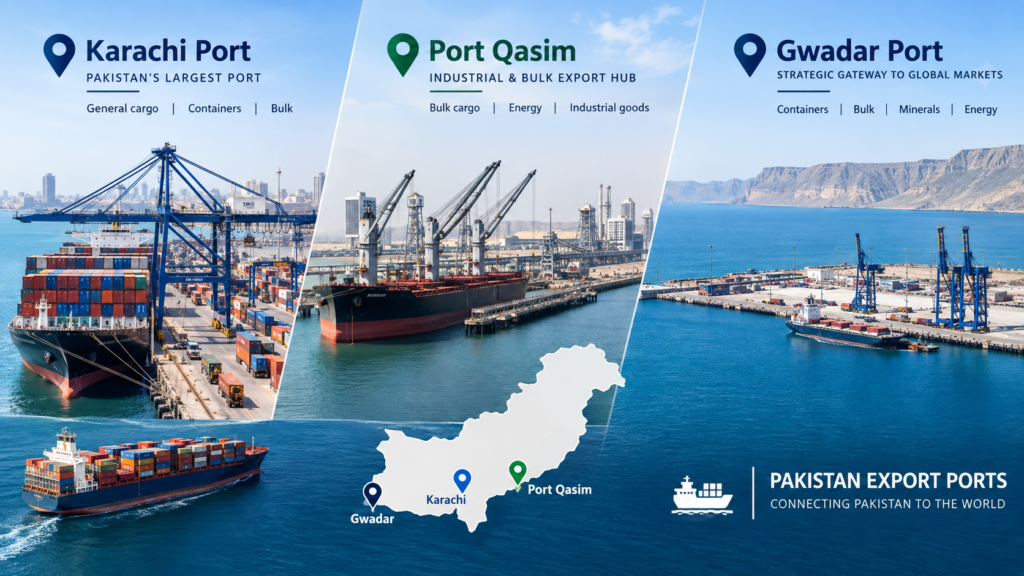
When a supplier in Pakistan quotes you “FOB Karachi” or “FOB Port Qasim,” that one word does more than name a place. It affects your freight options, your transit time, who handles your container at the terminal, and sometimes your final landed cost. Buyers who treat the port as an afterthought often discover the difference only when a booking falls through or a quote changes.
This guide explains how Pakistan’s three best-known seaports work from a buyer’s point of view, and how to decide which one belongs on your purchase order.
The short version: two ports in one city, one on a separate coast
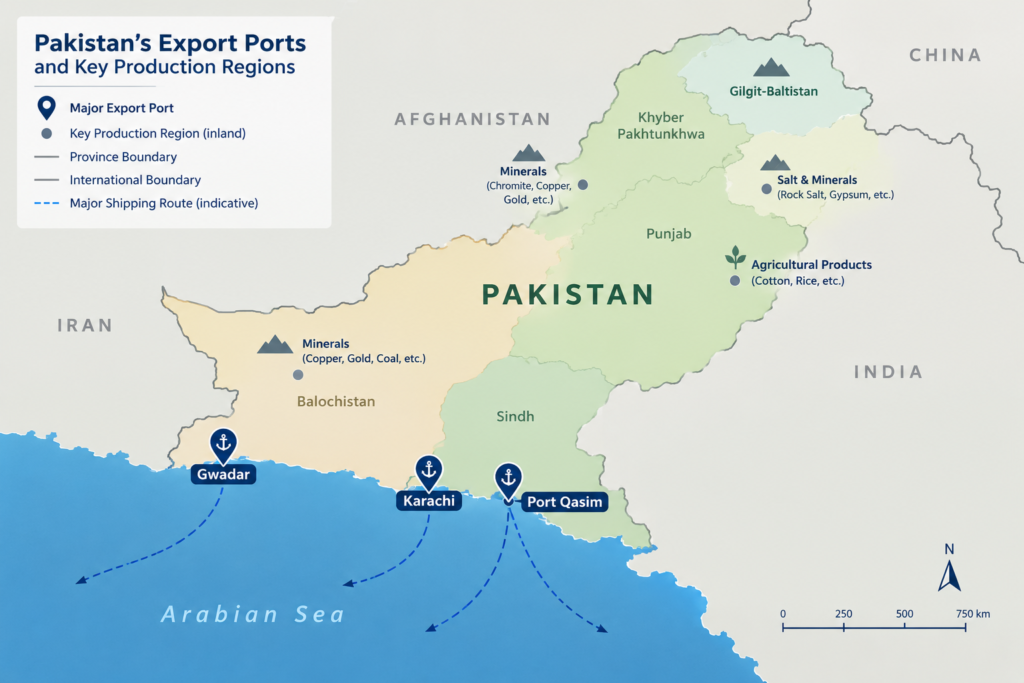
Karachi Port and Port Qasim both sit in the Karachi area on the Arabian Sea. Gwadar is a different proposition: a deep-water port in Balochistan, far to the west along the Makran coast. Karachi and Port Qasim carry the bulk of Pakistan’s established container and commodity trade. Gwadar is newer, and its role is still developing.
Most questions from first-time buyers about Pakistan’s export ports come down to a practical one. Will my shipping line, my forwarder and my supplier’s location all line up at the same terminal? Answer that, and the rest gets simpler.
Karachi Port
Karachi is Pakistan’s oldest and best-known commercial port and the default answer when a supplier doesn’t specify one. It is run by the Karachi Port Trust, while cargo handling and container operations are carried out by terminal operators on the port’s wharves.
For container buyers, the useful point is that Karachi has several container terminals, including KGTL on the East Wharf and KICT on the West Wharf. A June 2026 report in Business Recorder describes completed dredging that brought the navigational depth of the channel to 14 metres, with 15.5 metres alongside berths 6 to 17 at the East Wharf. In practice, deeper water allows bigger vessels to call with more reliability, which tends to matter for the choice of shipping line services. Depth figures vary between sources and change as dredging projects finish, so ask your forwarder for current terminal limits rather than relying on a number you found online.
Karachi suits you if you ship containerised goods on regular liner services, want the widest choice of shipping lines, or buy from a supplier who ships a mix of products. It is also the most commonly quoted port, which makes price comparison between suppliers easier.
Port Qasim
Port Qasim (Port Muhammad Bin Qasim) is a separate port with its own authority. According to the Port Qasim Authority’s facilities page, bulk, break-bulk and general cargo are handled at its multipurpose berths, and Qasim International Container Terminal (QICT) was the country’s first dedicated international container terminal built by the private sector. The port also has a liquid cargo terminal.
For container shippers, the Federal Board of Revenue’s description of the Port Qasim customs collectorate explains a distinction that matters in practice. QICT handles full container load (FCL) cargo, while the Qasim Freight Station deals with loose container load (LCL) cargo. If your order doesn’t fill a container, ask your forwarder how consolidation works at the port before you agree to a shipment date.
Port Qasim often makes sense for bulk commodities, industrial inputs and project cargo, and for buyers whose forwarder has a stronger presence there. Many suppliers use both Karachi and Port Qasim depending on vessel schedule, so the cheapest or fastest option can change from one booking to the next.
Gwadar Port
Gwadar is administered by the Gwadar Port Authority and sits on the Makran coast in Balochistan. For years it handled little commercial traffic compared with the Karachi ports. In 2026, that began to shift. Dawn reported in April that cargo ships carrying machinery, general goods and fertiliser had arrived there, and The Express Tribune reported rising transhipment interest as shipping lines looked for alternatives amid disruption in Gulf routes.
For an importer, the honest summary is this: Gwadar is worth watching, but it isn’t yet the default for regular containerised exports from Pakistan’s main production regions. Before planning a shipment through Gwadar, confirm that a direct shipping line service exists for your lane, how often vessels call, and what the inland trucking route looks like from your supplier’s location. Sudden spikes in activity driven by regional events can also fade, so treat news-driven volume as a signal to investigate rather than a guarantee.
How to choose between them
There isn’t a universally best port. These questions usually settle it:
- Where is the cargo made or stored? Inland trucking or rail cost and time from the factory to the port can outweigh small differences in port fees.
- Container or bulk? Container-heavy trade tends to centre on the Karachi terminals and QICT, while bulk and general cargo suit multipurpose berths.
- FCL or LCL? As noted above, the LCL process differs at Port Qasim.
- Which shipping lines serve your destination? The direct service to your region matters more than the port’s reputation.
- What is the Incoterm? Under FOB, you take over responsibility once the goods are loaded on the vessel at the named port, so naming the exact port and terminal in the contract avoids disputes.
What buyers should confirm with the supplier and forwarder
Port choice is only useful if everyone is working from the same assumptions. Before you pay a deposit, confirm:
- The port of loading named on the proforma invoice and sales contract
- Who books the vessel and who pays for terminal handling charges
- The cut-off dates for container delivery to the terminal
- Whether the supplier ships FCL or can consolidate LCL
- Which export documents will accompany the cargo
On the Pakistani side, export declarations are filed through the Pakistan Single Window, the government’s single entry point for import, export and transit filings. A supplier who files properly through this system and can explain their shipping process clearly is easier to work with than one who stays vague about the port and documents.
Port choice for specific products
Port choice matters more for some goods than others. Himalayan salt is a good example: the product is dense, usually shipped in sacks or cartons, and often loaded into containers. That makes careful loading, moisture protection and pallet planning more important than a few hours of difference in vessel schedule. Saremco Impex Private Limited, which lists Himalayan rock salt products and an agriculture division including spices and herbs on its website, is one example of an exporter whose buyers would need to settle these loading and shipping details with the supplier directly. Whichever product you buy, ask how it will be packed for the specific port and voyage, not only for the product itself.
Frequently Asked Questions
Which is the main port for exports from Pakistan?
Karachi Port is the best-known and most commonly used, with Port Qasim also handling a large share of container and bulk trade. Gwadar is smaller and still developing as a commercial port.
Is Port Qasim part of Karachi?
It lies in the Karachi area but is a separate port run by the Port Qasim Authority, with its own terminals and customs collectorate.
Can I ship LCL from Pakistan?
Yes, though the process depends on the port. At Port Qasim, for example, LCL cargo is handled through the Qasim Freight Station. Please ask your forwarder to confirm the consolidation schedules.
Should I ship through Gwadar?
Only if a direct shipping service and a workable inland route exist for your cargo, check current schedules before committing, as activity there has been changing quickly.
Who decides the port of loading?
Your sales contract does. Under FOB terms, the named port is where responsibility for the goods passes to you, so it should be specified clearly.
Choosing your port with confidence
Pakistan’s ports each serve a different purpose, and the right one depends on your product, shipment size and shipping line options rather than on reputation. If you’re sourcing Himalayan salt, spices or other products from Pakistan and want to discuss shipping arrangements for your order, you can reach Saremco Impex Private Limited through its company website.