Pakistan vs India Basmati Rice: What’s the Difference?
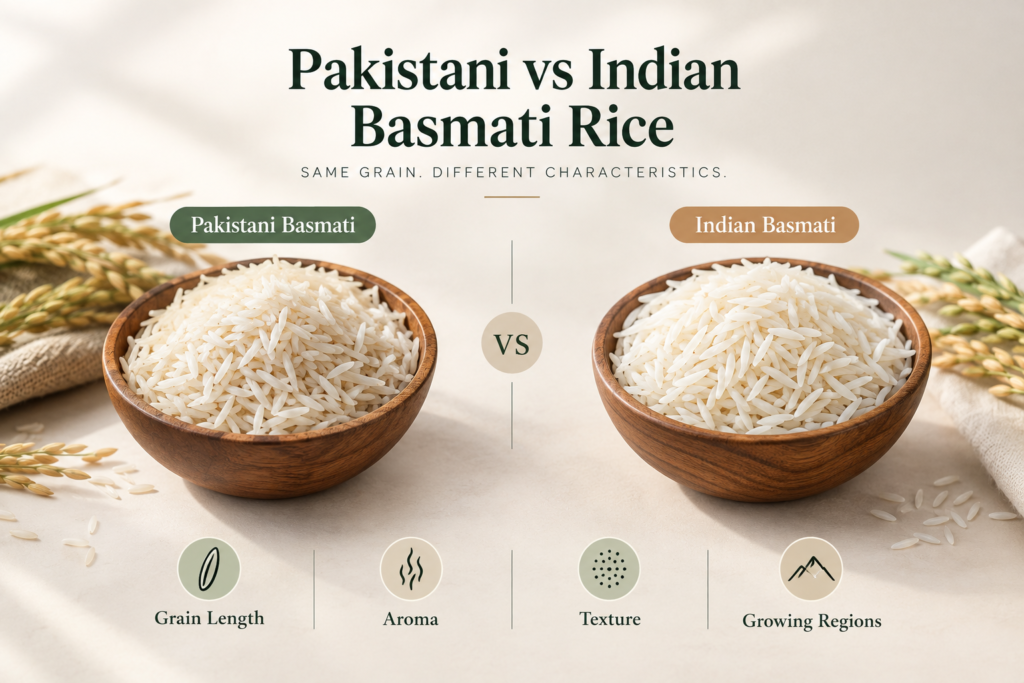
Basmati rice has captivated food lovers worldwide for centuries, but the rivalry between Pakistan and India’s varieties remains one of the most interesting discussions in the global rice trade. Both countries produce exceptional basmati rice, yet meaningful differences in aroma, grain characteristics, cultivation practices, and export standards set them apart in ways that matter to importers, retailers, and consumers.
If you’re evaluating basmati suppliers or comparing varieties for your business, understanding these distinctions helps ensure you’re sourcing the right product. This guide breaks down the real differences between Pakistani and Indian basmati rice, covering everything from geography and processing to certification and pricing.
The Origins and Geography of Basmati Production
Basmati is a specialty long-grain aromatic rice native to the Indian subcontinent, with cultivation concentrated in specific geographical regions. The name itself—derived from Sanskrit meaning “full of aroma”—reflects the distinctive fragrance these varieties develop under particular environmental conditions.
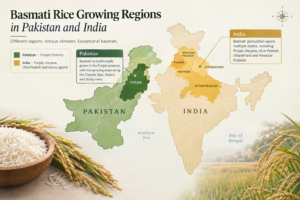
In Pakistan, basmati is traditionally grown in the Punjab province, with rice-growing areas along river valleys including the Chenab, Ravi, Jhelum, and Sutlej. The soil composition, humidity levels, and climate in these regions contribute to specific characteristics in the rice that develops there. According to the Trade Development Authority of Pakistan (TDAP), basmati rice grown throughout Pakistan’s designated geographical area shares consistent characteristics due to these environmental factors and approved cultivation methods.
India’s basmati production spans multiple states, including Punjab, Haryana, Uttar Pradesh, Uttarakhand, and Himachal Pradesh. The broader geographical spread means Indian basmati varieties experience varying climate and soil conditions, which has contributed to the development of multiple cultivated varieties with distinct profiles.
Physical Characteristics and Grain Quality
When examining basmati varieties from both countries, several physical characteristics distinguish them. These differences are measurable and impact both consumer satisfaction and commercial value.
Grain Length and Elongation
Both Pakistani and Indian basmati rice are prized for their exceptional length—some varieties can reach up to 20mm—but how they behave during cooking differs subtly. Research shows that quality basmati rice from both regions elongates by more than 75% during cooking, yielding grains with a length-to-width ratio greater than 3.5. The distinction lies in the consistency and uniformity of elongation across batches.
Indian basmati varieties, particularly popular types like Basmati 1121 and 1509, have been cultivated and refined through strict selection programs, resulting in more predictable elongation patterns. Pakistani Super Kernel basmati, the primary variety exported from Pakistan, also exhibits strong elongation but sometimes shows slightly more variability in grain size across commercial lots.
Aroma Profile
Aroma represents perhaps the most subjective yet important difference between the two sources. Both Pakistani and Indian basmati contain aromatic compounds, particularly 2-acetyl-1-pyrroline, which creates the characteristic fragrance when cooked. However, the intensity and nuance of aroma vary.
Pakistani basmati generally has a slightly different aroma profile compared to Indian varieties. Some international buyers report that Pakistani basmati has a more subtle, delicate aroma, while Indian basmati—particularly aged varieties—develops a more pronounced “popcorn” or sweet aromatic scent. The difference is subtle enough that blind tastings often yield mixed preferences, but it remains a significant consideration in premium restaurant and catering markets.
Aging significantly influences aroma development in both types. Freshly harvested basmati has minimal aroma, but rice aged for 6-12 months develops a more pronounced fragrance. Premium aged basmati commands a 10-20% price premium over new-crop rice due to superior aroma intensity.
Texture and Chalkiness
Both Pakistani and Indian basmati rice experience chalkiness, which appears as white centers or white bellies on grains—a characteristic that affects appearance and cooking texture. While some consumers perceive chalkiness as a flaw, it’s actually a common feature in both varieties and doesn’t necessarily indicate inferior quality. However, excessive chalkiness can cause grains to break during processing and cooking, resulting in economic loss due to increased broken-grain content.
Research shows that Pakistani basmati and Indian basmati can have similar levels of white-center grains, though percentages vary by harvest year, cultivation practices, and harvest timing. Rice harvested late in the season under wet and cool conditions tends toward higher chalkiness.
When cooked properly, quality basmati from both countries produces a dry, fluffy texture with distinct grains rather than a clumpy, starchy result.
Cultivation Practices and Growing Methods
While both Pakistan and India grow basmati using well-established practices, regional variations in farming methods and input use create differences in the final product.
Irrigation and Water Management
The river-fed irrigation systems in Pakistan’s Punjab provide consistent water availability, which basmati cultivation requires. Pakistan’s farmers utilize precision irrigation management to maintain optimal moisture levels throughout the growing season. This consistent approach produces rice with predictable characteristics.
India’s basmati-growing regions similarly depend on irrigation, though some areas receive supplementary rainfall. Irrigation techniques vary by state and individual farm, which contributes to greater variability in final product characteristics across different Indian-grown batches.
Farming Intensity and Yield
Basmati farming in both countries is notably less intensive than conventional rice production. Farmers generally use modest amounts of fertilizer compared to other crops, and field yields remain lower than non-basmati varieties—typically 2,000 to 2,500 lbs per acre. Despite lower yields, basmati commands premium prices in world markets, often selling for approximately twice the price of regular rice, making the crop economically viable.
Seed Varieties
India has developed a wider range of certified basmati varieties through research institutions, including selections like Basmati 1121, Basmati 1509, Pusa varieties, and Traditional Basmati 370. This diversity gives Indian suppliers greater flexibility to offer options across different quality and price points.
Pakistan focuses primarily on Super Kernel basmati and Basmati 370 varieties, with less varietal diversification in commercial production.
Export Standards and Quality Certification
This is where significant differences emerge between the two countries, particularly affecting international buyers and importers.
India’s Export Framework
India’s Agricultural and Processed Food Products Export Development Authority (APEDA) oversees strict quality standards for basmati exports. All basmati exported from India must be registered, tested, and traced through APEDA’s monitoring systems—standards that have been in place since APEDA obtained Geographical Indication (GI) status for Indian basmati in 2016.
These export controls provide baseline quality assurance to international buyers. Every shipment undergoes documentation and testing protocols before export approval. This regulatory framework gives Indian basmati a quality assurance advantage in markets like the European Union and North America.
Pakistan’s Export Standards
Pakistan established its own Geographical Indications Act in 2020 to protect basmati rice within its territory and internationally. The Trade Development Authority of Pakistan (TDAP) has published detailed specifications for basmati rice, covering approved varieties, quality parameters, and cultivation methods.
While Pakistan’s standards exist and are enforced domestically, the export verification and traceability systems differ from India’s structure. Pakistani basmati exporters must comply with international food safety standards (like HACCP and ISO certifications), but the government-level monitoring resembles a different model than India’s APEDA system.
Market Access Implications
In European Union markets, basmati import standards and pesticide residue limits are particularly stringent. India’s APEDA-managed supply chains have adapted to meet these strict requirements over many years. Pakistan’s exports have been growing significantly—doubling from 120,000 to 300,000 metric tonnes over recent years—partly because some Pakistani rice avoids certain EU import restrictions that affect Indian shipments.
Pricing and Market Positioning
These quality and certification differences translate into market pricing that fluctuates based on global supply, demand, and trade conditions.
Pakistani basmati typically costs 5-15% less than equivalent Indian varieties when purchased at comparable volumes and quality grades. This price differential reflects several factors: slightly lower certification costs, less stringent export verification requirements, and market positioning in price-conscious segments.
Indian basmati commands higher prices due to strict export certification standards, established brand recognition in premium markets, wider variety selection, and customer preference in high-end restaurants and specialty food markets.
For bulk purchasers and importers, the price difference becomes significant at volume levels, though quality differences—rather than simply price—should drive the decision.
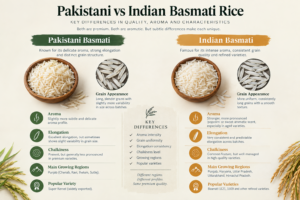
Key Differences Summary
| Aspect | Pakistan Basmati | India Basmati |
| Primary Variety | Super Kernel | 1121, 1509, Pusa, Traditional 370 |
| Growing Region | Punjab province | Punjab, Haryana, UP, Uttarakhand, HP |
| Aroma Profile | Subtle, delicate | More pronounced, develops with aging |
| Export Standards | TDAP specifications, international certifications | APEDA-managed GI system, strict traceability |
| Variety Selection | Limited | Wider range of certified options |
| Price Point | 5-15% lower than Indian equivalents | Premium positioning in global markets |
| EU Export Compliance | Growing market share, fewer restrictions | Facing stricter pesticide residue limits |
Choosing Between Pakistani and Indian Basmati
Your choice depends on specific requirements: budget constraints, destination market, end-use (restaurant, retail, bulk processing), preferred aroma intensity, and supply chain preferences.
Choose Pakistani basmati if: your business prioritizes cost efficiency, you serve price-conscious consumer segments, you need consistent supply without variety switching, or specific pesticide regulations don’t restrict your EU market access.
Choose Indian basmati if: your customer base demands premium quality branding, you operate in high-end restaurant or specialty retail segments, you require multiple variety options for different applications, or your markets require strict APEDA certification documentation.
For many importers, sourcing from both origins—using each strategically based on market segment—proves most effective. Some buyers maintain Pakistani basmati for value-oriented retail customers while stocking Indian premium varieties for restaurant and specialty segments.
Frequently Asked Questions
Q: Is Pakistani basmati rice inferior to Indian basmati?
No. Both produce excellent quality basmati rice meeting international standards. The differences are in aroma profile, certification structure, and price positioning rather than overall quality. Blind taste tests rarely show consistent preferences, indicating both are legitimately premium products.
Q: Why does Indian basmati cost more?
Indian basmati commands higher prices due to strict export certifications (APEDA system), established premium-market branding, wider variety selection, and dominant market share in high-end restaurant and specialty food markets. Price reflects positioning rather than inherent superiority.
Q: Which is better for restaurant use?
Indian basmati varieties like Basmati 1121 are popular in high-end restaurants due to predictable elongation, consistent grain separation, and proven flavor profiles. Pakistani Super Kernel performs excellently too, though restaurateurs may be less familiar with it. Testing both with your specific cooking methods is recommended.
Q: Does aging affect Pakistani and Indian basmati differently?
Aging improves both. The aroma compounds develop similarly in both varieties over 6-12 months of storage. Aged Pakistani and Indian basmati both command premium prices due to enhanced fragrance intensity.
Q: Can I mix Pakistani and Indian basmati in the same product?
Technically possible, but not recommended for premium applications. Mixed batches may lack uniformity in aroma, elongation, and appearance that consumers expect from basmati. Most suppliers maintain separate supply chains for each origin.
Q: What does “Super Kernel” mean in Pakistani basmati?
Super Kernel is a basmati variety cultivated primarily in Pakistan, selected for grain length and quality characteristics. It’s analogous to India’s Basmati 1121—both are standardized commercial varieties optimized for specific markets.
Q: Are there differences in nutritional content?
Both Pakistani and Indian basmati have similar nutritional profiles: low glycemic index, iron, zinc, and micronutrient content. Nutritional differences are negligible; quality lies in sensory attributes and cooking characteristics rather than nutrition.
Selecting a Reliable Supplier
Whether sourcing Pakistani or Indian basmati, partner with suppliers who provide:
- Verified certifications appropriate to your destination market
- Transparent traceability documentation
- Sample availability for testing before bulk orders
- Consistent quality across shipments
- Clear communication about harvest year and aging status
- Export documentation meeting your market’s regulatory requirements
A reputable supplier provides more assurance than the rice’s origin alone. Many successful importers work with established suppliers from both countries, letting product quality and reliability drive purchasing decisions rather than blanket preferences based on geography.
Conclusion
Pakistan and India both produce exceptional basmati rice, each with distinct characteristics that appeal to different market segments and buyer preferences. Understanding these differences—from aroma and grain quality to export standards and pricing—enables smarter sourcing decisions that align with your business requirements and customer expectations.
The real choice isn’t about which country produces “better” basmati, but rather which product best fits your market positioning, budget, regulatory environment, and customer preferences. Testing samples from quality suppliers in both Pakistan and India remains the most practical approach to making informed sourcing decisions.
If you’re looking to source premium basmati rice for your business, Saremco Impex Private Limited specializes in agricultural product exports and can connect you with reliable basmati suppliers and market insights. Contact the team to discuss your requirements and explore sourcing options tailored to your business needs.
https://saremcoimpex.com
info@saremcoimpex.com