Rice Export Documentation: Essential Certificates and Procedures
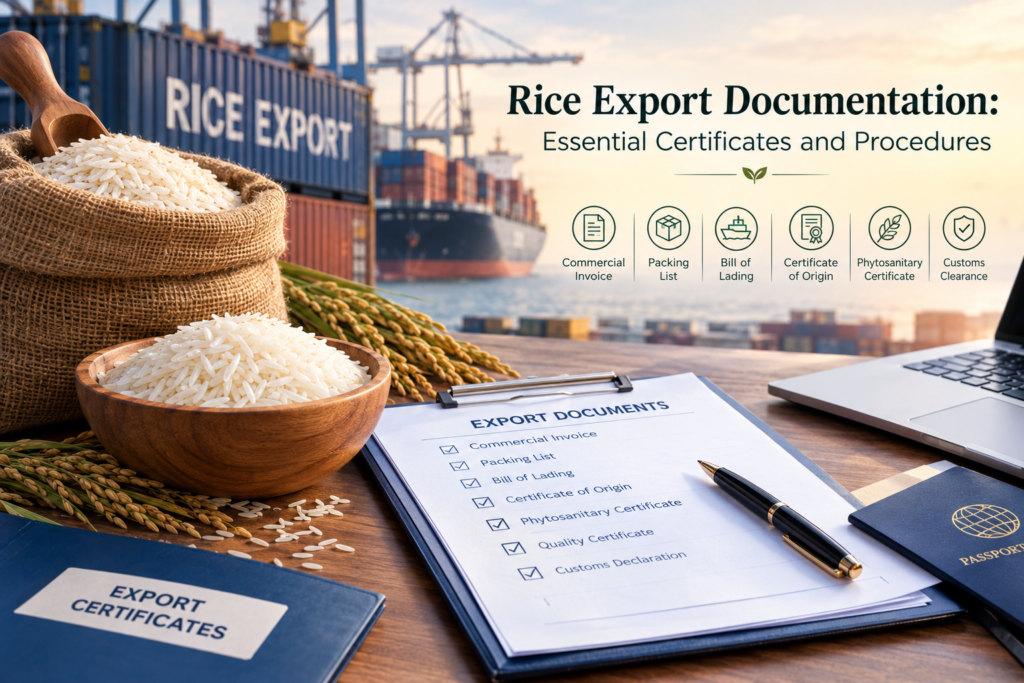
Managing rice exports requires navigating a complex landscape of documentation, certifications, and regulatory compliance. Whether you’re an exporter, importer, distributor, or buyer entering the rice market, understanding the critical documents and procedures can mean the difference between smooth shipments and costly delays.
This guide explains the essential certificates, documentation requirements, and procedures you need to know for successful rice exports—particularly from Pakistan, one of the world’s leading rice exporters.
Understanding Rice Export Documentation
Rice export documentation serves multiple purposes: it establishes the legal chain of custody for shipped goods, proves compliance with health and safety standards, confirms product origin, and satisfies importing country regulatory requirements. Every shipment crossing international borders requires a coordinated set of documents handled across multiple government and commercial entities.
Different destination countries impose different requirements, making a flexible documentation approach essential. What clears rice into one market may not satisfy requirements in another.
Key Certificates Required for Rice Exports
Phytosanitary Certificate
The phytosanitary certificate (PC) is the single most important document for rice exports. This official certificate confirms that exported rice has been inspected and is free from specified pests, diseases, and contamination that could threaten agricultural systems in importing countries.
The phytosanitary certificate is issued by the National Plant Protection Organization (NPPO) of the exporting country—in Pakistan’s case, the Department of Plant Protection (DPP). The certificate documents that the rice shipment meets the importing country’s Sanitary and Phytosanitary (SPS) requirements established under international trade agreements.
Different markets have different phytosanitary demands. For example, exports to the United States require certification that shipments are free from the Khapra beetle (Trogoderma granarium), a serious pest risk. Exports to other markets may require different pest-free declarations or fumigation certificates. Rice exported to any destination typically requires this certificate valid for 15 days before shipment.
Certificate of Origin
The Certificate of Origin (CO) officially documents where the rice was grown or processed. It’s required by most importing countries and is essential for buyers who need to verify the country of origin for quality, trade agreement eligibility, or business requirements.
In Pakistan, the Trade Development Authority of Pakistan (TDAP) issues Certificates of Origin. This process has been digitized through the Pakistan Single Window system, which allows exporters to apply and receive certificates online rather than through manual office procedures. The digital system issues certificates with QR codes for easy verification, eliminating the need for wet seals and stamps.
Commercial Invoice
The commercial invoice is the fundamental business document that describes the shipment in commercial terms: the exporter, importer, product description, quantity, unit price, total value, and payment terms. Importers, customs brokers, and freight forwarders all rely on this document to clear goods and process payments.
The invoice must accurately describe the rice type (basmati, non-basmati, broken rice, etc.), grade, packaging, weight, and any other specifications relevant to the buyer’s order. It’s the document against which all other shipment documentation is verified.
Bill of Lading
The shipping carrier issues the bill of lading (BOL) and serves as proof of receipt of goods for shipment. It functions as a receipt, a document of title, and a contract for carriage. The BOL must match the commercial invoice in terms of product description, quantity, and destination.
For rice shipments, the BOL specifies the container numbers, seal numbers, port of origin, port of destination, and estimated delivery date. Modern shipments typically use ocean bills of lading for sea freight or air waybills for air freight.
Pakistan’s Rice Export Framework
Pakistan exports rice to more than 150 countries and maintains a sophisticated regulatory framework for rice trade. Pakistan produces approximately 9–10 million metric tons of rice annually, with an exportable surplus ranging between 4.5 and 5.5 million metric tons. app
To legally export rice from Pakistan, exporters must navigate several foundational registration and compliance steps. These include business registration, obtaining a National Tax Number (NTN) and Sales Tax Registration Number (STRN) from the Federal Board of Revenue, Chamber of Commerce membership, and Web Based One Customs (WEBOC) registration for customs documentation.
The Department of Plant Protection (DPP) works to keep exports moving by providing efficient phytosanitary certification and ensuring strict compliance with Sanitary and Phytosanitary (SPS) requirements to prevent delays in shipments reaching destination markets. This regulatory focus has resulted in operational efficiencies: more than 85 percent of certificates are now being issued within 24 hours, helping improve export efficiency and reduce delays.
The Pakistan Single Window System
The Pakistan Single Window (PSW) is a government-operated digital platform that centralizes export documentation and regulatory approvals. Rather than submitting documents to multiple agencies through separate processes, exporters file standardized information once through the PSW portal, which routes it electronically to all relevant government bodies.
For rice exports specifically, the PSW system processes phytosanitary certificates through the Department of Plant Protection, Certificates of Origin through TDAP, and customs clearance documentation through Pakistan Customs. This integration dramatically reduces processing time and paperwork.
To use the system, exporters register on the PSW website and pay a one-time subscription fee. Once registered, they can file export declarations, upload required documents, and track the status of approvals in real time. The platform accepts online payment for all government fees.
Import Country-Specific Requirements
Beyond standard documentation, individual importing countries impose their own requirements. These can include specific product standards, additional certifications, or special declarations.
Some key importing markets and their particular demands:
United States: Requires a phytosanitary certificate with an additional declaration certifying that a registered milling facility processed rice and is free from the Khapra beetle.
European Union: May require registration under the REX system to access preferential tariff rates under trade agreements. Buyers may also request specific quality certifications or third-party inspection reports.
Russia: Has historically imposed strict phytosanitary standards and mill registration requirements following pest interceptions. Exporting facilities must be registered with Russian authorities and comply with their specific sanitary requirements.
Middle Eastern markets: Often have commodity-specific import regulations and may require additional certifications related to storage conditions, pesticide residues, or religious compliance standards.
Professional export agents and freight forwarders familiar with your destination market can advise on country-specific requirements for each shipment.
Quality and Compliance Standards
Beyond regulatory certificates, buyers increasingly expect quality documentation. Many rice exporters obtain third-party inspection reports confirming grade, moisture content, foreign material percentage, and other quality metrics before shipment. These reports—often provided by companies like SGS or Lloyd’s Register—add credibility and reduce buyer concerns about shipment quality.
Food safety certifications like HACCP (Hazard Analysis and Critical Control Points) are increasingly required by major importers and retail chains. These certifications document that rice has been handled through food-safe processes and facilities.
Some exporters pursue certifications like the British Retail Consortium (BRC) standard or other international food safety standards to gain access to premium markets. While not legally required for basic export, these certifications signal professional operations and can justify higher prices.
FAQ: Common Questions About Rice Export Documentation
How long does it take to obtain a phytosanitary certificate for rice?
In Pakistan, certificates are typically issued within 24 hours when filed through the Pakistan Single Window system, provided the rice meets phytosanitary standards and the application is complete.
Can I export rice without a phytosanitary certificate?
No. A phytosanitary certificate is mandatory for all rice exports to ensure the shipment meets international plant health standards and the importing country’s specific requirements.
What happens if rice doesn’t pass phytosanitary inspection?
If rice fails inspection due to pest presence or contamination, it cannot be exported in that condition. The exporter must address the issue—through re-processing, fumigation, or other corrective measures—before resubmitting for inspection.
Do I need different documents for different destination countries?
While core documents (phytosanitary certificate, bill of lading, commercial invoice) are standard, different countries may require additional declarations, country-specific certifications, or import permits. Research your destination market’s specific requirements before shipping.
How do I verify a Certificate of Origin is genuine?
Certificates of Origin issued through the Pakistan Single Window system include QR codes that can be scanned to verify authenticity and check the issuing details against official records.
Getting Started with Rice Export
Rice export documentation may seem complex, but the digitalization of Pakistan’s trade systems has simplified the process significantly. Saremco Impex Private Limited and other established exporters navigate these requirements through a combination of in-house expertise and partnerships with customs brokers and freight forwarders who specialize in agricultural trade.
Understanding the key documents—phytosanitary certificate, certificate of origin, commercial invoice, and bill of lading—and knowing how they work together gives you confidence in the export process. Staying updated on destination-country requirements ensures your shipments clear customs without delays.
Looking to establish rice export relationships or explore packaging and sourcing options? Connect with Saremco Impex to discuss your specific export requirements and explore how to streamline your rice trading operations.