Rice Milling & Processing: From Paddy to Export-Ready Grain
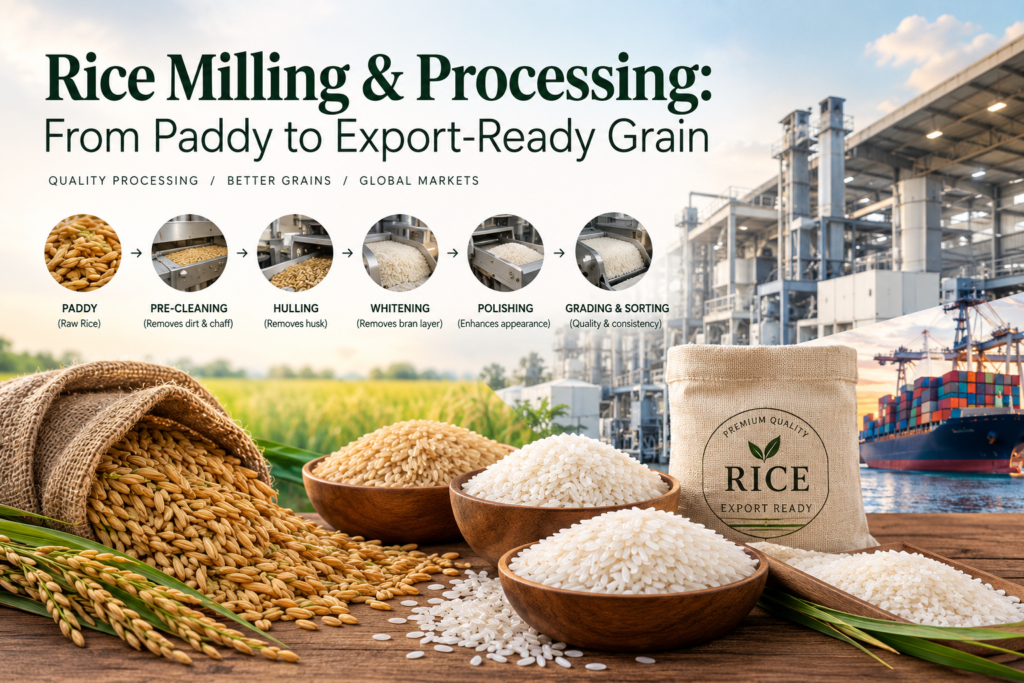
Rice arrives at mills as paddy—a seed enclosed in a protective husk. What happens next determines whether the grain meets export standards or becomes animal feed. Understanding rice milling reveals why some suppliers deliver consistent quality while others struggle to maintain specifications.
This guide explains the milling process, the factors affecting yield and quality, and how modern mills transform raw paddy into the finished product that reaches global markets.
What Is Rice Milling and Why It Matters
Rice milling is the process of removing the husk and bran layers from paddy to produce edible white rice, but calling it simply “removal” undersells the complexity. The process must accomplish competing goals: maximize the amount of whole grain recovered, achieve consistent whiteness and polish, and maintain the structural integrity of individual kernels.
Paddy rice consists of four distinct parts: the husk (brown protective layer), the bran (yellow layer underneath), the germ, and the endosperm (the white edible portion). Commercial milling removes everything except the endosperm. The challenge lies in doing so without breaking the grain into fragments that command 30-50% lower prices than whole kernels.
The economic significance is substantial. A 10 percentage point drop in head rice yield—the measure of unbroken kernels—can reduce the value of a rice lot by $0.32 per bushel. This makes every stage of milling critical to the final export product’s profitability.
Understanding Paddy Rice Preparation
Before milling begins, paddy requires preparation. Freshly harvested rice contains 20% or more moisture by weight. Left in high-temperature and humid environments, it will deteriorate in less than 24 hours. Suppliers dry paddy to approximately 14-15% moisture content using carefully controlled hot air, since excessive heat cracks or burns the grain.
Moisture management during this stage directly influences milling yield. Research shows that optimal harvest moisture content for long-grain rice varieties is approximately 19-21%, while medium-grain varieties perform best at 22-24%. Moisture content that is too high or too low at harvest increases the percentage of broken kernels during milling.
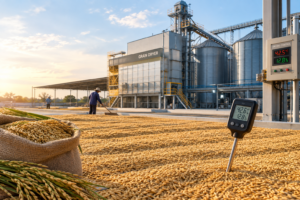
After drying, paddy passes through pre-cleaning, where coarse screens remove objects larger than rice grains—stones, straw, and debris—while fine screens separate smaller materials like weed seeds and dirt.
The Core Milling Stages
Commercial rice milling involves distinct sequential operations, each critical to the final product.
Husking: Removing the Outer Shell
Husking removes the outer husk (hull) from paddy rice, and this operation directly influences the yield and quality of the final product. The hull represents approximately 20% of rough rice weight.
Modern mills use rubber-roll huskers or disk shellers. Rubber rollers apply pressure to separate the husk without damaging the grain inside. The separated husk is collected and often used as fuel for mill boilers, creating a useful byproduct rather than waste.
After husking, the result is brown rice—rice with the bran layer still intact. If a buyer wants brown rice as the finished product, milling stops here. For white rice, the process continues.
Whitening and Polishing: Removing Bran Layers
Whitening (also called polishing) removes the bran layer—the yellow covering directly beneath the husk—from brown rice. The bran represents approximately 10% of the original rough rice mass.
The trade-off during this stage is significant. More aggressive polishing produces whiter, more visually appealing rice but breaks more kernels in the process. Excessive polishing reduces nutrient retention and increases grain breakage. Professional mills carefully calibrate polishing duration and intensity to balance whiteness with yield.
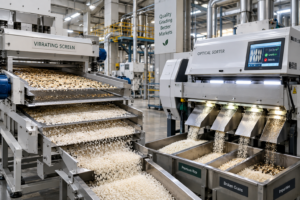
Quality polishers use abrasive or friction-based methods. Some modern facilities employ optical sorting technology to identify and separate discolored or damaged grains before they reach polishing, reducing downstream breakage.
Grading and Separation: Sorting by Size and Integrity
After polishing, the milled rice contains a mix of whole kernels, broken pieces, and occasional defects. Length graders separate whole kernels from broken fragments. Head rice is defined as kernels retaining three-fourths or more of their original length; anything shorter is classified as broken rice.
The ratio between head rice yield (HRY) and total milled rice yield (MRY) indicates quality. A common quality expression is a ratio such as 58/70, which indicates head rice yield of 58%, milled rice yield of 70%, and 12% broken kernels.
Typical milled rice yields range from 68- 72% of the original rough rice weight. Higher-quality milling processes and favorable grain characteristics can approach 72%; lower-quality operations or challenging paddy conditions drop to 60-65%.
Comparing Milling Types and Their Yields
Not all mills operate at the same level of sophistication. Understanding the differences clarifies why export-quality rice requires specific equipment.
Single-Pass (Huller) Mills
Single-pass mills use very high pressure to remove the hull and polish the grain in one operation, resulting in many broken kernels, low white rice recovery of 50- 55%, and head rice yields of less than 30% of total milled rice. These mills are economical for small-scale or household milling but produce significant waste and low-grade output unsuitable for premium export.
Two-Stage (Sheller) Mills
Two-stage mills separate hulling and polishing into distinct processes. Rubber rollers remove the husk first, producing brown rice. The brown rice then passes through a separate polishing stage. These mills have a capacity of 0.5 to 1 ton per hour paddy input and achieve milling recoveries normally above 60%.
Commercial Multi-Stage Mills
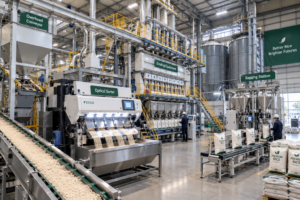
Commercial mills combine numerous operations that produce higher quality and higher yields of white rice from paddy. These facilities typically feature pre-cleaners, destoners, huskers, whiteners, polishers, optical sorters, and graders working in sequence. The investment in equipment and automation yields 70-72% recovery rates and consistent quality standards.
Suppliers targeting export markets operate multi-stage facilities capable of achieving consistent head rice yields of 55-65% and meeting rigorous foreign buyer specifications.
Quality Standards and Export Readiness
Export-ready rice must meet specific standards. Buyers evaluate products against several parameters:
Moisture Content: Moisture content of milled rice should not exceed 14%, with many international standards preferring 12-13%. Moisture above this threshold shortens shelf life and increases the risk of pest infestation or mold.
Broken Grains: Export specifications typically allow 2-5% broken rice, depending on grade. Premium grades accept less than 2% breakage; lower grades tolerate 5-10%.
Foreign Matter and Impurities: Extraneous matter should not exceed 0.1%. This includes stones, straw, dirt, and other non-rice particles.
Grain Length and Uniformity: Consistent grain length is critical for basmati and specialty varieties. Smaller, uniform particles command premium pricing in certain applications (food service, industrial processing); longer, more uniform grains suit retail and consumer markets.
Whiteness and Appearance: Excessive polishing produces whiter rice but damages kernels. The optimal balance between visual appeal and yield depends on the target market.
Presence of Defects: Yellowed, discolored, chalky (immature), or damaged kernels reduce grade. Premium rice contains minimal defects; lower grades tolerate higher defect percentages.
Factors That Influence Milling Yield and Quality
Several factors outside the mill itself determine final quality. Knowledgeable buyers understand these influences.
Paddy Variety and Maturity: Different rice varieties have inherent breakage tendencies. Some varieties naturally mill at 70%+ yields; others consistently produce 60-65% yields. Immature grains are weak and break easily during milling.
Harvest Conditions and Timing: Grain harvested during stress conditions—drought, excessive heat, inadequate sunlight—develops weaknesses that manifest as kernel breakage during milling. Harvesting at optimal moisture content is crucial but often conflicts with scheduling and cost management.
Storage Conditions: Improper storage exposes paddy to moisture fluctuation, causing kernels to develop cracks (fissures) that lead to breakage during milling.
Machine Maintenance and Calibration: Worn equipment, misaligned settings, or inadequate spacing between milling components all increase breakage. Professional mills maintain rigorous maintenance schedules.
Byproducts and Sustainability
Rice milling generates substantial byproducts. Rather than viewing these as waste, professional suppliers extract value from them.
Rice Hulls (approximately 20% of rough rice weight) are used as boiler fuel, animal bedding, or raw material for industrial applications.
Rice Bran (approximately 8-10% for white rice) is used in animal feed, oil extraction, or cosmetic applications.
Broken Rice (10-20% depending on milling quality) is sold at reduced prices for food manufacturing, brewing, or animal feed.
Handling these byproducts responsibly requires proper storage, drying, and pest management—adding complexity to operations but creating revenue streams that improve overall mill economics.
Understanding Milling Reports and Specifications
When evaluating a rice supplier, request detailed milling reports. Professional suppliers provide:
- Milling recovery rates (percentage of finished rice from input paddy)
- Head rice yield (percentage of whole, unbroken kernels)
- Broken grain percentage
- Moisture content measurement
- Foreign matter analysis
- Grain length specifications (in millimeters)
- Whiteness index
- Defect classification (damaged, discolored, chalky grains)
Third-party lab testing carried out by recognized certifying bodies (SGS, CCIC, or equivalent) adds credibility to supplier claims. Reputable exporters often provide such documentation without requiring special requests.
The Role of Technology in Modern Rice Milling
Automation and precision equipment have transformed rice milling from a commodity operation into a refined process.
Optical Sorters use cameras and light to identify grains by color, shape, and surface characteristics, removing defects at speeds human inspection cannot match.
Aspiration Systems use air current to separate light materials (dust, broken fragments, chaff) from heavier whole grains.
Destoners use gravity tables to remove stones and other dense foreign materials before they damage milling equipment.
Moisture Meters provide real-time feedback on grain moisture, enabling automated adjustments to drying parameters.
Facilities equipped with these technologies consistently achieve higher yields, better quality, and lower waste than operations relying on traditional methods alone.
Frequently Asked Questions
Q: What is the difference between head rice yield and milled rice yield?
A: Milled rice yield (MRY) is the total percentage of edible rice recovered from rough paddy—both whole and broken kernels combined. Head rice yield (HRY) is only the unbroken kernels (three-fourths length or greater). The difference between MRY and HRY equals the broken rice percentage. For example, 70% MRY minus 58% HRY equals 12% broken rice.
Q: Why does harvest moisture content affect milling quality?
A: Grains harvested at optimal moisture (typically 19-24%, depending on variety) have proper kernel strength for milling. Grains harvested too wet or too dry are structurally weak and break easily during the polishing stage. Imbalanced moisture also causes kernels to develop fissures that lead to breakage.
Q: Can rice be over-polished?
A: Yes. Excessive polishing removes so much bran that kernels become excessively fragile and break during remaining milling stages. Over-polished rice also loses nutritional value. Professional millers calibrate polishing duration to achieve whiteness without sacrificing yield.
Q: What does “degree of milling” mean?
A: Degree of milling (DOM) refers to how much of the bran layer has been removed. Lower DOM (2-4%) produces whiter but more fragile rice. Higher DOM (8-12%) produces yellower rice but with better structural integrity—the optimal DOM balances appearance with yield.
Q: How does machine type influence final rice quality?
A: Single-pass mills produce 50-55% yield with excessive breakage. Two-stage mills achieve 60%+ yield. Commercial multi-stage mills reach 70-72% yield with consistent quality. The equipment directly determines yield potential and quality consistency.
Q: What moisture content should finished rice have before export?
A: Export rice should have 12-14% moisture content, with many buyers preferring 13% or lower. Rice exceeding 14% moisture is subject to docking in price and may be rejected if it exceeds 15%.
Q: How long can properly milled rice be stored?
A: Rice milled to proper specifications and stored in cool, dry conditions (below 70°F, below 65% relative humidity) can be stored for 12-18 months without quality degradation. Higher moisture or temperature accelerates deterioration.
Connecting with Professional Rice Millers
Understanding the milling process helps buyers identify professional suppliers. Look for operations that:
- Provide detailed milling reports with specifications
- Maintain equipment regularly and upgrade to modern technology
- Source paddy from reliable, consistent suppliers
- Conduct regular quality testing through independent labs
- Understand export requirements for different markets
- Can explain their yield rates and how they compare to industry standards
Saremco Impex Private Limited and similar professional operators combine milling expertise with export infrastructure, connecting quality grain to global buyers seeking consistent, traceable supply.
The next time you evaluate a rice supplier, ask about their milling process, equipment, typical yield rates, and quality testing. The answers reveal whether you’re working with a professional operation or a commodity trader passing through inventory. Export-quality rice comes from operations that understand and optimize every stage of milling.
https://saremcoimpex.com
info@saremcoimpex.com