Top Basmati Rice Importing Countries in 2026
Basmati rice isn’t like other commodities. It’s a premium product with deeply rooted demand in specific regions, driven by centuries-old culinary traditions and established consumer preferences. Understanding which countries import basmati rice matters if you’re sourcing, trading, or building supply relationships—because the countries that buy basmati don’t simply import rice. They import a specific cooking experience.
The global basmati rice trade is concentrated in a relatively small number of countries, with the Middle East and parts of Africa representing the largest and most stable demand zones. Knowing who imports what, why they import it, and what quality they expect gives you a clearer picture of where supply opportunities exist and how to structure your sourcing strategy.
The Geographic Reality of Basmati Rice Imports
The GCC countries are the major importers of basmati rice in the Middle East. In 2018, Saudi Arabia and the United Arab Emirates together accounted for 30% of the exports of the rice variety from India. That concentration has only solidified since then.
Middle Eastern and African countries now represent the largest bloc of basmati rice importers globally. The region accounts for nearly 70% of basmati demand, making it the absolute center of gravity for basmati trade. This isn’t accidental—it’s the result of geography, population density, culinary culture, and the fact that production in the region far exceeds the demand for the basmati variety of the paddy crop, making the Middle East a net importer of the grain. Expert Market Research
Understanding this regional dependency matters because it explains pricing, supply stability, and why any disruption to shipping routes or export policies in India or Pakistan immediately ripples through global basmati markets.
Saudi Arabia: The Largest Single Importer
Saudi Arabia’s status as India’s second-largest basmati export destination accounts for 17.1% of total Indian basmati exports. In real terms, this means Saudi Arabia alone is responsible for a significant share of global basmati purchases. Expert Market Research
The demand in Saudi Arabia is driven by consumption patterns deeply embedded in daily life. Basmati is integral to traditional dishes like Kabsa and Mandi—layered rice dishes made with meats, dried fruits, and aromatic grains. These aren’t occasional dishes; they’re central to the country’s food culture. The result is steady, year-round demand that doesn’t fluctuate dramatically with seasonality or economic cycles the way commodity rice does.
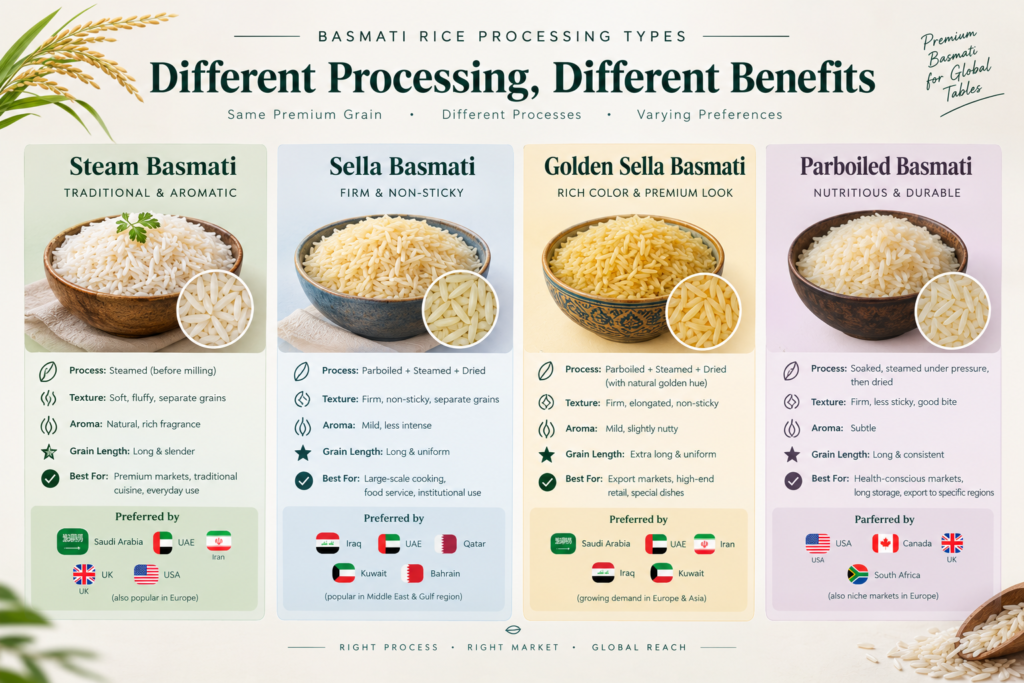
Saudi Arabia’s market preferences lean toward parboiled varieties, particularly Sella and Golden Sella grades, because these forms hold their texture and structure during bulk cooking—important when preparing large quantities for families and institutional settings.
United Arab Emirates: The Regional Hub
The UAE occupies a unique position in basmati trade. It’s simultaneously a major importer for domestic consumption and the Middle East’s primary re-export distribution center. The country has a large Indian and South Asian population, extensive hospitality and food service infrastructure, and Dubai’s strategic location makes it a natural gathering point for rice destined for Africa, Europe, and smaller Gulf markets.
The UAE is the largest basmati destination for Pakistani exports, with buyers preferring 1121 Steam and Golden Sella grades for retail and catering. The combination of direct consumption and re-export activities makes the UAE one of the world’s largest basmati markets by volume, even though it’s geographically small. AHK Rice
For exporters, the UAE market offers both high volumes and price stability—because demand doesn’t depend entirely on one country’s consumption patterns. It depends on the entire region’s supply chains flowing through Dubai’s ports.
Iran: Historical Heavyweight with Geopolitical Complexity
Iran is one of the world’s oldest and largest basmati rice markets. The country’s massive population relies on rice as a dietary staple, and basmati specifically is deeply preferred for its aroma and cooking qualities. In 2016, Iran was considered the largest importer of rice from India, with massive demand for rice due to the vast population there who eat rice as a staple food.
However, Iran’s market operates under geopolitical constraints that no other major importer faces. Payment complexity, shipping route disruptions, and trade sanctions can interrupt supply flows unpredictably. Recent improvements in regional stability have boosted outlook—the June 2025 Israel-Iran ceasefire and improved Middle East geopolitical stability directly supported parboiled basmati export volume recovery. Expert Market Research
For business purposes, Iran remains a significant market, but with higher operational complexity than stable markets like Saudi Arabia or the UAE. Exporters typically require specialized logistics support and payment arrangements.
Iraq: Bulk Purchases for Domestic Consumption
Iraq imports significant volumes of basmati rice, both for household consumption and through government supply programs. Iraq remains one of the largest bulk buyers, with government tenders specifying 1121 Parboiled (Sella) rice because it withstands long storage and high-temperature conditions. AHK Rice
The Iraqi market values consistency and reliability. Importers need suppliers who can deliver large volumes reliably, as government procurement cycles and institutional food service operations require predictable supply. The preference for parboiled grades reflects practical storage conditions and the need for rice that won’t deteriorate during extended warehousing.
Yemen, Kuwait, Qatar, and Smaller Gulf Markets
While Saudi Arabia, UAE, and Iraq command the largest volumes, smaller Gulf states and Yemen maintain steady, significant basmati imports. Kuwait and Qatar have high per-capita consumption due to their wealthy populations and large expatriate workforces. Yemen imports cost-effective Sella rice for staple consumption.
These smaller markets matter for diversification—they keep demand steady even if one major market experiences temporary disruption. They also represent growth opportunities for suppliers looking to expand beyond the top three importer countries.
United Kingdom: Diaspora-Driven Premium Market
The UK represents a different type of basmati market. Rather than bulk consumption, UK demand comes from Indian, Pakistani, and South Asian communities living in Britain. The UK imports for diaspora consumption, with retailers requiring branded 1121 Steam and White rice with strict food safety certifications.
This market demands premium packaging, English-language branding, and compliance with UK and EU food safety regulations. It’s a higher-margin market than Middle Eastern bulk sales, but requires meeting different quality and certification standards. For suppliers focused on Western markets, the UK represents an important entry point into diaspora-driven basmati demand across Europe.
United States: Growing Premium Segment
The USA is an emerging premium market for basmati rice. The South Asian diaspora, premium retail brands, and food service chains strongly drive demand. American demand isn’t large by Middle Eastern standards, but it’s growing and commands higher prices because of premium branding and food service applications.
The US market requires FDA compliance, specific labeling, and often demands direct relationships with branded retailers or restaurant chains. It’s a smaller volume market but with significantly higher per-ton realization than bulk Middle Eastern sales.
East African Nations: Expanding Import Growth
East African countries represent a growth region for basmati rice, though currently smaller than Middle Eastern volumes. Kenya, Tanzania, and other nations are experiencing rising populations, urbanization, and growing middle-class consumption patterns that increasingly include basmati rice.
East African markets import for both consumption and trade, with buyers preferring Golden Sella due to its long shelf life and resistance to breakage. East Africa also represents supply opportunities for Pakistani exporters, who have geographic and shipping advantages over Indian suppliers accessing East African ports. AHK Rice
Quality Preferences Across Importing Countries
Different importing countries have different processing requirements because they have different cooking methods, storage environments, and cultural preferences. Understanding these distinctions is crucial for exporters and suppliers.
Iran imports premium aromatic rice, with buyers demanding Steam and White 1121 Basmati with strict grain uniformity and aroma retention. Saudi Arabia imports Creamy Sella and Golden Sella because these grades maintain texture during bulk cooking. Iraqi government tenders specify 1121 Parboiled (Sella) rice because it withstands long storage and high-temperature conditions. Yemen imports cost-effective Sella rice for staple consumption, prioritizing durability over aroma intensity due to storage conditions.
These distinctions mean that a supplier selling to Iran needs a different quality control process than a supplier selling to Iraq or Yemen. Processing specifications, grain selection, moisture levels, and packaging materials all shift based on where the rice will ultimately be sold.
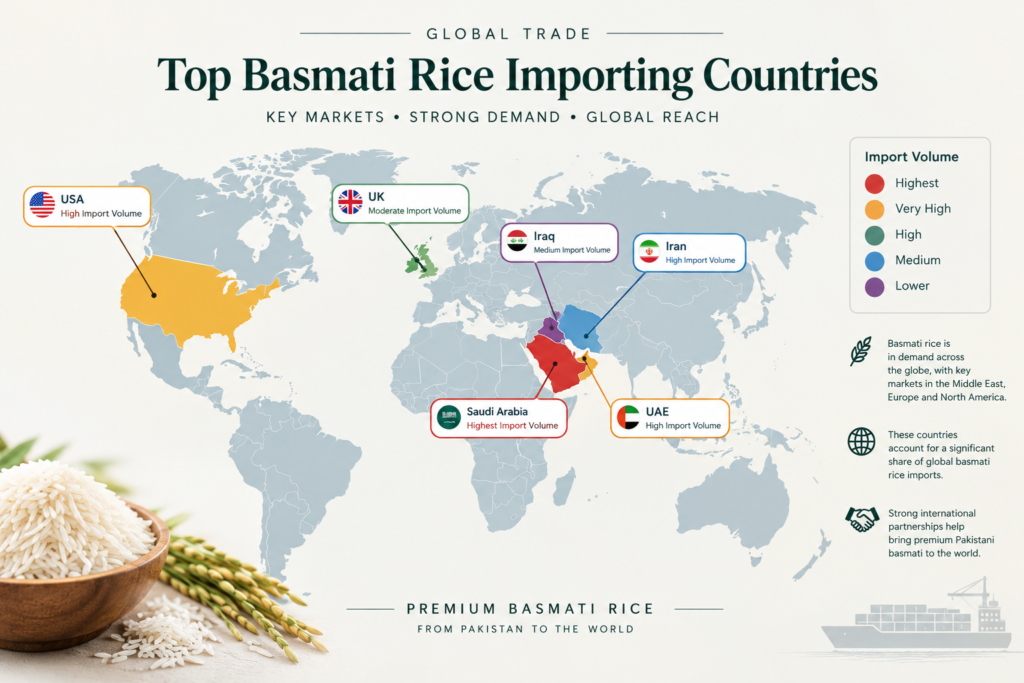
[IMAGE 1 — INSERT HERE]
Suggested image: World map highlighting top basmati rice importing countries with Saudi Arabia, UAE, Iran, Iraq, UK, and USA marked with different colors or emphasis levels based on import volume.
Purpose: Visually communicates the geographic distribution of basmati rice demand and helps readers instantly grasp which regions are primary markets.
Suggested ALT TEXT: World map showing top basmati rice importing countries in 2026, highlighting the Middle East and Africa as the largest importing regions.
Market Drivers Behind Basmati Demand
Several factors drive basmati imports across these countries simultaneously, creating stable, predictable demand patterns—unlike commodity rice markets that swing with price fluctuations.
First is cultural integration. Basmati rice is an integral part of various Middle Eastern cuisines, being used to prepare rich dishes made of multiple layers of dried fruits, meats, and rice, forming part of the staple diet of the population in the Middle East and Africa. This isn’t a preference that changes with economics—it’s embedded in how families cook and eat.
Second is urbanization and income growth. The rapid growth in the population of the region is acting as a catalyst for industry growth, with the urban population in the UAE almost reaching 93% of the total population, along with rising disposable incomes in the area driving the basmati rice industry forward. As people move to cities and incomes rise, basmati consumption typically increases because it’s positioned as a premium staple rather than a commodity.
Third is the re-export opportunity. The UAE’s position as a regional hub creates logistical demand independent of local consumption—rice imported into Dubai can be distributed across Africa, smaller Gulf states, and global markets from that central location. This creates additional volume beyond what domestic consumption alone would drive.
Supply Chain Implications for Exporters
Understanding the geography of basmati imports has practical implications for how suppliers and exporters structure their operations.
The Middle East’s dominance means that suppliers need reliable, consistent shipping to Middle Eastern ports—Jeddah for Saudi Arabia, the ports of Dubai and Ras Al Khaimah for the UAE, and ports in Iraq. Supply disruptions or shipping route complications (like the Red Sea incidents that affected Indian and Pakistani exports in recent years) create immediate market stress because there’s no geographic diversity to fall back on.
The concentration also means that Middle Eastern importers have significant negotiating power. Large bulk buyers like Saudi Arabia and Iraq can dictate specifications, pricing, and payment terms because they represent enormous volume. Smaller suppliers struggle to reach these markets except through established importers or trading companies.
For newer exporters or smaller suppliers, the strategy typically involves either building relationships with established importers in Middle Eastern hub countries (particularly the UAE) or pursuing secondary markets like East Africa, the UK, or the US—which have smaller volumes but also less competitive intensity.
Practical Considerations for Import Sourcing
If you’re sourcing basmati rice for any of these markets, several practical factors affect your strategy.
Payment terms and currency risk matter more in some markets than others. Saudi Arabia and the UAE offer relatively straightforward trade—L/C or bank transfers. Iran requires specialized payment mechanisms. Iraq uses government tenders with specific procurement procedures. Understanding these differences before you engage with importers prevents delays and surprises.
Certification and documentation requirements vary significantly. UK imports require EU food safety compliance. US imports require FDA approval. Middle Eastern imports require certificates of origin and, in some cases, Halal certification. East African markets may require specific phytosanitary documentation. Your supplier must be prepared to provide the correct documentation for your destination market—not just generic quality certificates.
Minimum order quantities and lead times differ based on whether you’re selling to a bulk importer, a government tender, or a retail distributor. Bulk markets accept container loads (20,000+ MT). Premium branded markets may work with smaller initial orders to test performance.
FAQ: Basmati Rice Importing Countries
Which country imports the most basmati rice?
Saudi Arabia is the largest single importer globally, though the UAE imports similar volumes while also functioning as a re-export hub. The Middle East collectively represents about 70% of global basmati demand, making the region the dominant market.
Why is the UAE such a large importer even though it’s a small country?
The UAE imports for three reasons: direct domestic consumption (large expatriate population), food service and hospitality demand, and strategic re-export hub activities. Rice imported into Dubai can be distributed across Africa, smaller Gulf states, and other global markets, creating additional demand beyond what local consumption alone would drive.
Has basmati demand changed significantly since 2024?
Middle Eastern demand remains stable because it’s driven by culture and population growth rather than economic cycles. However, geopolitical factors (Red Sea disruptions, Iran sanctions) periodically affect supply flows. East African and Western markets are growing as urbanization and middle-class consumption rise in those regions.
What’s the difference between the basmati rice imported by Iran versus Saudi Arabia?
Iran prefers premium Steam and White basmati with strict aroma retention because it’s used in high-end dishes. Saudi Arabia imports larger volumes of parboiled varieties (Sella and Golden Sella) for bulk cooking and institutional use. The preferences reflect different cooking methods and consumption patterns.
Can exporters enter basmati markets outside the Middle East profitably?
Yes, but with a different business model. Western markets (US, UK) and East Africa require premium branding, strict certifications, and smaller order volumes, but command higher per-ton pricing. Exporting to the US or UK requires FDA or EU compliance. Exporting to East Africa requires competitive positioning against Middle Eastern suppliers who have shipping advantages.
Do geopolitical tensions actually affect basmati prices?
Yes. When Red Sea shipping routes face disruption, or Iran faces payment complications, it restricts supply to those countries and can push buyers toward alternative suppliers (Pakistan, Thailand, Vietnam), affecting global pricing. Since Middle East imports represent 70% of demand, disruptions there impact world markets.
Conclusion
The global basmati rice market is geographically concentrated, culturally driven, and remarkably stable—but only if you understand which countries buy, why they buy, and what they expect. Saudi Arabia, UAE, Iran, and Iraq represent the overwhelming majority of basmati demand, with smaller but significant imports in Kuwait, Yemen, the UK, and growing volumes in East Africa and North America.
For suppliers and exporters, this geography is both opportunity and constraint. The opportunity is that stable, predictable demand in Middle Eastern markets creates long-term relationships and consistent volume. The constraint is that the Middle East’s dominance means geopolitical factors, shipping disruptions, or policy changes in those few countries can ripple through global markets.
If you’re sourcing basmati rice for import or export, prioritize understanding the specific quality preferences, documentation requirements, and payment terms for your target market. Middle Eastern bulk markets demand different things than Western premium markets or East African growth markets. One-size-fits-all sourcing doesn’t work in basmati—the market is too specific, too regional, and too driven by local preference.
Looking to source basmati rice for your business? Saremco Impex specializes in the production and trading of agricultural products worldwide and can discuss your specific market requirements and sourcing needs. Whether you’re importing for Middle Eastern markets, Western retail, or East African distribution, understanding your destination market determines your supply strategy.