International Trade Documents: A Practical Checklist for Importers
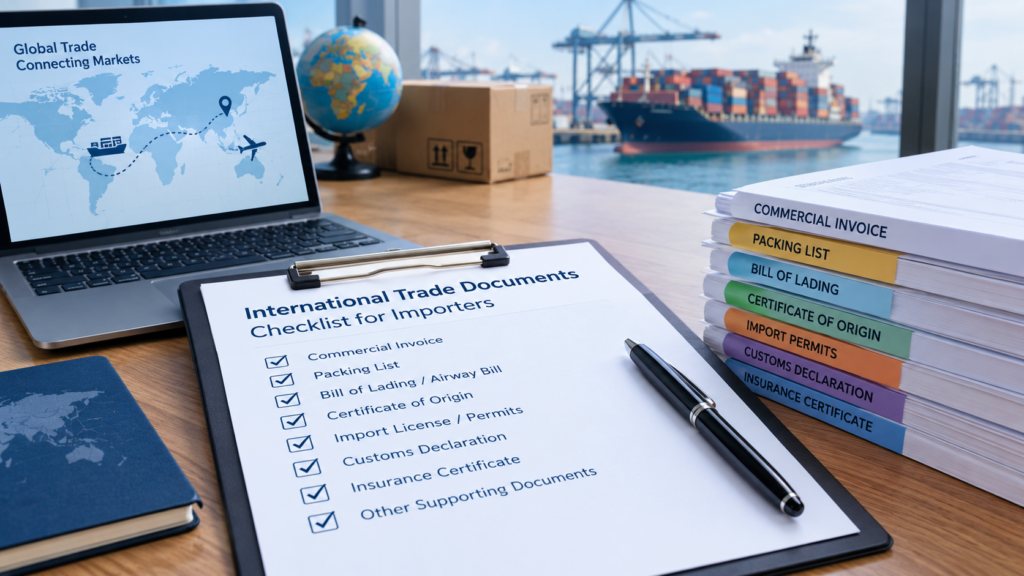
Most import delays come from paperwork rather than the goods. A container can leave the port on time and still sit at the destination because the invoice says one thing, the packing list says another, and the certificate names a different consignee. Customs officers do not guess. They compare documents against each other and against what is physically in the box.
This checklist covers the international trade documents an importer should expect from a supplier, what each one does, and what to check before it reaches your customs broker. Requirements differ by country and by product, so treat it as a working framework and confirm the final list with your customs authority or broker.
What Counts as International Trade Documents?
International trade documents are the records that describe a cross-border sale: what was sold, at what price, how it was packed, how it moved, and whether it meets the rules of the importing country. Some are commercial, such as the invoice and the packing list. Some are transport records. Others are issued by a government or an inspection body, such as a certificate of origin or a plant health certificate.
It helps to sort them by purpose:
- Sale documents: purchase order, proforma invoice, commercial invoice, packing list
- Transport documents: bill of lading or air waybill, delivery order, insurance certificate
- Compliance documents: certificate of origin, phytosanitary certificate, certificate of analysis, import permits where required
- Financial documents: letter of credit or payment instructions, and the bank paperwork that goes with them
The Core Documents Every Importer Should Collect
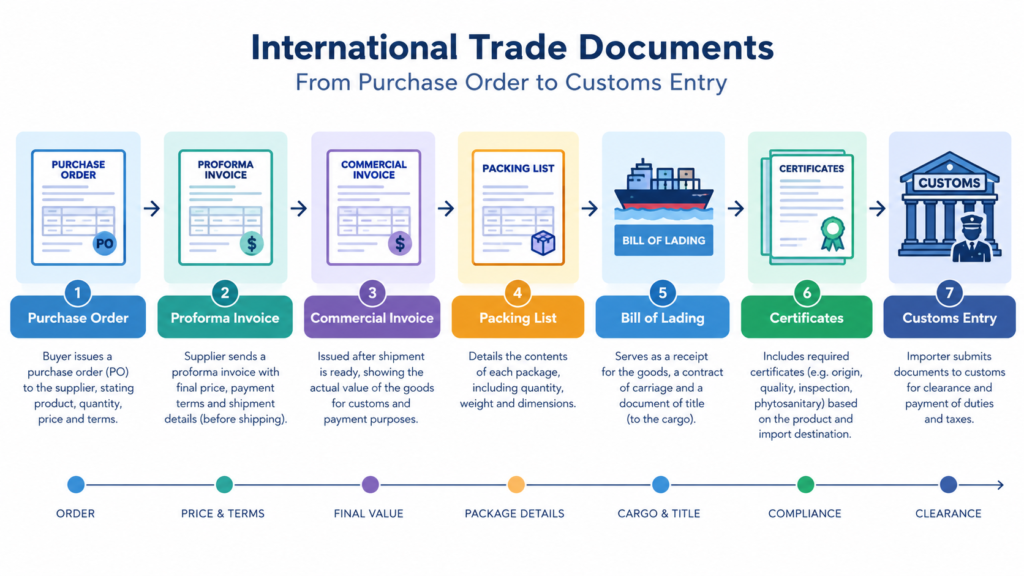
Proforma invoice
This comes first, before any money moves. The supplier states the price, product description, quantity, packaging and delivery terms so you can confirm them, arrange payment, and apply for any permits. It is an offer, not a final record. Customs will want the final commercial invoice instead.
Commercial invoice
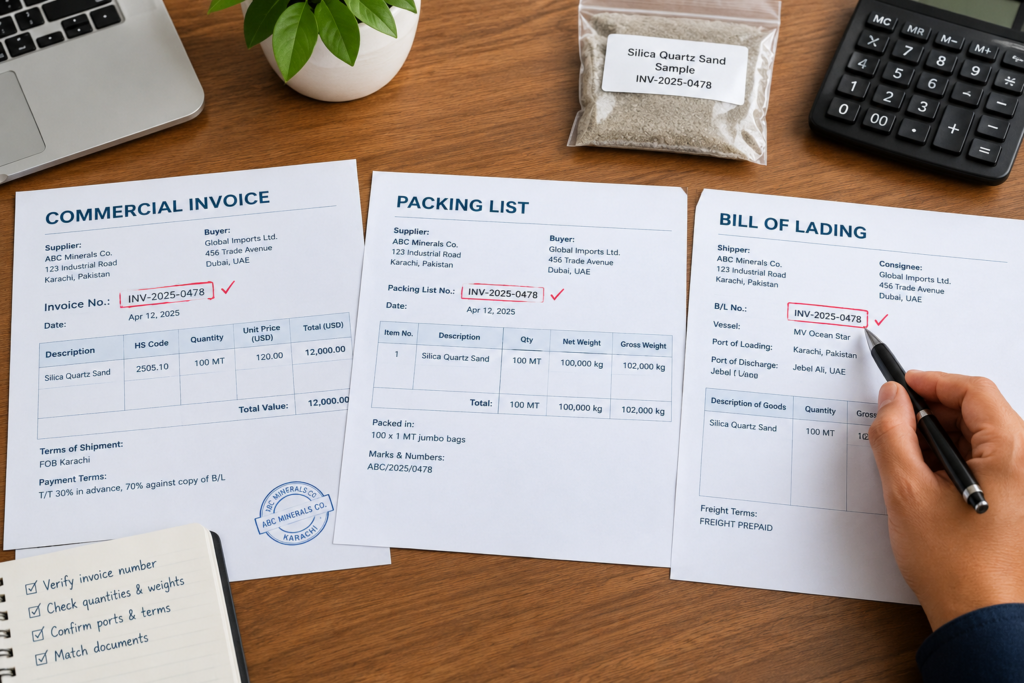
This is the document your broker will lean on most. It should name the buyer and seller accurately and describe the goods in plain, specific terms. It should also show unit price, total value, currency, the agreed trade term, and the invoice date and number.
Vague descriptions cause trouble. “Rice” is weaker than the actual variety, grade and pack size. Please ensure whatever appears here matches the packing list and the bill of lading, down to quantities and consignee.
Packing list
The packing list breaks the shipment into physical units: number of bags or cartons, weight per unit, gross and net weights, and marks and numbers. Your warehouse uses it to receive the goods, and customs uses it to check that the count lines up with the invoice. If the invoice lists 1,000 bags and the packing list lists 980, we’ll expect questions.
Bill of lading or air waybill
For sea freight, the bill of lading is the carrier’s receipt for the cargo and the contract of carriage. It is often the document that lets you collect the goods at the destination. Check the consignee, notify party, port of loading, port of discharge, container and seal numbers, and whether it is original or a surrendered or electronic release. Air shipments use an air waybill, which serves a similar purpose but is not used the same way for claiming goods.
Certificate of origin
Where duty preferences, trade agreements or origin rules apply, this certificate states where the goods were produced. Importers sometimes treat it as optional until a customs office asks for it. Ask your broker early whether your destination requires one for your product.
Product-specific certificates
This is where food, agricultural, and mineral shipments diverge from general cargo. Depending on the product and destination, you may need:
- a phytosanitary certificate for plant products
- a certificate of analysis showing tested specifications
- a fumigation certificate
- a health or quality certificate
- an import permit issued in your country before the goods ship
For plant products, the certificate attests that the consignment meets the plant health requirements of the importing country. Electronic exchange is increasingly common. Great Britain’s plant health portal, for example, explains how ePhyto certificates are received for imports, and the exact process depends on whether the exporting country exchanges electronic certificates with yours.
Insurance certificate
Some trade terms put insurance on the seller; others leave it to you. Either way, confirm who is covered, for what value, and from which point to which point. A policy that ends at the origin port does little for a claim at the destination.
Why Incoterms Decide Who Handles Which Paper
The trade term in your contract determines who arranges transport, who pays for it, and where risk passes from seller to buyer. Those terms are the Incoterms rules published by the International Chamber of Commerce. The ICC’s Incoterms 2020 introduction lists eleven rules, from EXW and FCA to FOB, CIF and DDP.
Why does this matter for paperwork? Under FOB, you normally arrange the main sea freight so that you will be dealing with the carrier’s documents directly. Under CIF, the seller books the freight and insurance, so the bill of lading and insurance certificate arrive from them. Under EXW, you are responsible for more of the process at the origin. If your contract does not state a term and version clearly, document responsibility becomes a negotiation after the fact, which is the worst time to have it.
The HS Code: One Number That Appears on Almost Everything
Customs classifies goods using the Harmonized System, maintained by the World Customs Organization. According to the WCO, the Harmonized System is used by more than 200 countries and economies as the basis for customs tariffs and trade statistics.
The first six digits are standardized globally. Countries then add their own digits for national tariffs, so the code you pay duty under may be longer than the one on your supplier’s invoice. The U.S. International Trade Administration’s overview of HS codes describes how six-digit codes become eight- or ten-digit national codes.
Two practical points follow. Ask your supplier to state the HS code on the invoice, but let your broker confirm the classification for your own country. And make sure the product description on every document supports that code. A mismatch between description and code is a common reason for inspection.
A Pre-Shipment Document Checklist
Use this before the vessel sails, when corrections are still cheap:
- Purchase order and proforma invoice agreed, with product specification, quantity, packaging, price, currency and trade term in writing.
- Import permits or licences confirmed in your country if your product category requires them.
- Draft commercial invoice and packing list reviewed. Check names, addresses, descriptions, quantities and weights.
- HS code agreed between you, the supplier and your broker.
- Certificates identified by name and issuer: origin, phytosanitary, analysis, or others your authority specifies.
- Bill of lading draft checked for consignee, ports, and cargo description.
- Insurance arranged according to the trade term.
- Payment documents aligned. If you pay by letter of credit, the documents must match the credit’s wording exactly, because banks check against the letter, not against common sense.
After shipment, repeat the comparison on the final versions. Invoice number, shipment date, container number and weights should agree everywhere they appear.
Common Mistakes That Hold Shipments Up
- Inconsistent descriptions. The invoice says one product name, the certificate another.
- Wrong consignee details. A misspelt company name or old address can hold up release.
- Quantity or weight gaps between the packing list and the invoice.
- Certificates issued after shipment where the importing country expects them beforehand.
- Late discovery of permit requirements. If your country requires a permit before shipping, it’s best to confirm during price negotiation, not after the container is booked.
- Relying on a proforma invoice for customs. It was never meant for that purpose.
Questions to Ask a Supplier About Documents
Before placing a first order, ask:
- Which documents will you provide with each shipment, and in what format (original, scanned, electronic)?
- Can you provide a sample set from a previous shipment with confidential details removed?
- Who issues each certificate, and how is it verified?
- How are corrections handled if a document contains an error after shipment?
- Which trade term do you quote, and which Incoterms version?
A supplier who answers these clearly is usually one who handles documentation routinely.
Exporter-Side Systems Worth Knowing About
It helps to know how documents are produced at the origin. In Pakistan, the Pakistan Single Window handles many of them electronically. The Department of Plant Protection user manual on the PSW site describes how traders and customs agents obtain export certificates, including phytosanitary certificates, through the portal. A PSW circular from April 2022 also moved rice export consignments through Karachi’s seaports onto the Single Declaration system, with phytosanitary certificates issued electronically by the department. For an importer, this means certificates may be issued digitally and shared through electronic channels, so ask your supplier how yours will be delivered.
Working With an Exporter on Documentation
Documentation goes more smoothly when the supplier handles export paperwork as part of their normal process. Saremco Impex Private Limited is a Pakistani export company with a rice division and a salt division, and its website lists private label and packaging options for export markets. Its article on what makes extra long grain rice premium also notes that certificates of analysis and sample kits are available on request, which is exactly the supporting paperwork worth asking any supplier for.
Frequently Asked Questions
What are the most important international trade documents for importers?
The commercial invoice, packing list and bill of lading or air waybill form the core set. Depending on your product and destination, add a certificate of origin, product-specific certificates and any import permit.
What is the difference between a proforma invoice and a commercial invoice?
A proforma invoice is a preliminary quotation used to agree terms and arrange payment or permits. A commercial invoice is the final record of the sale, issued once the goods ship, and it is what customs relies on.
Do I always need a certificate of origin?
Not always. It depends on your destination country’s rules, whether you claim a preferential duty rate, and the product. Check with your customs authority or broker before the shipment is booked.
Who issues a phytosanitary certificate?
The plant protection authority of the exporting country issues it, after inspection, to confirm the consignment meets the importing country’s plant health requirements. Check whether your country accepts electronic certificates.
What happens if documents do not match?
Customs may query the shipment, hold it for inspection, or delay release until the discrepancy is corrected. Correcting documents before the goods arrive is usually faster and cheaper than doing it afterward.
Who is responsible for documents under FOB or CIF?
It depends on the agreed trade term. Under CIF, the seller arranges freight and insurance, so those documents come from them; under FOB, the buyer usually arranges the main carriage. Please read the Incoterms rule you chose and include the version in your contract.
Final Thoughts
Good documentation is mostly consistency: the same names, numbers and descriptions repeated correctly across every page. Agree the document list with your supplier before the order is placed, compare drafts against each other, and confirm country-specific requirements with your broker. If you are sourcing rice or Himalayan salt from Pakistan and want to discuss the paperwork that would accompany your order, you can reach the team through the Saremco Impex contact page, or start from the company homepage to see the product divisions.